A heated neck massager is safe for daily use, but the safe window is narrower than most people assume: 15-20 minutes per session, up to two or three times a day, not one long session that runs the whole afternoon. Get the frequency wrong and you trade tension relief for reddened skin, a numb neck, or a device that quietly overheats.
- 15-20 minutes per session, 2-3 times a day, is the safe range for how often to use a heated neck massager in 2026.
- Start with one 15-minute session on day one and build up rather than maxing out immediately.
- Skip a session if skin is broken, sunburnt, or you're on blood thinners without medical clearance.
- Desk workers get more benefit from a short mid-afternoon session than a long one first thing in the morning.
Why this matters
Heat therapy works by increasing blood flow to tight muscle tissue, but that effect has a ceiling. Push past it with back-to-back sessions or a max heat setting for an hour straight, and you're not relaxing the muscle anymore, you're irritating skin and dulling the sensation that tells you when to stop. That's the real risk with a heated neck massager for neck pain: it feels good enough that people forget it's a heat device with limits, not a wearable you leave running.
The fix isn't complicated. It's a session length, a daily cap, and a few checkpoints along the way. The rest of this guide walks through exactly how to build that routine without guessing.
What you'll need
- A heated neck massager with an adjustable heat setting
- A phone timer or kitchen timer (don't rely on memory)
- A thin cotton scarf or cloth if your device runs hot at the highest setting
- 15-20 minutes of uninterrupted time, ideally seated
- A charging cable on hand if the unit is cordless
The steps
1. Check the device and your skin first
Before the first session of the day, run your fingers along your neck and shoulders. Any sunburn, broken skin, rash, or recent injury means you skip that area entirely, heat accelerates inflammation on compromised skin rather than easing it. Check the device too: a frayed cord, a heating element that won't hold a setting, or a battery that won't charge past 50% are all reasons to stop and troubleshoot rather than push through.
Common mistake: using the device on a cold, stiff neck straight out of bed without checking skin temperature or sensitivity first.
2. Set the timer for 15 minutes to start
Don't estimate the time by feel. Set a hard timer for 15 minutes on session one, especially in the first week of ownership. This accomplishes two things: it stops you from dozing off with heat against your skin, and it gives you a consistent baseline to compare against as you figure out your own tolerance.
Common mistake: running the first session for 30-40 minutes because it feels relaxing, then being surprised by tender or reddened skin the next morning.
3. Choose the right heat setting for your skin
Start on the lowest or second-lowest heat setting, not the highest. Skin sensitivity varies enormously person to person, and the goal on day one is to establish a comfortable baseline, not to test the ceiling. If the device supports a low-medium-high dial, medium is the practical daily setting for most people; high is reserved for particularly stiff days, not routine use.
Common mistake: assuming higher heat equals faster relief. Heat needs dwell time in the tissue to work, a moderate setting for the full 15 minutes outperforms the highest setting for five minutes.
4. Position it correctly across the neck and shoulders
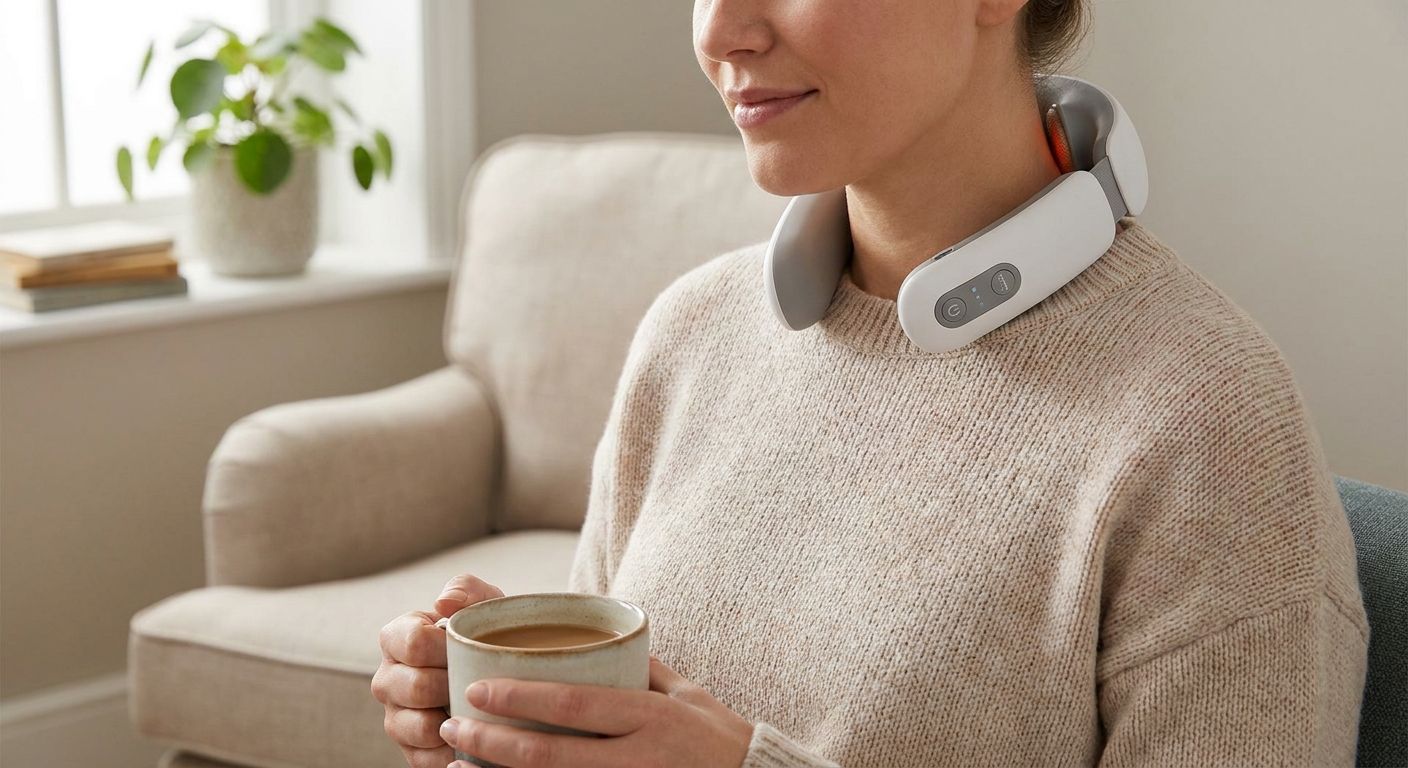
A heated neck massager for desk workers needs to sit against the base of the skull and upper trapezius, where tension actually accumulates from hours at a screen, not just draped loosely around the collar. Adjust the fit so it has even contact without being so tight it restricts circulation. If you're using a heated neck massager for desk workers, the mid-afternoon slump around 2-3pm is the highest-value window, tension has built up all day but you still have hours left at the desk.
Common mistake: positioning the unit over the spine directly instead of the muscle either side of it, which reduces effectiveness and increases pressure discomfort.
5. Run one session, then wait at least 3 hours before another
One 15-20 minute session, then a gap of at least three hours before the next one. This isn't arbitrary, it gives the skin time to return to normal temperature and lets you gauge whether the tension has actually eased or just gone numb temporarily. Two to three sessions spaced through the day beats one long session every time.
Common mistake: running a second session an hour after the first because the relief from session one wore off quickly, this usually means the setting was too low, not that more heat sooner is the answer.
6. Track how skin and neck respond for the first week
For the first seven days, note how your skin looks 30 minutes after each session, and how your neck feels the next morning. Mild pinkness that fades within 20-30 minutes is normal. Persistent redness, itching, or a headache after use are signals to drop back to a shorter session or lower setting.
Common mistake: ignoring early warning signs because the immediate relief feels good, then hitting a skin reaction a week in.
7. Build up to 2-3 sessions per day for chronic tension
Once you've established your baseline in week one, chronic neck and shoulder tension responds well to two to three short sessions daily, morning, mid-afternoon, and evening, rather than one extended session. This is also where a heated neck pillow for shoulder tension earns its keep, since shoulder tension tends to build through the day rather than peak once.
Common mistake: trying to fix months of built-up tension in a single weekend of back-to-back long sessions instead of a consistent daily routine.
8. Know when to stop for the day
Stop at your daily cap even if it still feels good, two to three sessions is the ceiling for 2026 safety guidance on heat therapy devices, not a floor to push past. If you're travelling and the unit is your only tool for a stiff neck after a long flight, the same 15-20 minute rule applies, a heated neck massager for travel doesn't get a pass on session length just because it's cordless.
Common mistake: using the device as background noise during a long flight or drive, running it for hours because it's convenient, not because it's necessary.
Troubleshooting
- Skin stays red for over an hour after a session — drop to a lower heat setting and shorten the session to 10 minutes until skin tolerance improves.
- Neck feels numb rather than relaxed afterward — this usually means the setting was too high for the duration; numbness is a sign to stop, not a sign it's working harder.
- Device won't hold a charge through a full session — check the charging cable and port for debris, and avoid running the unit while it's still plugged in unless the manual explicitly allows it.
- Tension returns within an hour of finishing — this points to posture, not heat dosage; pair sessions with regular movement breaks rather than adding a fourth session.
- Headache after using on the highest setting — high heat against the upper neck and base of skull can trigger headaches in some people; move to medium and reassess.
- Device heats unevenly across the pad — this is a hardware issue, not a usage issue; stop use and check the product's warranty terms rather than compensating with longer sessions.
Tools and resources
- Best heated neck massager for neck pain — for choosing a unit built for chronic tension rather than occasional use
- Heated neck massager for desk workers — session timing built around a workday
- Heated neck massager for travel — cordless options for flights and long drives
- Heated neck pillow for shoulder tension — for tension that spreads past the neck into the shoulders
What to do next
Once the neck routine is dialed in, the same 15-20 minute, two-to-three-session logic applies to other heat therapy tools around your day. The best heat massage pillow for office use is worth a look if your tension is really a whole-back problem and the neck is just where you feel it first.
FAQ
How often can you use a heated neck massager?
Two to three sessions of 15-20 minutes each per day is the safe range in 2026. Running one long session instead of several short ones increases the risk of skin irritation without adding extra relief.
Can you use a heated neck massager every day?
Yes, daily use is fine as long as each session stays within 15-20 minutes and you leave at least a few hours between sessions. Daily use only becomes a problem when sessions run long or stack back-to-back.
Is it bad to fall asleep with a heated neck massager on?
Yes, falling asleep with the device running removes the timer check that prevents overheating skin. Set a hard timer and treat sessions as active, seated use rather than something to nap through.
How long should one heated neck massager session last?
15-20 minutes is the standard session length for most heat therapy devices. Shorter sessions on a higher setting don't give the heat enough dwell time to reach the muscle.
Can a heated neck massager help with tension headaches?
Many people use heat on the upper neck and base of the skull for tension headaches, but a session that's too hot or too long can trigger a headache instead. Start on a lower setting and shorter duration if headaches are the reason you're using it.
Who should avoid using a heated neck massager?
Anyone with broken or sunburnt skin, recent neck injury, or on blood thinners should get medical clearance before regular use. Pregnant users and anyone with a pacemaker should also check with a doctor first.
Does a higher heat setting work faster?
No, a moderate setting held for the full 15-20 minutes is more effective than a high setting for a few minutes, because heat needs time to penetrate the tissue. Maxing out the heat setting mainly increases skin irritation risk.
Can you use a heated neck massager for travel the same way as at home?
Yes, the same 15-20 minute, two-to-three-session rule applies on flights or long drives. A cordless unit doesn't change the safe frequency, only the convenience of using it away from a power outlet.
One last thing
The biggest mistake isn't overuse, it's using the highest heat setting for a short burst instead of a moderate one for the full session. Heat needs dwell time in the tissue to actually loosen a tight muscle; a quick blast of maximum heat mostly just warms the skin surface and leaves the knot underneath untouched. Dial it back one notch and let the timer run the full 15-20 minutes before you judge whether it worked.