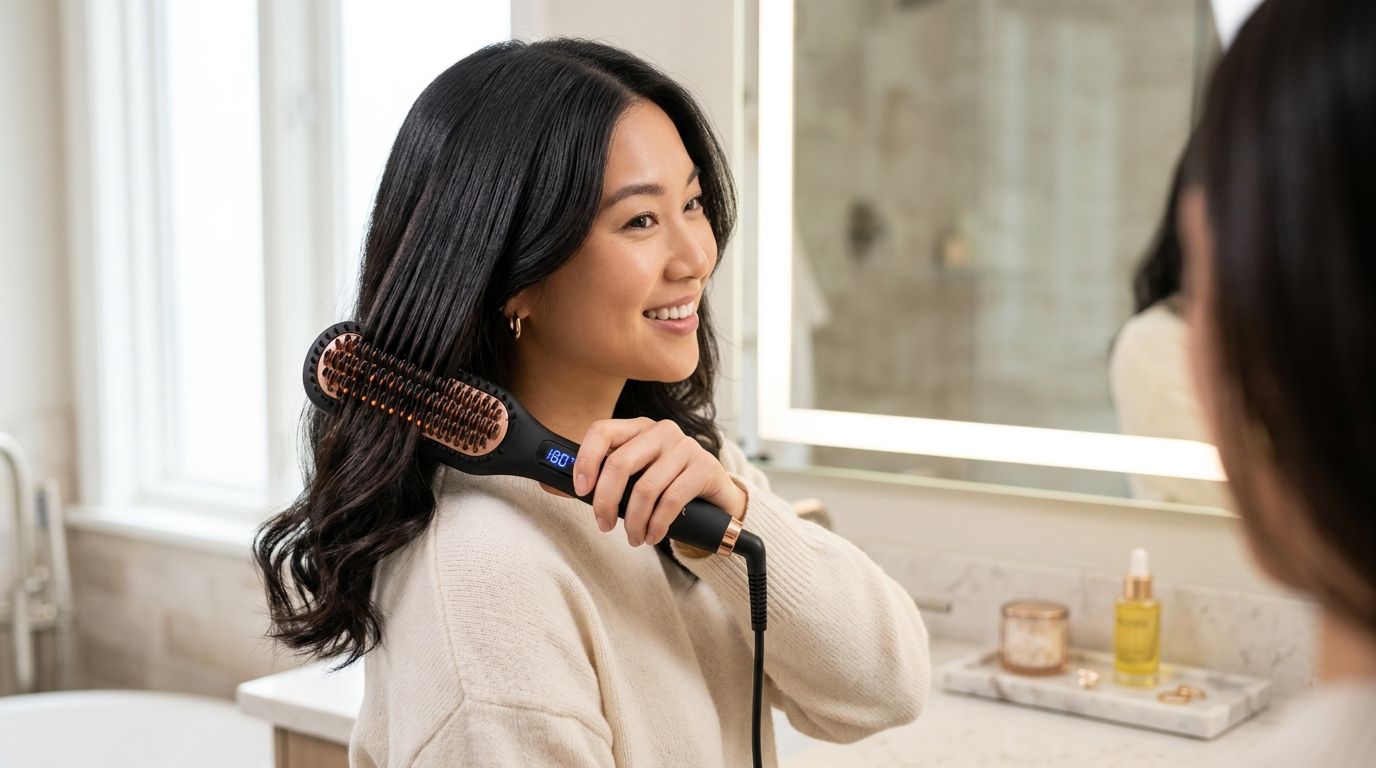
Heated hair brush for Asian hair textures is a styling tool built to smooth naturally straight-to-wavy, dense strands without the frying effect of a flat iron dragged across resistant hair. Asian hair typically runs thicker in diameter and higher in density per square centimetre than the average, which means it needs a hotter barrel, slower passes, and a brush design that gets close to the root without pulling.
- A heated hair brush for Asian hair works best at 180-200°C because of higher strand diameter and density.
- Napio's heated brush line targets thick, resistant hair without the flat-plate drag of a straightener.
- Section hair into 4-6 parts before styling to avoid re-passing the same strands twice in one session.
- Ceramic or tourmaline coating matters more than wattage for reducing frizz on this hair type in 2026.
- Skip daily full-heat styling on color-treated strands to avoid protein breakdown over a few months.
Why heated hair brush choice matters for Asian hair
Asian hair strands average a rounder cross-section and thicker cuticle layer than many other hair types, which is why the same heat setting that smooths fine European hair in one pass often does nothing on thick, straight Asian hair. The trade-off is real: push heat higher to get the smoothing effect, and you raise the risk of surface damage if the tool cycles too slowly between passes.
Searches for this exact styling problem cluster around three needs: taming frizz on humid days, getting a silk-press finish at home instead of paying for a salon blowout, and finding a brush that won't take 40 minutes on thick hair. A cordless hair straightener for thick hair solves the density problem differently than a corded heated brush, and the two tools serve different parts of the same routine.
Verdict up front: a heated brush rated to 200°C with ceramic-tourmaline plates is the right call for thick, resistant Asian hair in 2026 — a lower-heat brush built for fine hair will leave you re-passing the same section three or four times, which does more damage than one clean pass at the right temperature.
How to style Asian hair with a heated brush
Match barrel heat to your strand diameter
Asian hair sits on the thicker end of most diameter charts, so a brush that maxes out at 160°C will underperform no matter how many passes you run.
- Start at 180°C for a first test section near the nape, where damage is less visible
- Move to 190-200°C only if the 180°C pass leaves visible frizz or springback
- Never exceed 200°C on hair that's been chemically treated in the last 6 months
- Run a strand test on a small section before committing to a full head style
- Note that thicker sections near the crown often need 10-15°C more than the ends
Detangle and section before you touch the brush
Skipping this step is the single biggest reason stylists redo the same patch of hair twice, which doubles heat exposure for no extra smoothness.
- Comb through fully dry hair with a wide-tooth comb first
- Split hair into 4-6 sections using clips, working from nape to crown
- Keep sections no wider than 2-3cm for dense hair — wider sections force multiple passes
- Clip away hair you're not actively working on to avoid accidental re-heating
Choose a brush with the right bristle spacing for density
Wide-set bristles glide through thinner hair but lose grip on thick, straight Asian strands, causing the brush to slip without smoothing.
- Look for tighter bristle rows that hold dense sections against the heated plate
- A rotating or dual-sided brush head clears static better on straight hair than a flat paddle
- If frizz persists after the first pass, the bristle spacing — not the heat — is usually the issue
- Cross-check against a straightening brush for color-treated hair if you're also managing dye damage
Time each pass and avoid re-passing hot sections
Re-passing the same strand within 30 seconds of the first pass is what causes cumulative heat damage, not the heat setting itself.
- Move the brush at a steady, unhurried pace — roughly 3-4 seconds per 5cm of hair
- Let each section cool for a few seconds before checking if it needs a second pass
- A brush with a faster heat-up and stable barrel temperature cuts the number of passes needed on thick hair, which is where a Napio heated hair brush earns its keep over a budget tool that loses heat mid-stroke
- Check the best heated hair brush for damaged hair guide if you're working with previously heat-stressed ends
Protect the hairline and baby hairs
Asian hairlines often carry finer baby hairs at the temples that burn faster than the rest of the head.
- Use the lowest setting the brush offers for the first 1-2cm along the hairline
- Keep the brush moving continuously near the temples — never pause with heat against fine hair
- Apply a small amount of protectant specifically to this zone before styling
Build a heat-protectant routine into every session
Skipping protectant on thick hair is common because people assume density equals resistance to damage. It doesn't — it just delays the visible signs.
- Apply a heat protectant spray to towel-dried or fully dry hair before any heat tool touches it
- Reapply on humid days, since Asian hair's tendency to frizz in humidity often tempts a second unprotected pass
- Confirm your protectant is rated for the temperature you're actually using — check the right heat setting for a straightening brush if you're unsure where to start
Comparing your options for Asian hair textures
| Option | Best for | Key limitation |
|---|---|---|
| Heated straightening brush | Daily smoothing on thick, straight-to-wavy hair | Slower on very long hair below mid-back |
| Traditional flat iron | Sharp, pin-straight silk-press finish | Flat plates can crease hair if angle slips |
| Hot comb | Root-to-tip smoothing with less flat-surface drag | Requires more hand control to avoid uneven sections |
| Blow-dry brush | Volume plus light smoothing in one step | Doesn't fully flatten very resistant, coarse strands |
Buy the heated brush if your priority is daily maintenance styling; reach for a flat iron only when you want a full silk-press look for a specific occasion.
Common mistakes people make styling Asian hair with heat tools
- Using the same heat setting year-round — humidity in summer months means Asian hair frizzes faster, so the setting that worked in a dry winter often underperforms in January-February humidity in Australia's east coast cities.
- Skipping the strand test — thick hair varies in diameter from crown to nape, and a setting that's perfect at the back can scorch finer sections near the hairline.
- Re-passing wet or damp sections — heat applied to hair that isn't fully dry causes the moisture to boil inside the strand, which is a major driver of breakage on dense hair.
- Ignoring bristle wear — bristles that have flattened from months of daily use lose grip on thick hair and force people to compensate with higher heat, which is the wrong fix.
- Treating color-treated sections the same as virgin hair — bleached or dyed strands need a lower ceiling regardless of natural thickness.
FAQ
What heat setting is best for a heated hair brush on Asian hair?
Most thick, straight-to-wavy Asian hair responds well to 180-200°C on a heated brush in 2026. Start at the lower end of that range and only increase if a test section still shows frizz or springback after one pass.
Is a heated hair brush better than a flat iron for Asian hair?
A heated hair brush is better for daily maintenance styling because the bristles reduce static and glide with less crease risk than flat plates. A flat iron still wins for a sharp, pin-straight silk-press finish on special occasions.
Can a heated hair brush damage thick Asian hair?
Yes, if you re-pass the same section repeatedly at high heat without a protectant. Damage on thick hair usually comes from too many passes, not the temperature setting alone.
How often should I use a heated brush on Asian hair textures?
Daily use is fine at a moderate 180°C setting with heat protectant applied first. Push above 190°C only a few times a week to limit cumulative stress on the cuticle.
Does a heated brush work on color-treated Asian hair?
It can, but keep the setting under 190°C and check ends more frequently since dyed hair loses moisture faster under heat. A dedicated straightening brush for color-treated hair guide covers protectant timing in more detail.
Why does my heated brush not smooth my hair in one pass?
The most common cause is bristle spacing too wide for dense, thick strands, followed by heat set too low for the hair's actual diameter. Test a small section at a higher setting before assuming the tool is faulty.
What's the difference between a hot comb and a heated brush for this hair type?
A hot comb gives more root-to-tip control on very thick sections but takes longer to master than a heated brush. A heated brush is faster for people doing their own hair daily without salon training.
Do I need a heat protectant with a heated hair brush?
Yes, every time, regardless of how thick or resistant the hair feels. Skipping protectant on dense hair just delays visible damage rather than preventing it.
One last thing
The detail most people miss: bristle spacing matters more than wattage for Asian hair specifically, because the issue is grip on dense, straight strands, not raw heat output. A brush advertised at a higher wattage but with wide-set bristles will still slip and underperform against thick hair compared to a lower-wattage brush with tighter bristle rows that actually hold the section against the heated plate.