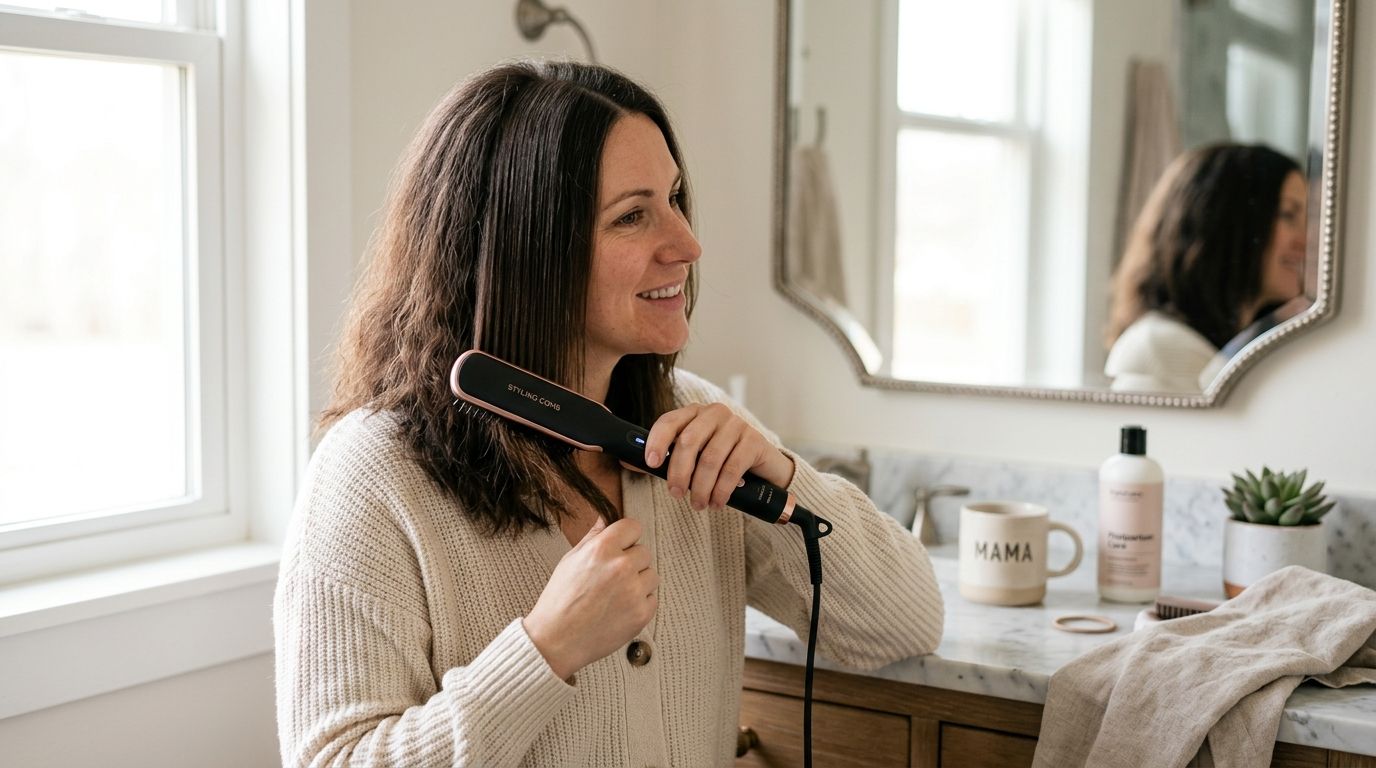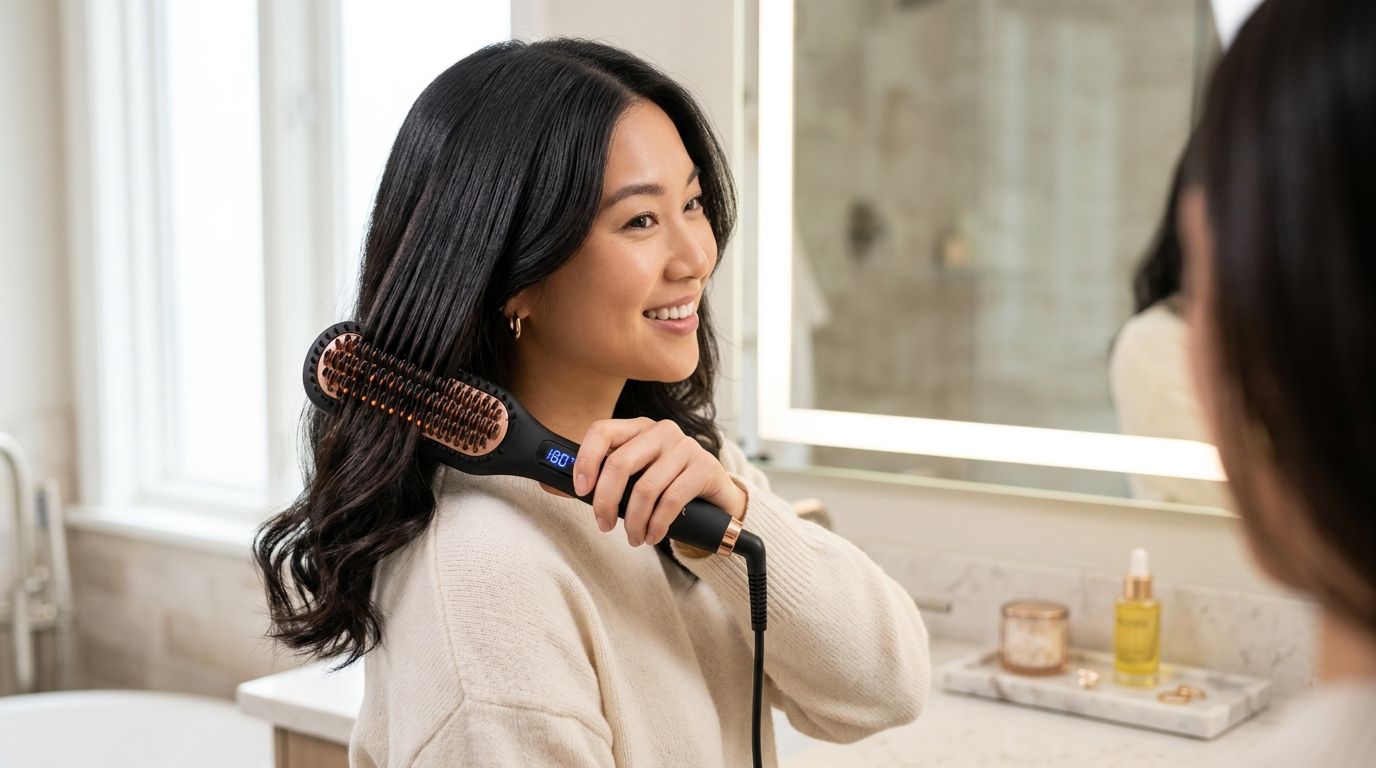
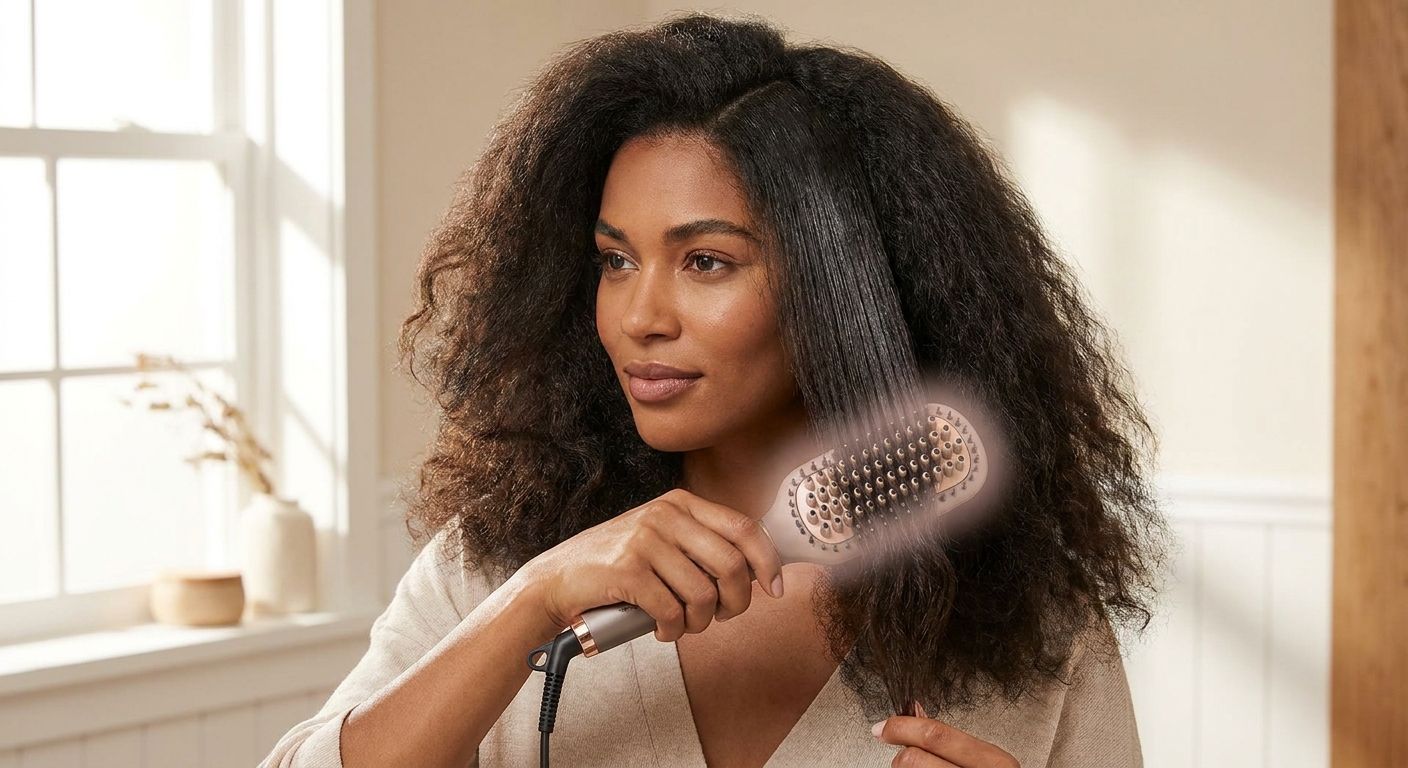
Thick, frizzy hair fights back against most heat tools — the brush either doesn't get hot enough to smooth the cuticle or it scorches the ends before the roots are done. Here's what actually separates a heated hair brush for thick frizzy hair from one that just sits in a drawer after two uses.
- Titanium-plate heated hair brushes outperform ceramic-only models on thick, frizzy hair in 2026 — buy titanium.
- Adjustable heat up to 230C matters; anything capped under 200C won't tame coarse frizz reliably.
- Napio's electric hair straightening comb works as a daily touch-up tool between full blowouts — consider it.
- Skip single-setting brushes under $30 — thick hair needs higher heat than fine hair, and one setting can't do both.
Why this matters
Thick and frizzy hair strands have a raised, uneven cuticle layer. Heat has to hold long enough to reshape that cuticle, but most cheap heated brushes lose temperature the second they touch a section of hair thicker than average. The result: you pass the brush through five, six, seven times chasing a smooth result that a properly specced brush gets in two.
That repeated re-heating is also where the real damage happens. It's not one high-heat pass that fries thick hair — it's five low-heat passes stacked on top of each other, each one drying out the cuticle a little more. Get the spec right once and you cut both the passes and the damage.
Who this is for
This guide is for anyone dealing with hair that's naturally coarse, high-density, or prone to frizz in humidity — think 2c to 4a curl patterns, thick Type 2 waves, or straight hair with a lot of strands per square inch. If your hair is fine, thin, or already heat-damaged, a lower-heat ceramic brush is the better call and most of the picks below will run hotter than you need.
What to look for in a heated hair brush for thick frizzy hair
Plate and bristle material
Titanium conducts heat faster and holds it more evenly across the barrel than ceramic alone, which matters when you're pulling the brush through a section that's genuinely thick. Ceramic-only barrels are gentler but they cool down mid-stroke on dense hair, forcing repeat passes. If your hair takes more than 10 minutes to blow out on a normal dryer, prioritise titanium or a titanium-ceramic hybrid.
Heat range and control
Thick, frizzy hair typically needs 200-230C to get a lasting smooth result, while fine hair burns above 180C. A brush that only offers one fixed temperature is guessing on your behalf. Look for at least 3 heat settings so you can run hot on the mid-lengths and back off near the scalp and ends.
Ionic technology for frizz control
Ionic output breaks down water molecules on the hair shaft faster and neutralises the static charge that causes flyaways. For frizz-prone hair specifically, this is arguably more important than raw heat — a brush with strong ionic output at 200C can outperform a non-ionic brush running at 220C. Check that the ionic claim is actually specified, not just implied by a smooth marketing label.
Brush design and bristle spacing
Thick hair needs wider bristle spacing so the brush can actually get through a full section without snagging or bunching hair against the barrel. Tight, densely-packed bristles are built for fine hair and will drag on coarse strands, which slows you down and adds unnecessary tension at the root.
Safety features and auto shut-off
Any brush running above 200C needs an auto shut-off, full stop — thick-hair users tend to leave the brush resting on a section longer while detangling, and that's exactly when an unattended hot barrel becomes a problem. A heat-resistant swivel cord also matters if you're doing a full head, since thick hair sessions run longer than average.
Cord length and dual voltage
If you travel between Australia and the US, or anywhere with different voltage standards, a dual-voltage brush avoids the awkward situation of a tool that overheats or underperforms on the wrong power supply. A 2.5-metre cord gives enough slack to work a full head without repositioning the outlet.
Top picks for thick, frizzy hair
Titanium-plate rotating heated brush — the safe pick. Heats to 230C with multiple adjustable settings, which covers the full range from coarse mid-lengths to more sensitive ends in one tool. This is the category that consistently handles high-density hair without repeat passes. Buy.
Ionic ceramic round brush — the frizz-fighter. Lower max heat around 200C but strong negative-ion output that specifically targets static and flyaways rather than raw smoothing power. Best paired with a blow dryer rather than used standalone on very thick sections. Consider.
Fixed-temperature ceramic brush under $30 — the budget trap. Runs a single fixed heat around 180C with no adjustment, which undershoots what thick, coarse hair needs to hold a smooth result past a few hours. Looks like a bargain, performs like one. Skip.
Napio's electric hair straightening comb — the daily touch-up pick. Built for spot-smoothing and root-to-tip touch-ups rather than a full-head blowout replacement, which makes it a useful companion tool between wash days when frizz creeps back in. It's not a substitute for a full heated brush session on very thick hair, but for maintaining a style day-to-day it earns its spot in the routine. Consider.
What to avoid
- Ceramic-only brushes marketed as for all hair types. Thick, coarse hair almost always needs more heat and stronger ionic output than a genuinely universal brush can offer without also frying fine hair.
- Metal-bristle brushes without a heat-resistant coating. They look premium and heat up fast, but bare metal bristles snag thick strands and create more breakage than a properly spaced nylon or ceramic-tipped bristle.
- Brushes with no visible temperature display. If you can't see the actual heat setting, you're guessing every time — and on thick hair, guessing usually means running hotter and longer than necessary.
Verdict comparison
| Type | Heat range | Best for | Verdict |
|---|---|---|---|
| Titanium-plate rotating brush | Up to 230C | Thick, coarse, high-density hair | Buy |
| Ionic ceramic round brush | Up to 200C | Frizz and static control | Consider |
| Fixed-temp budget ceramic | ~180C fixed | Fine or already-smooth hair | Skip |
| Electric straightening comb | Spot-touch heat | Daily maintenance between blowouts | Consider |
FAQ
What's the best heated hair brush for thick, frizzy hair in 2026?
A titanium-plate heated brush with adjustable heat up to 230C and ionic technology is the best combination for thick, frizzy hair in 2026. Ceramic-only brushes tend to cool down mid-stroke on dense sections, forcing repeat passes that add unnecessary heat exposure.
Is a heated hair brush better than a flat iron for thick hair?
A heated brush is faster for volume and light smoothing, while a flat iron gives a sharper, sleeker finish on very coarse hair. Many people with thick, frizzy hair use a brush for daily maintenance and a flat iron or straightening comb for a fully polished look.
How hot should a heated brush be for coarse hair?
Coarse, thick hair generally needs 200-230C to get a lasting smooth result. Fine hair should stay under 180C, so a brush with adjustable heat settings covers both without switching tools.
Can a heated hair brush damage thick frizzy hair?
Yes, if you're forced into repeated low-heat passes because the brush can't hold temperature on dense sections. A properly specced titanium brush that smooths hair in one or two passes causes less cumulative heat damage than a weaker brush needing five or six.
How often should you use a heated hair brush on thick hair?
Three to four times a week is a reasonable ceiling for thick hair to avoid cumulative dryness. Days in between can rely on a spot-touch tool like an electric straightening comb rather than a full heat session.
Is titanium or ceramic better for frizzy hair?
Titanium holds heat more evenly across the barrel, which matters most for thick, high-density hair. Ceramic is gentler and better suited to fine or already-manageable hair that doesn't need sustained high heat.
How much does a good heated hair brush cost in 2026?
Quality titanium-plate heated brushes with adjustable settings typically sit above the $30 fixed-temperature budget models. Check current pricing directly on the retailer's site since ranges shift through 2026.
Does a heated hair brush work as well as a straightening comb?
A heated brush is built for full-head smoothing and volume, while a straightening comb like Napio's electric hair straightening comb is better for targeted, root-to-tip touch-ups. Most thick-hair routines use both for different jobs rather than picking one over the other.
One last thing
The number that actually predicts performance on thick hair isn't wattage — it's how fast the barrel recovers heat after contact with a dense section. A brush can advertise 230C all day, but if it drops to 190C the second it touches a thick strand and takes 15 seconds to climb back, you're effectively running a weaker tool than the spec sheet promises. If a heated hair brush for thick frizzy hair doesn't list recovery time or at least multiple heat settings, that's the gap most people miss until they're standing there running the same section through for the fourth time.