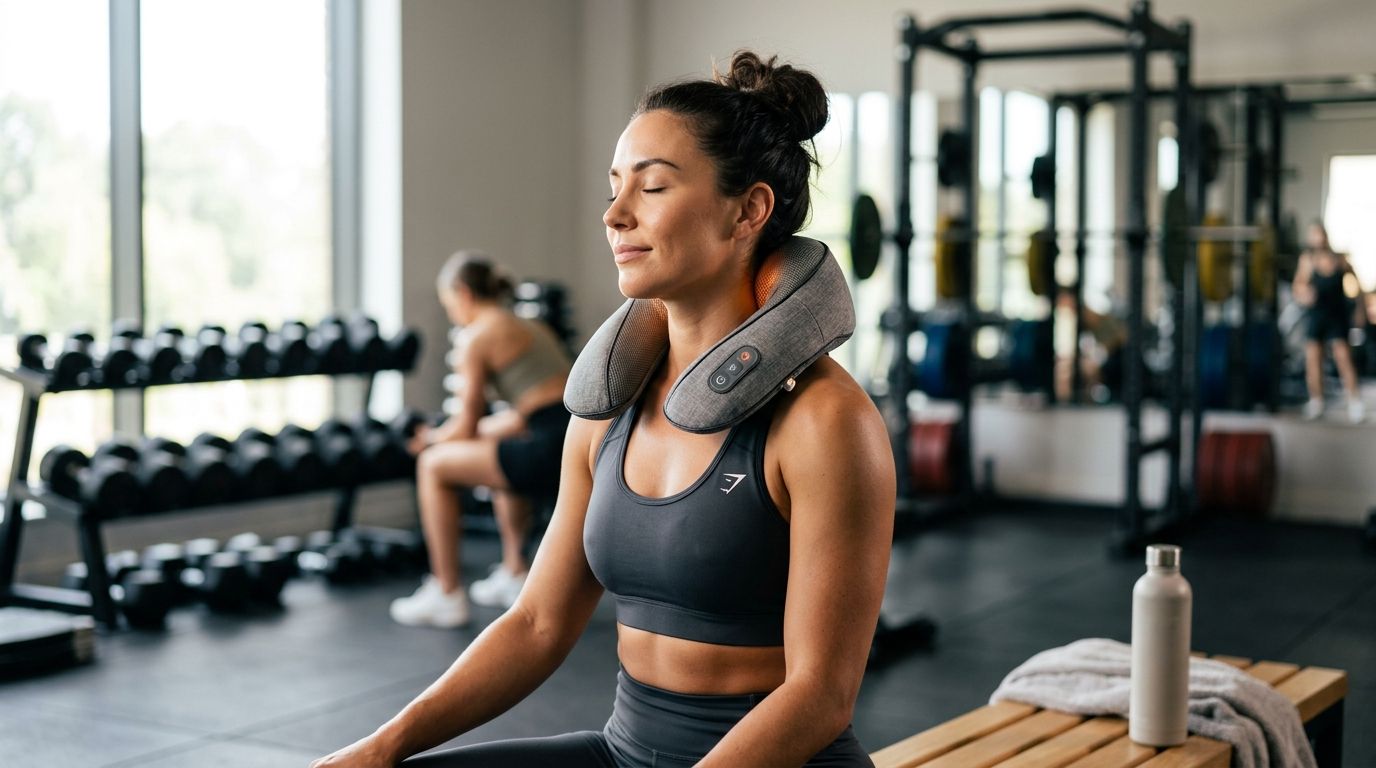
Heated neck massager for gym recovery is a cordless, heat-and-vibration device used after training to loosen the trapezius, levator scapulae, and cervical muscles that lock up from heavy lifting, before soreness sets in the next morning. Gym-goers need something different from what a desk worker or a light traveller needs: a unit that survives a sweaty gym bag, charges fast between sessions, and hits enough heat to cut through a tight upper back after a deadlift day, not a delicate plug-in pillow meant for the couch.
- A heated neck massager for gym recovery needs to be cordless and gym-bag durable, not a plug-in unit built for the couch.
- Apply heat 10-15 minutes right after training, before the trapezius and neck tighten into next-day soreness.
- DOMS (delayed onset muscle soreness) peaks 24-48 hours post-workout, so heat timing matters more than heat strength.
- Cordless rechargeable models with 2-3 heat settings outperform single-setting corded units for daily gym use in 2026.
- Heat speeds loosening but doesn't replace stretching or a proper cooldown.
Why heat therapy matters for gym recovery specifically
A desk worker's neck tension builds slowly over eight hours of poor posture. A lifter's neck tension arrives fast, loaded through the traps during compound movements like deadlifts, overhead press, and heavy rows. That's a different injury pattern and a different recovery window.
Delayed onset muscle soreness typically peaks 24-48 hours after training, which is why the neck and upper back often feel worse the day after leg day than immediately after it. Heat increases local blood flow and loosens the fascia around tight muscle fibers, which is why a heated neck massager for desk workers gets used for slow-burn tension while a gym version gets used for acute post-session tightness, right after the barbell goes down.
The practical difference: gym users need a device that's ready in the locker room within a couple of minutes, not one that needs a wall outlet and twenty minutes of warm-up.
Stretch before you reach for heat
Heat works better on muscle that's already been moved through range, not muscle that's still locked in a rigid position from the barbell.
- Do a 60-90 second doorway chest stretch to open the front of the shoulders
- Roll the neck slowly through flexion, extension, and lateral tilt, no forcing
- Shrug and roll the shoulders 10-15 times to pump blood into the traps
- Skip static stretching on a muscle that's actively cramping, that's a different problem
Time your heat session right after training
Applying heat within the first 15-30 minutes post-workout, while blood is already moving, gets more out of the session than waiting until you're home and cold.
- Use heat for 10-15 minutes directly after the cooldown walk
- Combine with hydration, muscle tissue recovers slower when dehydrated
- Avoid heat directly on a fresh acute strain or sharp pain, that calls for ice and a physio, not a heat pack
- Log which sessions (push day, pull day, leg day) leave the neck tightest, so you know when to prioritize heat
Choose the right heat setting for your tolerance
Most heated massagers offer two or three heat levels. Gym users tend to run hotter settings than desk workers because they're working through denser, more inflamed tissue.
- Start on the lowest setting for the first 60 seconds to check skin tolerance
- Move up only if the muscle still feels knotted after two minutes
- Never fall asleep on the highest setting, that's how skin irritation happens
- Pair heat with light massage or vibration rather than heat alone for deeper release
Layer heat with mobility work, not instead of it
Heat loosens tissue; it doesn't correct the movement pattern that got the neck tight in the first place. Lifters who skip mobility work and just rely on heat tend to cycle through the same tightness week after week.
- Add 5 minutes of thoracic spine rotation on rest days
- Use a foam roller on the upper back before the heat session, not after
- Check bar path on overhead presses, a forward-drifting bar loads the neck more than it should
- Reassess grip width on rows if the traps are the first thing that fatigues
Pick a cordless unit that survives your gym bag
This is where gym recovery diverges hardest from every other segment. A plug-in heated pillow doesn't travel well and can't run in a locker room with no outlet nearby. A cordless heated neck massager built for travel tends to hold up better under daily gym-bag conditions too, same durability demands, different use case.
- Rechargeable battery that lasts multiple sessions before needing a top-up
- A wipeable or washable cover, since gym sweat is a different beast than desk sweat
- Compact enough to fit a gym bag side pocket without adding bulk
- Fast charge time so it's ready again before the next session, not sitting dead on the shelf
Charge and clean between sessions
A dead battery on leg day is a wasted recovery window. Build the charging habit the same way you'd rack weights.
- Charge fully after every second or third use, don't wait for it to die completely
- Wipe down the contact surface with a damp cloth after sweaty sessions
- Store it dry, a damp unit left in a closed gym bag breeds bacteria and shortens battery life
- Check the strap or fit adjustment monthly, elastic degrades with heat and sweat exposure
Track how your neck responds week to week
Recovery tools only earn their spot in the routine if they're actually working. A quick, honest log beats guessing.
- Rate neck and trap tightness on a 1-10 scale the morning after training
- Note which sessions (heavy overhead press vs. light accessory day) cause the most tightness
- Adjust heat duration if 10 minutes stops feeling like enough after a few weeks
- Flag anything sharp or radiating down the arm, that's outside what a heated massager should be treating
Comparison: recovery options for gym-goers
| Option | Best for | Key limitation |
|---|---|---|
| Cordless heated neck massager | Post-workout use in the locker room or car, right after training | Battery needs regular charging between sessions |
| Microwavable heat pack | Home use after a shower, no charging needed | Not gym-bag practical, needs a microwave nearby |
| Heated massage pillow | Slow recovery on rest days at home | Bulky, plug-in only, not built for travel |
| Foam roller (no heat) | Loosening large muscle groups pre- or post-session | No heat component, works fascia not deep muscle warmth |
Verdict: a cordless heated neck massager wins for gym recovery because it's the only option built for the 15-minute post-workout window rather than a full at-home routine.
Common mistakes gym-goers make with heat therapy
- Using heat on an acute strain instead of ice. Heat on freshly inflamed tissue can make swelling worse; that calls for ice in the first 48 hours, not warmth.
- Running the highest heat setting every session out of impatience. Skin tolerance builds slowly; jumping straight to max heat risks irritation, not faster recovery.
- Letting the battery die mid-week and skipping recovery entirely. A charging routine matters as much as the training split.
- Treating heat as a substitute for mobility work. Heat loosens tissue temporarily; it doesn't fix the movement pattern causing the tightness.
- Sharing one device across a damp gym bag without drying it. Moisture trapped against a heat element shortens the unit's life and isn't great for hygiene either.
If trap and neck tension is showing up alongside headaches after heavy pressing days, the mechanism is often the same: tight upper traps referring pain up into the skull. The approach to using heat for tension headaches applies just as directly after a heavy training block as it does after a stressful workday.
FAQ
What's the best heated neck massager for gym recovery in 2026?
A cordless, rechargeable model with 2-3 heat settings and a wipeable cover works best for gym recovery in 2026, since it needs to survive gym-bag transport and run without a wall outlet. Plug-in pillows are better suited to home rest-day use.
Is heat or ice better after a gym session?
Heat works best on tight, non-inflamed muscle like the traps and neck after a lifting session. Ice is better for acute strains or sharp, localized pain in the first 24-48 hours.
How long should you use a heated neck massager after a workout?
10-15 minutes right after the cooldown is enough to loosen tight neck and trap muscles. Longer sessions on a high setting risk skin irritation without added benefit.
Can a heated neck massager replace stretching?
No, heat loosens tissue but doesn't correct the movement pattern that caused the tightness. Pair it with mobility work and stretching for lasting results.
Is it safe to use a heated neck massager every day?
Daily use is generally fine on a low-to-moderate setting for short sessions. Skip it directly over acute injuries or skin irritation and check with a physio if pain is sharp or radiating.
How much does a heated neck massager cost in 2026?
Pricing varies widely by brand and feature set, so check current listings for exact figures rather than relying on a fixed number. Cordless rechargeable models generally sit in a higher bracket than basic corded units.
Can a heated neck massager help with tension headaches from heavy lifting?
Yes, tight upper traps from heavy pressing or overhead work often refer pain up into the skull, and loosening that tissue with heat can ease the headache. It won't help headaches with a different root cause, like dehydration or eye strain.
What heat setting is best for sore trap muscles?
Start on the lowest setting for the first minute to check skin tolerance, then move up only if the muscle still feels knotted after a couple of minutes. Gym-related tightness often needs a slightly higher setting than desk-related tension.
One last thing
DOMS peaks 24-48 hours after training, not immediately after, which means the heat session that matters most isn't always the one right after the workout. If the neck and traps feel fine walking out of the gym but tighten up the next morning, a second short heat session the day after often does more for recovery than a longer one on the day of.