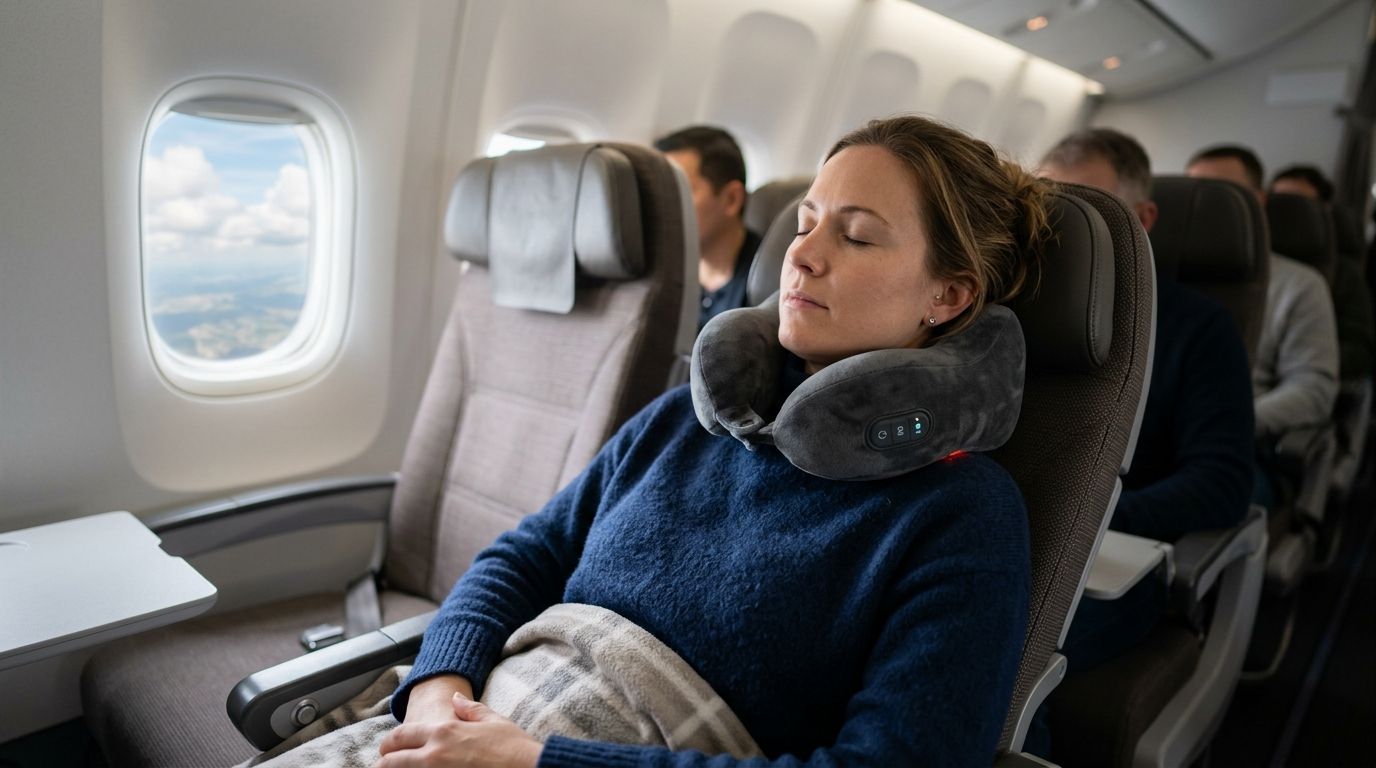
A heated neck pillow for long flights is a neck support device with a built-in warming element, worn or wrapped through boarding, cruising, and landing to stop the muscle lock-up that comes from hours upright in an economy seat. Long-haul flyers need something different from a desk-worker's heating pad: it has to run on battery (not mains power), survive security screening, and hold heat through a cabin that stays dry and cool for 8 to 14 hours straight.
- A heated neck pillow for long flights needs a USB-rechargeable battery rated for your full flight time, not mains power.
- Cabin air runs dry and cool for the whole flight, which is why unheated travel pillows do less for stiff necks than heated ones.
- Lithium batteries in any heated neck massager must travel in carry-on, never checked luggage, under standard airline rules.
- Napio's guide to heated neck massagers for travel breaks down which heat settings suit long sectors versus short hops.
- Skip max heat for the whole flight — it causes overheating and skin irritation on trips over 6 hours.
Why a heated neck pillow for long flights matters
Economy seats push your head forward the second you doze off, and there's no headrest angle that fixes it on a 14-hour sector. That forward-head position loads the same muscles for hours without a break, which is a different problem from the occasional stiff neck a desk worker gets after one bad night.
Cabin air is also kept dry through the flight, which tightens muscles and skin faster than a cold day at ground level. A heated neck pillow for long flights works because it keeps blood flow moving into muscles that would otherwise sit locked in one position for the entire trip — that's the one sentence worth remembering before you buy.
Short domestic hops under 3 hours don't need the same device as a 14-hour international leg. Battery capacity, not heat intensity, is what separates a pillow built for heated neck massagers for travel from one built for a 45-minute commute.
Check flight duration against battery life
Match the device's runtime to your actual sector length before you pack it, not after you're in seat 34B with a dead battery over the Pacific.
- Confirm advertised battery life covers your longest single sector, not your total trip time.
- Add 90 minutes of buffer for boarding delays and ground holds before takeoff.
- Check if the unit supports mid-flight charging via a USB-A or USB-C port at your seat.
- Test the battery at home for a full charge-to-empty cycle before the flight, not on travel day.
- Pack a slim power bank as backup on sectors over 10 hours.
Confirm it's cabin-compliant before you fly
Every heated neck device on a plane runs on a lithium battery, and airlines treat those batteries as a security item, not a comfort accessory.
- Carry the device and any spare battery in your cabin bag, never in checked luggage.
- Check the battery's watt-hour rating against your airline's carry-on limit before departure.
- Keep the device accessible for a quick check at security screening.
- Avoid devices with removable batteries over standard carry-on thresholds for international routes.
Pick the right heat setting for a pressurized cabin
Cabin pressure and dry air change how heat feels against skin compared to home use, so the highest setting isn't automatically the best one.
- Start on the lowest heat setting for the first 20 minutes to gauge how your skin reacts at altitude.
- Reserve the highest setting for the descent phase, when muscles tend to tense up again.
- Use a timed auto-shutoff feature if the device has one, so it doesn't run unattended while you sleep.
- Switch to a lower setting the moment you feel any tingling or excess warmth on skin.
Position it against the cervical curve, not the back of your skull
Most of the relief from a heated neck pillow for long flights comes from placement, not from the heat itself.
- Sit the warm section against the base of the skull and upper neck, not flat across the shoulders.
- Recline the seat slightly before fitting the pillow so it doesn't ride up when you lean forward.
- Loosen any strap enough that two fingers fit between the pillow and your throat.
- Reposition every 2 to 3 hours rather than leaving it fixed for the whole flight.
If you want a shortcut past the trial-and-error stage, heated neck pillows for shoulder tension covers placement differences between neck-only and neck-and-shoulder designs, which matters more on a long flight than on a short commute.
Pack it for fast access, not buried in checked luggage
A heated neck pillow only helps if it's out and running before you're an hour into the flight, not still zipped in the overhead bin.
- Store it in the same bag pocket as your passport, so you grab it at the same time.
- Compress it into a stuff sack if the model isn't already collapsible.
- Keep the charging cable in the same pouch, not a separate bag.
- Skip checking it even on flights where you check your main bag.
Clean it between multi-leg trips
A heated pad against skin for 8-plus hours picks up oil and sweat fast, especially across two or three connecting flights in one trip.
- Wipe the fabric cover with a damp cloth after each flight, not just at the end of the trip.
- Remove and hand-wash any detachable cover per its care label.
- Let it air dry fully before repacking it for the return leg.
- Avoid submerging the heating element itself in water.
Comparison: heated neck options for long-haul flyers
| Option | Best for | Key limitation |
|---|---|---|
| USB-rechargeable heated neck wrap | Sectors over 8 hours where battery life matters most | Needs a full charge before departure; no mid-flight top-up without a power bank |
| Microwavable heated neck pillow | Short domestic hops under 3 hours | Loses heat within roughly an hour and can't be reheated in-flight |
| Heated shiatsu neck massager | Flyers prioritising deep pressure alongside warmth | Bulkier to pack and heavier in carry-on |
| Standard unheated travel pillow | Budget-conscious flyers on any sector length | Does nothing for muscle stiffness, only head position |
Verdict: for any single flight over 6 hours, the USB-rechargeable heated wrap wins on battery life and packability — the microwavable version simply can't hold heat long enough to matter on a long-haul sector.
Common mistakes long-haul flyers make
- Running max heat for the entire flight. This overheats skin on sectors past 6 hours and leaves you groggier, not less stiff, on arrival.
- Packing the spare battery in checked luggage. Airlines require lithium spares in carry-on only, and this gets flagged at check-in.
- Buying based on short-haul reviews. A device praised for a 90-minute flight often can't hold charge through a 14-hour one.
- Ignoring position changes. Leaving the pillow fixed in one spot for the whole flight reduces its benefit versus repositioning every few hours.
- Skipping the pre-flight battery test. Finding out mid-flight that the charge doesn't last is the single most common complaint about this category.
FAQ
Is a heated neck pillow for long flights worth it?
Yes for sectors over 6 hours, where forward-head posture and dry cabin air cause real muscle stiffness by landing. For flights under 3 hours the benefit is smaller and a standard travel pillow often does enough.
Can you bring a heated neck massager on a plane?
Yes, but the lithium battery must travel in your carry-on, not checked luggage, and needs to stay within your airline's watt-hour limit. Check the specific limit with your airline before an international flight.
How long does the battery last on a heated neck pillow?
Battery life varies by model and heat setting, so match the advertised runtime to your longest single sector plus a buffer for delays. Lower heat settings extend runtime versus running on maximum the whole flight.
Is heated neck pillow or unheated travel pillow better for long flights?
A heated option does more for muscle stiffness on sectors over 6 hours, since it keeps blood flow moving instead of just holding your head in place. An unheated pillow only addresses head position, not muscle tension.
Can you use a heated neck pillow the whole flight?
No, running heat continuously for 8-plus hours risks skin irritation and overheating. Cycle between low heat and no heat every 2 to 3 hours instead.
Does cabin pressure affect how a heated neck pillow feels?
Yes, dry cabin air and pressure changes make skin more sensitive to heat than at ground level. Start on the lowest setting and increase only if needed.
What heat setting is best for a red-eye flight?
Low to medium heat works best for overnight flights since you won't be monitoring skin reaction while asleep. Use a model with auto-shutoff if you plan to sleep through most of the flight.
One last thing
The detail most flyers miss isn't the heat setting — it's the battery rule. Every airline treats a lithium battery in a heated neck device the same way it treats a spare phone battery: carry-on only, never checked, regardless of how small the device looks. Pack it wrong and you'll be repacking at the check-in counter with a boarding group already called.