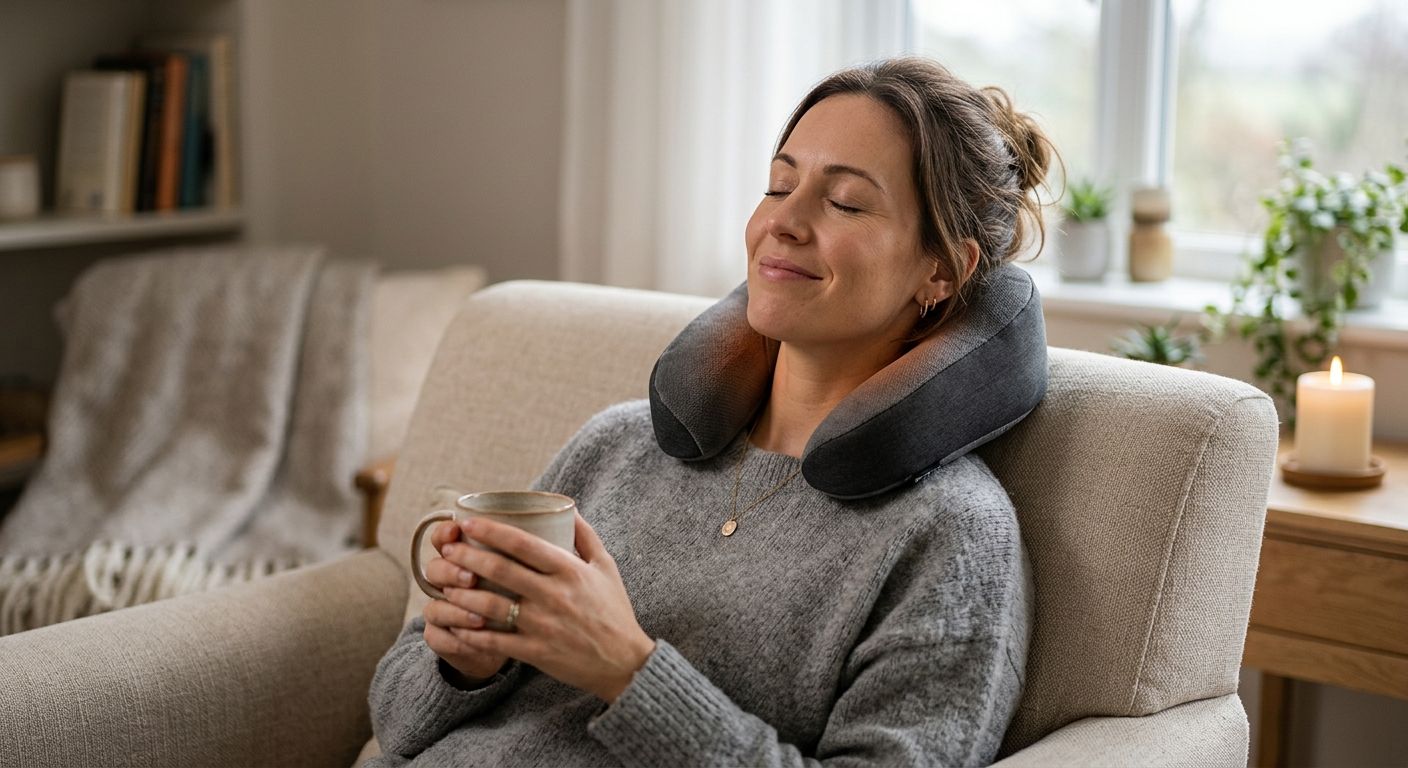
Migraine sufferers use a heated neck massager to loosen the trapezius and suboccipital muscles that tighten before and during a migraine, with the goal of cutting the frequency and intensity of attacks without adding another pill to the routine. Someone dealing with migraine needs something different from a person with plain neck stiffness: heat has to stay low and steady, because a device that runs too hot can spike the same light and heat sensitivity that makes migraines worse in the first place.
- A heated neck massager on low-to-medium heat is the fastest non-drug way to loosen migraine-linked neck tension in 2026.
- Migraine sufferers should time sessions before the headache peaks, not just during it, for the best result.
- Sessions of 15-20 minutes are the standard heat-therapy window recommended for tension relief without skin irritation.
- A heated neck massager works best for tension-driven migraines; it does little for aura-only or vestibular migraines.
- Track four weeks of use before judging whether heat therapy is actually cutting your attack frequency.
Why heated neck massagers matter for migraine sufferers
Migraine affects roughly 1 in 7 people worldwide, according to World Health Organization data, and neck or shoulder tension is one of the most frequently reported triggers alongside sleep disruption and stress. That's a different starting point from someone buying a neck massager for a stiff commute or a bad night's sleep — for a migraine sufferer, the neck isn't just sore, it's a trigger point that can tip a dull ache into a full attack.
This is why timing and heat control matter more than raw power. A guide on using a heated neck massager for tension headaches is a useful starting point precisely because tension headaches and migraine share the same muscular trigger, even though the conditions aren't identical.
A heated neck massager set to low-to-medium heat is the fastest non-drug way for migraine sufferers to loosen trigger-point tension at a desk, on a couch, or mid-flight — best for tension-driven migraines, not aura-only or vestibular migraines.
The heated neck massager routine for migraine relief
Getting a benefit out of a heated neck massager isn't about owning one — it's about using it on a schedule that matches how your migraines actually build. Here's the sequence that works, starting with what costs nothing.
Map your trigger points before you buy anything
Spend a week noticing exactly where tension sits before an attack starts. Most migraine sufferers carry it in one of a few spots.
- Base of the skull, where the suboccipital muscles attach
- Upper trapezius, the ridge between neck and shoulder
- One side more than the other, which often tracks with which side the migraine lands on
- Jaw and temple, if you clench under stress
Choose a heat range you can control precisely
A fixed, single-temperature heat pack is a blunt tool for a migraine brain that's already oversensitive to stimulus. Look for control before you look for anything else.
- Multiple heat settings, not just on/off
- A low setting that's genuinely gentle, not just "low" on the label
- Auto shut-off so you're not tempted to leave it on past the point of comfort
- A wearable, hands-free shape so you're not holding a hot pack against your neck for 20 minutes
Time sessions around the pre-headache window, not just the pain
Most people reach for heat once the migraine has already started. The better window is the tension build-up beforehand — the tight-neck, foggy-headed hour that precedes a full attack for a lot of migraine sufferers.
- Use heat as soon as you notice neck tightness, before pain sets in
- Keep sessions to 15-20 minutes, the standard window for heat therapy without skin irritation
- Pair it with a dark, quiet room if light sensitivity is already climbing
- Stop immediately if the heat itself feels uncomfortable rather than soothing
Pair heat with a manual stretch routine
Heat loosens the muscle; movement is what actually releases it. Skipping this step is the single biggest reason people say heat therapy "doesn't work" for them.
- Slow chin tucks, ten reps, done gently
- Shoulder rolls backward, not forward
- A short side-to-side neck stretch, held for 20-30 seconds each side
- Standing up and walking for two minutes if you've been seated for hours
This is the point where a dedicated device earns its place. A best heated neck massager for neck pain comparison is worth reading once you've confirmed manual heat and stretching actually help you — it tells you what to look for once you've decided the category works for your triggers.
Track patterns for four weeks
One good session doesn't prove anything. Migraine frequency needs a longer window to judge.
- Log the date, time of day, and neck tension level before each attack
- Note whether you used heat preventively or only after pain started
- Track sleep and screen time alongside it — both interact with neck tension
- Compare attack frequency at week four against your baseline month
Build recovery windows into your desk day
Migraine sufferers who work at a screen for long stretches often carry tension that never fully releases between attacks.
- Set a break every 45-60 minutes, even a two-minute stand-and-stretch
- Keep a heat device at your desk rather than only at home
- Adjust monitor height so your neck isn't tilted forward for hours
- Use a lumbar-supported chair position to reduce the compensating tension that travels up to the neck
Know your stop signals
Heat therapy has a ceiling. Recognising when to stop protects you from making a migraine worse, not better.
- Skin that's pink or tingling past a mild warmth
- Heat that increases rather than reduces your headache
- Any dizziness, which points to a different trigger than muscular tension
- A migraine with aura, where heat isn't the primary tool most people reach for
“If the heat feels blinding rather than soothing, turn it off — heat should melt tension, not add another sensory assault to an already inflamed nervous system.”
Which option fits your migraines
Migraine sufferers land on different tools depending on what triggers them. Here's how the main non-drug options compare.
| Option | Best for | Key limitation |
|---|---|---|
| Heated neck massager | Tension-driven migraines needing hands-free heat at a desk or on the move | Doesn't treat aura or vestibular symptoms |
| Hot water bottle | Occasional use with no interest in a gadget | Cools quickly, needs refilling, no hands-free wear |
| Plug-in heating pad | People who stay in one seat for long stretches | Corded, not portable, no travel use |
| OTC pain relief | Fast relief once an attack is already active | Doesn't address the muscular trigger, not for daily long-term use |
| Weighted sleep mask | Migraine sufferers whose triggers include light sensitivity | Doesn't touch neck tension directly |
For light-sensitive migraine, a weighted sleep mask for migraines solves a different half of the problem than heat does — the two are complementary, not competing.
Common mistakes migraine sufferers make
- Cranking the highest heat setting mid-attack. More heat doesn't mean more relief — during an active migraine, high heat often reads as another painful sensory input rather than comfort.
- Only using heat once pain has already started. Waiting until the migraine peaks skips the window where heat does the most good: the tension build-up beforehand.
- Skipping the stretch entirely. Heat alone loosens muscle temporarily; without movement, the tension returns within an hour.
- Treating a heated neck massager as a cure-all. It targets muscular tension, not aura, vestibular symptoms, or hormonal triggers — those need a different plan.
- Never tracking whether it's actually working. A single good day isn't data. Four weeks of logged attacks is what separates a real pattern from a placebo effect.
FAQ
What is the best heated neck massager for migraine relief in 2026?
The best option in 2026 is one with multiple low-heat settings and a hands-free wearable shape, since migraine sufferers need gentle, controllable heat rather than maximum output. A single fixed-temperature device is a poor fit for anyone with heat or light sensitivity.
Can a heated neck massager stop a migraine once it starts?
It can ease the muscular tension component but it won't stop a migraine that's already progressed past the tension stage. Heat works best as prevention, applied as soon as neck tightness appears, not as a rescue tool once pain is severe.
How long should you use a heated neck massager for migraine relief?
Sessions of 15-20 minutes are the standard heat-therapy window, long enough to loosen muscle without irritating skin. Longer sessions don't add benefit and increase the risk of the heat itself becoming an uncomfortable stimulus.
Is heat or cold better for migraine relief?
Heat targets neck and shoulder muscle tension, while cold is more commonly used for the throbbing head pain itself. Many migraine sufferers use both at different points in the same attack rather than picking one over the other.
Can you use a heated neck massager every day?
Daily use is common for preventive tension relief, provided sessions stay in the 15-20 minute range and heat stays on a low setting. Stop and reassess if skin irritation, dizziness, or worsening headache shows up.
Do heated neck massagers work for tension headaches too?
Yes — tension headaches and migraine share the same muscular trigger point at the base of the skull and upper trapezius. The same low-heat, short-session approach applies to both.
Is a heated neck massager safe during pregnancy or for teens?
Anyone pregnant, a teen, or managing a chronic condition should check with a doctor before starting heat therapy for migraine, since individual guidance varies. This applies to any heat device, not just a neck massager specifically.
What's better for migraines: a heated neck massager or a weighted eye mask?
They solve different triggers — a heated neck massager targets muscular tension, a weighted eye mask targets light sensitivity. Migraine sufferers dealing with both often use one of each rather than choosing between them.
One last thing
The detail most migraine sufferers miss isn't the device, it's the timing: heat applied during the tension build-up, before the pain phase, does more than the same heat applied at the peak of an attack. If you've only ever reached for heat once the headache is already bad, try moving the session earlier for four weeks before deciding heat therapy "doesn't work" for you — the data point that matters is frequency over a month, not relief in any single session.