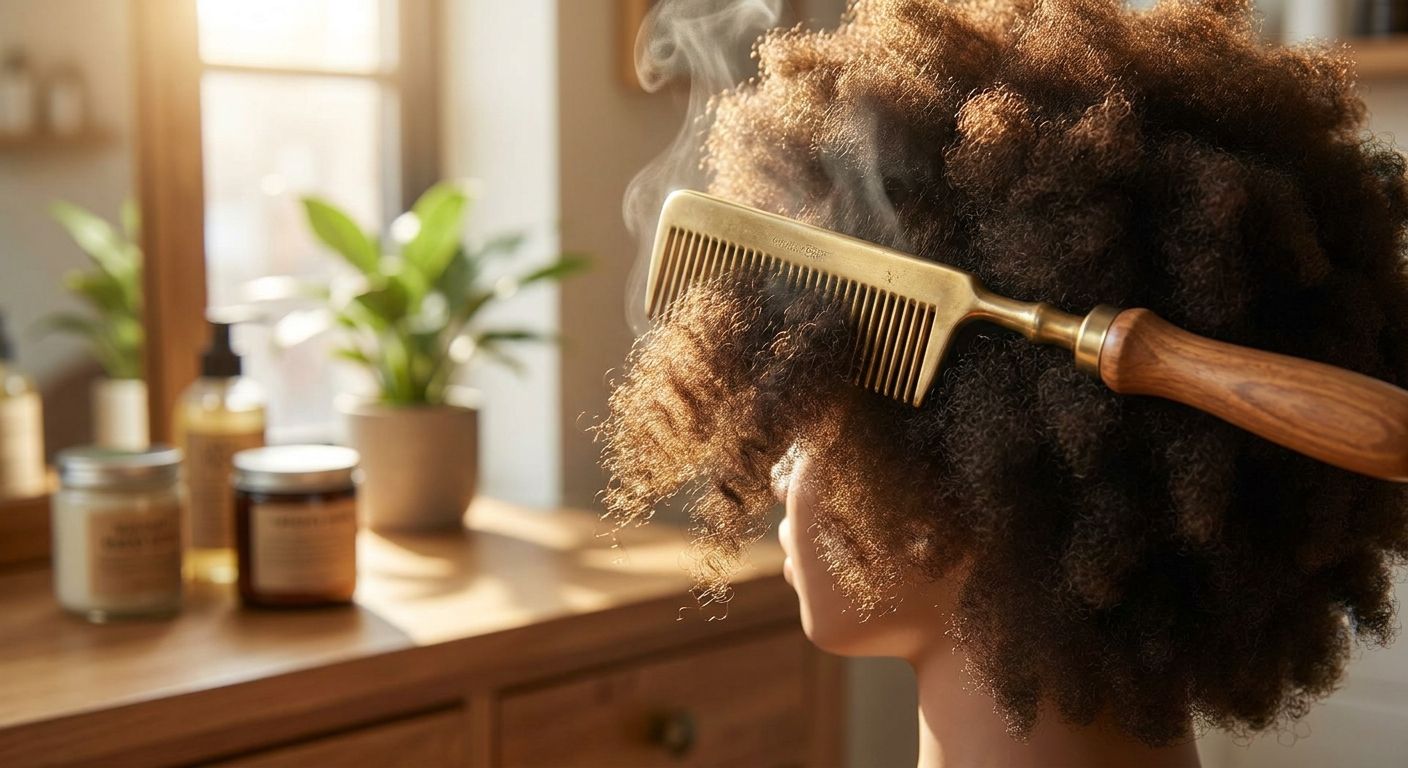
Afro and natural hair can take heat, but only the right heat, at the right point of contact, for the right amount of time — and most hot combs on the market get one of those three wrong.
- A hot comb for natural hair needs 150-230°C adjustable heat, not a single fixed setting — Buy adjustable, Skip fixed-temp models.
- Ceramic or tourmaline-coated plates reduce snagging on coily strands; bare metal plates grip and break hair — Skip bare metal.
- Wide tooth spacing matters more than wattage for 4A-4C hair; tight teeth stall on dense curls and force repeat passes.
- Napio's electric hair straightening comb pairs adjustable heat with a detangling head built for natural texture — Buy for daily styling.
- Dual-voltage combs (110-240V) matter if you travel in 2026; single-voltage combs are fine if you never leave the country.
Why this matters
Afro-textured hair has more cuticle layers exposed per strand than straight hair, which is exactly why it feels tougher and breaks easier under the wrong heat tool. A hot comb that runs one fixed temperature regardless of hair density will scorch fine edges while barely touching a thick crown — that's the damage nobody warns you about until the ends start snapping. Napio's electric hair straightening comb exists because the standard hot comb design ignores texture variation across a single head of hair.
Getting this purchase right in 2026 means understanding what natural hair actually needs from a heat tool, not just what's cheapest on a shelf.
Who a hot comb for natural hair is really for
This guide is for anyone with 3B through 4C texture who wants smooth, straight sections without a salon trip every time — box braid takedowns, wash-and-go transitions to straight styles, or protective-style prep. It's also for people managing shrinkage: natural hair can shrink 50-75% from its stretched length, and a hot comb is often the fastest way to get an accurate length check or a sleek finish before a photo, event, or workday. It is not for anyone chemically relaxed already or dealing with heat-damaged, brittle ends — that hair needs a trim and a break from heat tools, not another pass through one.
What to look for in a hot comb for natural and afro hair
Plate material and coating
Ceramic and tourmaline-coated plates distribute heat evenly and glide through hair with less friction than bare metal. Bare metal plates heat unevenly, creating hot spots that scorch one section while leaving another under-styled. On dense 4C hair, that friction difference is the line between a smooth pass and a snapped strand.
Heat range and control
A hot comb worth buying in 2026 gives you a dial or digital display, not a single on/off switch. Fine, color-treated, or previously relaxed natural hair styles well at 150-180°C. Thicker, virgin 4B-4C hair can usually tolerate up to 220-230°C for a single clean pass, but going in cold and doing three passes at high heat does more cumulative damage than one deliberate pass at the right setting.
Tooth spacing and detangling design
Wide-set teeth move through coily hair without stalling; narrow teeth built for straight or wavy hair will catch, pull, and force you to redo sections. If the comb can't get through a section on the first attempt, you're adding heat exposure every time you go back over it.
Cord type, wattage, and travel voltage
A fixed low-wattage cord means slower heat-up and more time hovering the plates over one spot. Dual-voltage design (110-240V) matters if you're packing the comb for a trip in 2026 — a single-voltage tool either won't heat properly abroad or risks blowing on the wrong outlet.
Safety features and heat-resistant base
An auto shut-off after 30-60 minutes of inactivity and a heat-resistant stand aren't nice-to-haves on a tool that regularly runs above 180°C. Shared bathroom counters and quick styling sessions are exactly where an unattended hot plate becomes a real risk.
If there's one line that sums up the buying decision: the plate that heats evenly at an adjustable temperature will always beat the one that just runs hotter.
“If the plate heats past 230°C on natural hair, you're not styling it — you're frying it.”
Where each type of hot comb fits
The everyday smoother. Ceramic-titanium plates, adjustable dial from 150-230°C, wide-set teeth for dense sections. This is the profile that handles daily or weekly styling without cumulative heat damage across a year of use. Buy for anyone styling more than twice a week.
The low-heat protector. Capped around 180°C with extra-wide tooth spacing, built for fine natural hair, color-treated strands, or hair recovering from previous heat damage. Slower to fully straighten dense sections, but the tradeoff is worth it if your ends are already fragile. Buy if damage prevention matters more than speed.
The travel pick. Dual-voltage (110-240V), compact barrel, usually a fixed mid-range heat setting rather than a full dial. Good for occasional trips in 2026 where packing a full-size comb isn't practical. Consider — fine as a backup, not ideal as your only comb.
Napio's all-rounder. Napio's electric hair straightening comb combines adjustable heat with a detangling head shaped for natural texture, aimed at people who want one tool that does daily smoothing without babying it through settings menus. For technique specifics — section size, pass count, heat setting by hair density — the how to use an electric hair straightening comb guide walks through it step by step. Buy for daily-to-weekly use on 3B-4C texture.
The bargain no-name. Single fixed high temperature, bare metal plates, no auto shut-off, sold mostly on price. It looks like a hot comb for natural hair on the box, but the fixed heat and lack of coating make it a fast route to split ends. Skip.
What to avoid
- Fixed single-temperature combs. They look identical to adjustable models in photos but give you zero control over how much heat hits fine edges versus a thick crown.
- Bare metal plates marketed as "professional grade." Professional-grade in a salon usually means the stylist is controlling section size and pass speed manually — at home, bare metal on natural hair just means more friction and more breakage.
- Narrow-tooth combs built for straight hair. They photograph well and often cost less, but they stall on coily sections, which means more passes and more heat exposure than a comb designed for the texture.
Hot comb for natural hair: quick verdict comparison
| Type | Heat Range | Plate | Best For | Verdict |
|---|---|---|---|---|
| Everyday smoother | 150-230°C adjustable | Ceramic-titanium | Weekly styling | Buy |
| Low-heat protector | Up to 180°C | Ceramic-coated | Fine or damaged hair | Buy |
| Travel pick | Fixed mid-range | Ceramic | Occasional trips | Consider |
| Napio electric comb | Adjustable | Ceramic-coated | Daily-to-weekly, 3B-4C | Buy |
| Bargain no-name | Fixed high heat | Bare metal | Nobody | Skip |
FAQ
What's the best hot comb for natural hair in 2026?
The best hot comb for natural hair in 2026 has adjustable heat between 150-230°C, ceramic or tourmaline plates, and wide tooth spacing built for coily texture. Fixed-temperature or bare-metal combs cost less but cause more breakage over repeated use.
Is a hot comb bad for afro hair?
A hot comb is not inherently bad for afro hair, but the wrong settings are. One clean pass at a heat setting matched to your hair's density styles safely; repeated passes at a fixed high temperature is where the damage compounds.
How often should you use a hot comb on natural hair?
Most natural hair holds up well with hot comb styling one to two times a week, with a deep conditioning treatment in between. Daily heat use on fine or color-treated hair increases breakage risk regardless of the comb's quality.
What temperature should a hot comb be for 4C hair?
4C hair generally tolerates 200-230°C for a single pass because of its density, while fine or previously relaxed sections do better at 150-180°C. An adjustable dial lets you switch between the two across one head of hair.
Hot comb vs flat iron for natural hair — which is better?
A hot comb detangles and smooths in one motion, which suits natural hair that needs section separation before it lies flat. A flat iron works faster on already-detangled sections but does nothing to break up shrinkage or tangles first.
Can you use a hot comb on wet natural hair?
No — hot combs are built for dry or nearly dry hair, and running one over wet strands causes the moisture to boil at the follicle, which damages the hair shaft. Blow-dry or air-dry to at least 90% before using a hot comb.
How much does a good hot comb cost in 2026?
Adjustable, ceramic-plated hot combs built for natural hair typically sit in the mid-range price tier rather than the bargain bin — check current pricing on the retailer's site since it shifts through the year. Fixed-temperature bargain models cost less upfront but wear out faster and damage hair more.
Do hot combs cause more damage than blow dryers?
A hot comb applies more concentrated, direct heat to the hair shaft than a blow dryer's ambient airflow, so it carries higher damage risk per use if the temperature is too high. Used at the right setting with a heat protectant, the risk drops close to that of any other styling tool.
One last thing
The single biggest mistake on natural hair isn't the heat setting — it's the second pass. One clean pass at the right temperature styles the section; a second or third pass over the same spot because the first one didn't fully smooth it is where most of the cumulative damage happens in 2026 styling routines. If a section needs more than one pass, the comb's tooth spacing or heat setting is wrong for that hair, not the technique.