Heat loosens tight neck muscles fast, but only if you get the temperature, timing and position right — get any of those wrong and you're just warming skin while the knot underneath stays locked. This guide walks through the exact setup that works in 2026, plus the mistakes that waste a whole session.
- 15-20 minutes of moist heat at 104-113°F loosens neck muscle spasm within one session.
- A heated neck massager for neck pain beats a hot towel because it holds steady temperature for the full stretch.
- Heat before stretching, never during acute swelling — ice wins in the first 48 hours after a strain.
- Repeat heat sessions every 2-3 hours on bad days; more than 20 minutes straight risks skin irritation.
Why this matters
Desk work locks the trapezius and levator scapulae into a shortened position for eight hours a day, and that muscle doesn't just relax the second you stand up. Heat increases blood flow to the area, which flushes out the lactic acid buildup causing the ache and lets the fibres stretch without tearing.
A hot shower does this too, but it cools in minutes and you can't wear it at your desk. A heated neck massager for neck pain holds a consistent temperature against the exact muscles that lock up from screen posture, which is why it's become the go-to home fix in 2026 for people who can't get to a physio every week.
What you'll need
- A heat source you can wear or drape around the neck — a heated wrap, heating pad, or microwaveable pack
- A towel if you're using a pad directly on skin (never apply bare heating elements to skin)
- 15-20 minutes of uninterrupted time
- A wall or doorway for the post-heat stretch
- A mirror or phone camera to check your posture mid-stretch
- Optional: a mechanical neck stretcher for after the heat session, since heat alone loosens muscle but doesn't correct the joint position causing the tension
The steps
1. Check for red flags first
Heat is wrong for the first 48 hours after a sharp injury, whiplash, or visible swelling — ice wins there. If the pain is dull, tight, and builds over a day at a desk rather than from a sudden movement, heat is the right call. Skipping this check is the single most common mistake people make before reaching for a heating pad.
2. Warm the pack to 104-113°F
Too cool and nothing happens; too hot and you burn skin before the muscle relaxes. Most electric neck wraps have a medium setting that sits in this range — check the device manual rather than guessing. Expected outcome: the pack should feel warm and comfortable within 10 seconds of contact, never sharp or stinging.
3. Position it over the base of the skull and upper traps
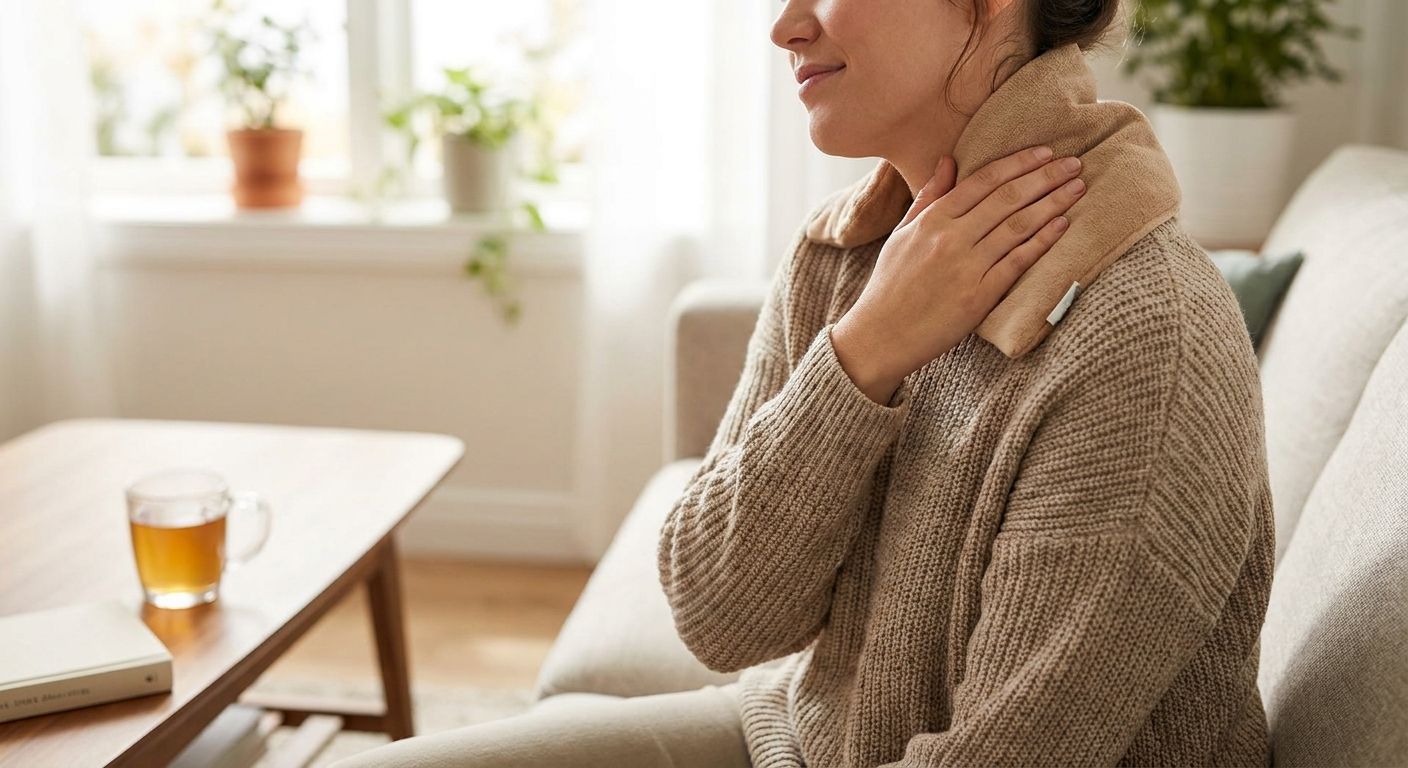
The muscles that tighten from screen time sit where your neck meets your shoulders, not just the back of the neck itself. Drape the wrap so it covers both sides evenly — one-sided heat only fixes half the problem. Common mistake: centring the pack too high, which warms the scalp and misses the trap muscle entirely.
4. Hold still for 15-20 minutes
Sit or lie back, let your shoulders drop, and resist the urge to check your phone with your neck bent forward — that re-tightens the exact muscle you're trying to loosen. Set a timer. Twenty minutes is the upper limit for a single session; longer risks skin irritation without added benefit.
5. Stretch immediately while the muscle is still warm
Heated muscle stretches further with less resistance, so this window matters. Tilt your ear toward one shoulder, hold 20-30 seconds, then repeat on the other side. A heated neck pillow for shoulder tension that supports the curve of your neck makes this step easier because it holds the stretch position without you having to brace with your hands.
6. Repeat every 2-3 hours on a bad day
One session eases the ache temporarily; three or four spaced through the day compound the loosening effect. This is where a portable or desk-friendly heat source earns its keep over a one-off hot towel.
7. Rebuild the habit that caused it
Heat treats the symptom. If your monitor sits below eye level or your chair has no lumbar support, the tension comes back within a day. Fixing posture is the only step that stops you from needing heat therapy every afternoon.


Troubleshooting
- Heat feels good but pain returns within an hour. You're treating the muscle, not the cause — check your monitor height and add a stretch break every 45 minutes.
- Skin turns red or itchy after 10 minutes. The pack is running hotter than 113°F or sitting directly on skin without a towel barrier. Cool it down and add a layer.
- Pain is worse in the morning than at night. This usually points to a pillow that doesn't support neck curvature during sleep, not a heat therapy problem — heat won't fix a pillow issue.
- Numbness or tingling down the arm. Stop heat therapy and see a doctor — this is a nerve symptom, not muscle tightness, and heat can mask it rather than treat it.
- One side of the neck stays tight no matter what. Uneven heat coverage is a common culprit; make sure the wrap sits symmetrically rather than favouring your dominant side.
Tools and resources
If you sit at a desk daily, a heated neck massager for desk workers that plugs into USB or runs cordless makes the 2-3 sessions a day realistic without leaving your chair. Heat therapy isn't unique to neck pain either — the same principle behind loosening a tight trapezius is what makes heat effective for period pain relief without medication, so if cramps are also on your radar, the mechanism is the same: consistent, controlled warmth applied where the muscle is spasming.
What to do next
Once heat therapy is part of your routine, the next fix is addressing why the tension builds up in the first place — chair setup, monitor height, and how long you go between stretch breaks. A posture corrector worn for an hour a day retrains the habit that heat alone can't touch.
FAQ
What's the best way to relieve neck pain with heat therapy at home?
Apply moist heat at 104-113°F for 15-20 minutes directly over the base of the skull and upper traps, then stretch immediately while the muscle is warm. Repeat every 2-3 hours on days when tension is severe.
Is heat or ice better for neck pain?
Heat is better for chronic tightness and muscle spasm from posture; ice is better for the first 48 hours after a sharp injury or visible swelling. Using heat too early on an acute injury can increase swelling.
How long should I use a heating pad on my neck?
15-20 minutes per session is the standard guideline for 2026. Longer sessions raise the risk of skin irritation without adding therapeutic benefit.
Can heat therapy fix neck pain permanently?
No, heat manages muscle tension but doesn't correct the posture or ergonomic setup causing it. Pair heat sessions with posture correction for a lasting fix.
How much does a heated neck massager cost in 2026?
Prices vary by brand and features; check current listings for exact pricing. Focus on adjustable temperature settings over price alone when comparing options.
Can I use a heating pad for neck pain every day?
Yes, daily use is safe as long as sessions stay under 20 minutes and you check skin for irritation. Daily heat combined with stretching produces better results than occasional use.
Does heat help a pinched nerve in the neck?
Heat can ease surrounding muscle tension but won't resolve nerve compression itself. Numbness or tingling down the arm needs medical evaluation, not just heat therapy.
What temperature should a heating pad be for neck pain?
104-113°F is the standard therapeutic range for moist heat packs. Anything hotter risks burns before the muscle has time to relax.
One last thing
The stretch you do in the 60 seconds right after heat matters more than the heat session itself — skip it and you've just warmed a tight muscle back into the same position it started in.