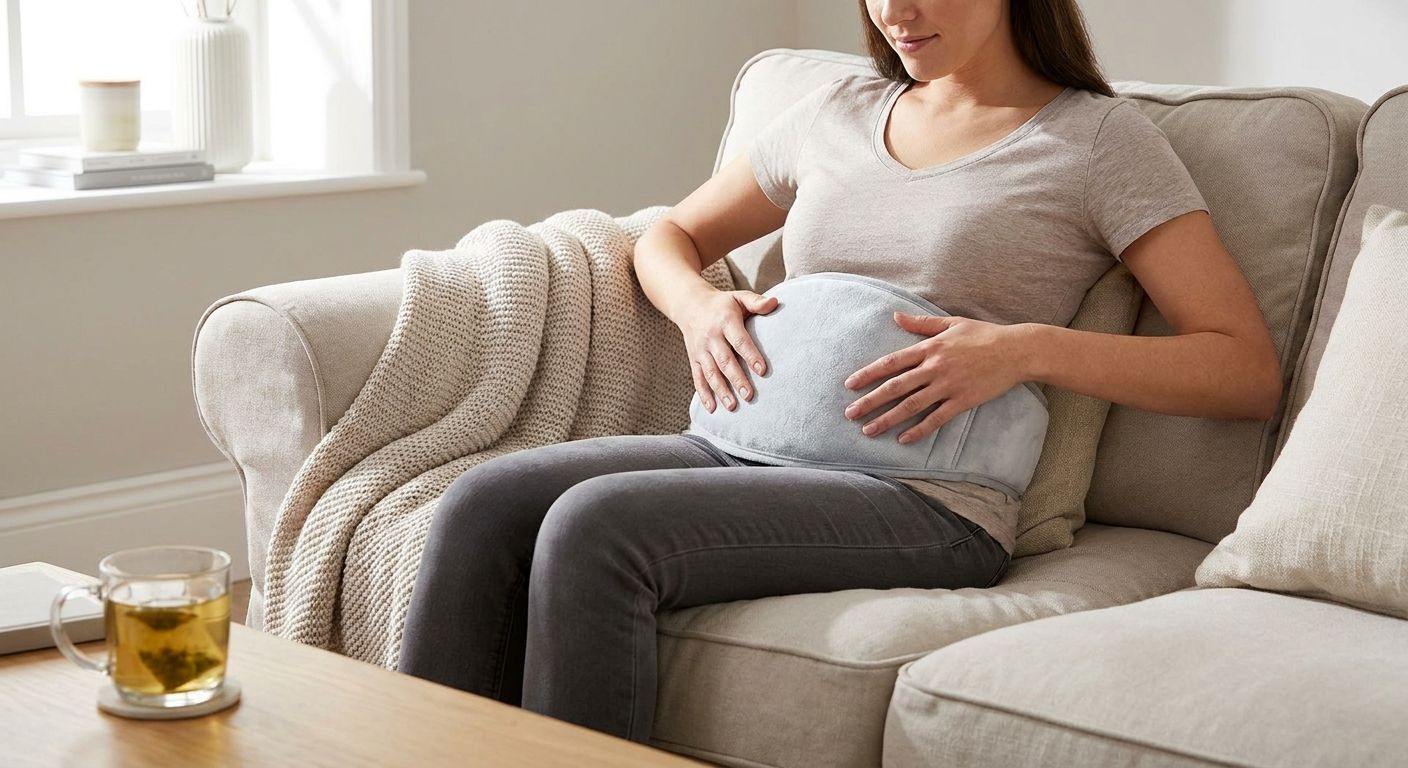
Cramps hit at the worst time, and popping another ibuprofen every four hours gets old fast. A heated period belt gives you drug-free heat therapy you can wear under your clothes at your desk, on the train, or curled up on the couch — but only if you use it properly.
- Charge the belt fully before your cycle starts — a flat battery mid-cramp defeats the purpose.
- Start on the lowest heat setting and position it over the lower abdomen, not the back, for period pain.
- Run 15 to 20 minute heat cycles rather than leaving it on continuously for hours.
- Heat therapy performs on par with ibuprofen for period pain in published dysmenorrhea research.
- Skip belts with a single fixed heat setting if cramp intensity shifts across your cycle.
Why this matters
Dysmenorrhea — the clinical term for period cramps — is driven by prostaglandins that make the uterus contract harder than it needs to. Heat relaxes that muscle and increases blood flow to the area, which is why a hot water bottle has been the default fix for generations.
A heated period belt does the same job with less mess and more control. Research on continuous low-level topical heat therapy for menstrual cramps found heat performed on par with ibuprofen for pain relief, and that finding still holds up in reviews cited through 2026.
The difference between a belt that actually helps and one that ends up in a drawer usually comes down to how you use it, not which one you bought. Get the placement, timing, and heat setting wrong and you're just wearing a warm strap. Get them right and you can cut reliance on painkillers during the worst two days of your cycle. Napio covers this device category because readers ask the same three questions: where does it go, how hot should it get, and how long should it stay on.
What you'll need
- A fully charged heated period belt (most rechargeable models need 1.5 to 2 hours on USB before first use)
- A charging cable, plus a power bank if you're wearing it away from home
- A snug but breathable base layer — leggings or fitted underwear beat loose clothing, which lets the belt slide
- A phone timer to track heat cycles
- Five minutes the first time you wear it to get strap tension right
The steps
1. Charge the belt completely before day one of your cycle
Don't wait until cramps start to plug it in. A half-charged unit runs heat for a fraction of the time you need, and most rechargeable belts take 1.5 to 2 hours for a full charge. Charge it the night before your period is due, based on your own tracking, so it's ready the moment cramps hit.
Common mistake: leaving the belt on the charger for days. Unplug it once it's full — lithium batteries degrade faster under constant trickle charging.
2. Start on the lowest heat setting
Start cool, not hot. Skin sensitivity varies across a cycle, and what feels comfortable on day one can feel too intense by day two. Work up through the settings over the first five minutes rather than jumping straight to the top.
Expected outcome: steady warmth you can wear for a full session without peeling it off after two minutes.
3. Position it over the lower abdomen, not the lower back
Period cramps originate in the uterus, which sits low and central in the abdomen, so that's where heat does the most work. Back placement helps if pain radiates there, but it's the secondary spot. If cramps come with lower back ache — common with more severe cramping — some belts wrap further round for exactly that reason.
Common mistake: sitting the belt too high, near the navel, where it does little for uterine cramping.
4. Secure the straps snug, not tight
You want skin contact firm enough that heat transfers evenly, loose enough that you're not restricting movement. A belt cinched too tight also traps heat unevenly against one patch of skin, which is where irritation starts on long sessions.
Check fit by taking a full breath in. If the belt digs in, loosen it a notch.
5. Run heat in 15 to 20 minute cycles
Rather than leaving the belt on high for hours, cycle it: 15 to 20 minutes on, a short break, then back on if cramps return. This mirrors how heat therapy is applied clinically and cuts the chance of skin redness from prolonged direct heat.
Expected outcome: relief that carries through the break, not just the minutes the belt is running.
6. Layer clothing so heat stays close to skin
Wear the belt against skin or over a thin base layer. Heavy jumpers over the top trap heat and can push the effective temperature past what the setting suggests. Thin, fitted clothing lets you judge actual warmth accurately.
7. Track which setting and placement work for you
Cramp intensity shifts across a cycle and month to month. Note the setting and position that gave the fastest relief so day two of a heavy cycle isn't trial and error again. People managing chronic pelvic pain often need a heated belt for endometriosis pain that holds steadier heat across longer sessions than a belt built for occasional mild cramps.
8. Clean and fully dry the belt between cycles
Sweat and skin oils build up on the inner lining over a period. Wipe it down per the manufacturer's care instructions and let it air dry completely before storing. A damp belt shoved in a drawer is how internal components corrode early.
“If the belt cools faster than your pain does, it's the wrong device for period cramps.”
Troubleshooting
- Belt won't heat at all. Check charge first — most units sit dead-cold below a minimum battery threshold rather than heating weakly. Confirm you're holding the power button, not tapping it; many models need a 2-3 second press.
- Heat feels weak on the highest setting. On many rechargeable belts, output drops as charge drops. Recharge fully and retest before assuming the unit is faulty.
- Skin turns red after wear. Drop a heat setting and shorten sessions to 10-15 minutes. Continuous high heat on one patch of skin for over an hour is the usual cause, not the device.
- Cramps aren't improving after a full cycle. Heat manages muscle-driven cramping well and does less for pain from other causes. If pain persists across 2026 cycles despite consistent use, raise it with a GP rather than replacing the belt.
- Strap keeps sliding down. Refit at the smallest comfortable notch and check the belt sits below the navel. A higher position slides more with movement.
- Battery drains faster than it used to. Rechargeable cells lose capacity with age and repeated full discharges. A shorter runtime after a year of use is normal wear, not a defect.
Tools and resources
- Portable heat therapy belt for period pain at work for discreet relief through an 8-hour shift
- A cycle-tracking app, so charging happens ahead of day one instead of during it
- A phone timer for managing 15-20 minute heat cycles
- A GP consult if cramps disrupt daily activity despite consistent heat therapy
What to do next
Once charge, placement, and heat cycling are dialled in, the useful next read is how heat therapy differs for chronic conditions versus occasional cramps. Comfort needs also differ by age — someone with a newly established cycle wants different settings and session lengths than an adult managing years of predictable cramping, which the menstrual heat belt for teens guide covers in detail.
FAQ
How do you use a heated period belt properly?
Charge it fully, start on the lowest heat setting, position it over the lower abdomen, and run it in 15 to 20 minute cycles instead of leaving it on continuously. Move it toward the lower back only if your cramps radiate there.
Is a heated period belt better than a hot water bottle?
A heated period belt stays put under clothing and holds a consistent temperature without reheating, which a hot water bottle cannot do once it cools. Both work through the same heat-therapy mechanism.
How long should you wear a heated period belt?
Run it in 15 to 20 minute cycles with short breaks rather than hours of continuous heat. Sustained high heat on the same patch of skin for over an hour is the most common cause of irritation.
Can you sleep with a heated period belt on?
Only if the model has an auto shut-off, since unmonitored heat overnight raises the risk of skin irritation. Check the belt's safety features before wearing it to sleep.
Does a heated period belt actually help with cramps?
Yes. Heat relaxes the uterine muscle and increases blood flow, and published research on continuous low-level heat therapy found it performs on par with ibuprofen for period pain.
Where do you place a heated period belt for cramps?
Directly over the lower abdomen, below the navel, because that is where uterine cramping originates. Shift it toward the lower back only if pain radiates there.
How often can you use a heated period belt in 2026?
As often as cramps require during your period, cycling roughly 15 to 20 minutes on and off. The practical limits are battery life and skin comfort, not a usage cap.
What heat setting is best for period cramps?
Start on the lowest setting and increase gradually across the first five minutes. Skin sensitivity shifts through a cycle, so the level that felt right on day one can feel too intense by day two.
One last thing
The detail most people skip: on rechargeable belts, heat output is tied to battery level, not just the setting dial. A belt on high at 40% battery can run cooler than the same belt on medium at full charge. If a session feels weaker than usual, check the battery before blaming the setting. Nail the charge routine and the rest — placement, timing, heat level — does the real work through every cycle in 2026.