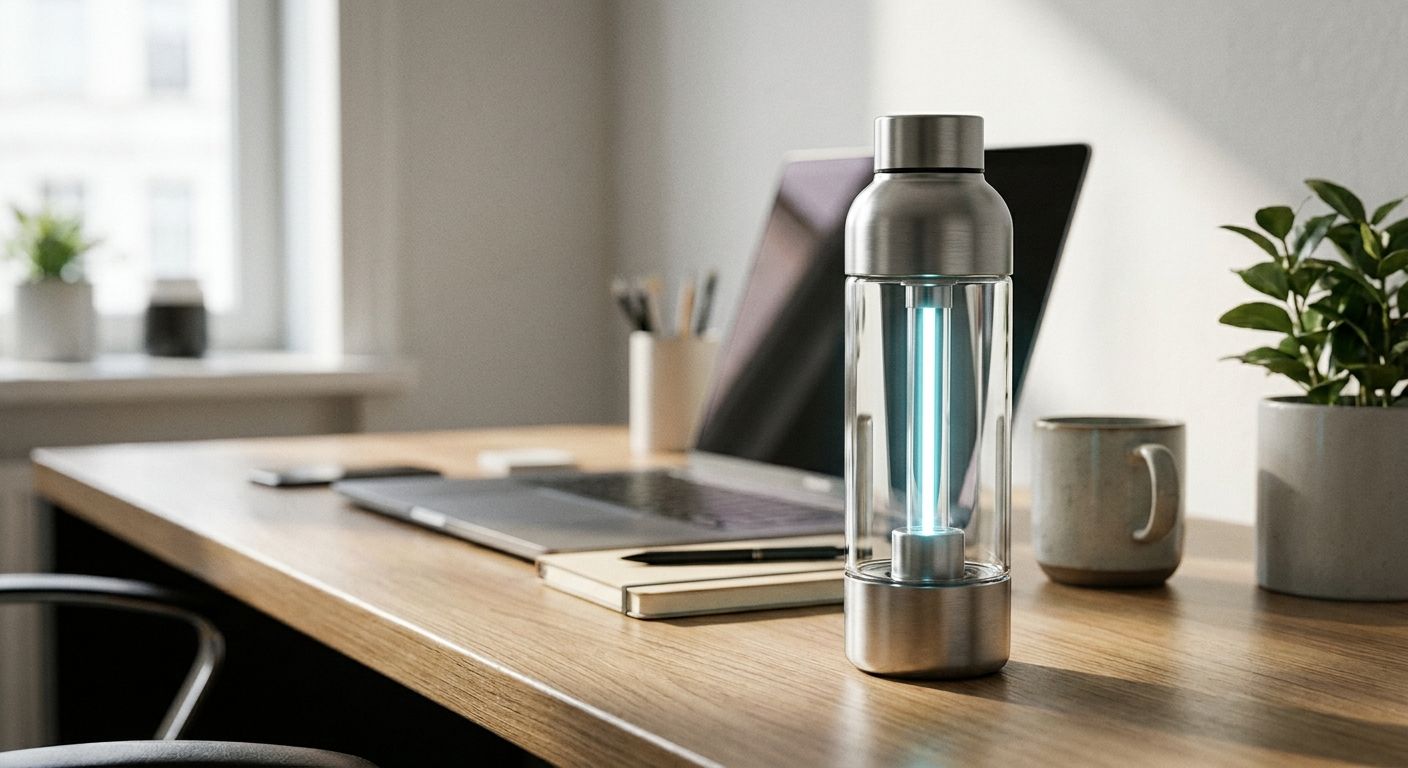
A self-cleaning bottle for office desks solves one specific problem: bacteria buildup in a bottle that sits capped on your desk for eight hours a day. This guide breaks down what separates a genuine UV-C self-cleaning bottle from a bottle that just says "self-cleaning" on the box, and where it fits next to the rest of your desk-day recovery kit.
- A genuine self cleaning bottle for office desks runs a UV-C or ionizer cycle every 2 hours, not once a day.
- Capacity of 500-750ml covers a standard 8-hour desk shift without a refill.
- USB-C charging under 2 hours is the baseline for 2026 models — anything longer is a red flag.
- Narrow-neck bottles without a self-clean cycle are the most common false pick. Skip them.
- Pair hydration gear with desk-recovery tools like a heated neck massager for desk workers for a full desk-day routine.
Why this matters
A bottle that sits on an open-plan desk gets touched, breathed near, and re-capped a dozen times before lunch. Standard bottles rely on you actually washing them, and most desk workers don't. A self-cleaning water bottle removes that step entirely by running a UV-C or ionizer cycle on a timer, so the inside gets sanitized whether or not you remember to scrub it that night.
The category got noisy through 2025 and into 2026, with plenty of bottles slapping "self-cleaning" on packaging while doing almost nothing beyond a wide mouth for easier hand-washing. The distinction matters more for office use than gym or home use, because a desk bottle sits capped and warm for hours at a time — the exact conditions bacteria need.
Who this is for
This guide is for desk workers who keep a bottle within arm's reach for a full 8-9 hour shift, hybrid workers who move a bottle between home and office daily, and anyone who has noticed a musty smell from a bottle they "cleaned" the night before. If you rinse and refill twice a day and never let the bottle sit capped for more than an hour, you likely don't need the self-cleaning tier. If you're one bottle for the whole day, every day, in 2026, this is the category to shop.
What to look for in a self cleaning bottle for office use
Self-clean cycle technology and frequency
UV-C light and ionizer/electrolytic silver technology are the two real mechanisms in this category — anything else is marketing. A bottle that only claims "self-cleaning" because of a wide mouth or a dishwasher-safe lid isn't solving the problem you're buying it for. Look for a cycle that runs automatically on a timer, roughly every 2 hours, not one you have to trigger manually every time you remember.
Capacity matched to a desk shift
A 500-750ml capacity covers most people through a standard workday without a refill trip. Go smaller and you're up walking to the water station four times a day, which defeats the point of a desk bottle. Go much larger and the bottle becomes a liability on a crowded desk next to a laptop and a monitor arm.
Charge time and battery life
USB-C charging under 2 hours is the 2026 baseline — the self-clean mechanism needs power, and a bottle that dies mid-week is a bottle you stop using. Battery life should comfortably cover a full work week between charges if you're only running the automatic cycle, not constant manual sanitizing.
Material and taste retention
Stainless steel and BPA-free Tritan are the two materials that hold up to daily UV-C or ionizer cycles without degrading or picking up plastic taste. Cheaper plastics can break down under repeated UV exposure over months, which is exactly the failure mode you're trying to avoid by buying a self-cleaning bottle in the first place.
Noise and cycle visibility in an open office
A self-clean cycle that hums or clicks audibly is a problem in a quiet open-plan office. The better 2026 models run silent cycles with a small LED indicator instead of a sound, so nobody at the next desk notices your bottle is mid-cycle.
Leak-proof lid design
A self-cleaning mechanism built into a lid that doesn't seal properly turns a hygiene upgrade into a desk hazard. Check for a locking or flip-seal cap rated for daily open-close cycles, not just a friction-fit lid borrowed from a non-cleaning bottle design.
Top picks by bottle type
UV-C cap bottles — the safe pick. These run a UV-C light cycle inside the cap every 2 hours, the most tested mechanism in the category through 2026. One concrete number that matters: cycle length is typically under 60 seconds, so it doesn't interrupt you mid-sip. Buy if you want the most proven self-cleaning method on the market.
Ionizer/silver-electrode bottles — the quiet option. No UV light means no visible cycle and no light-up cap, just a slower electrolytic process that ionizes silver into the water. Verdict: Consider this if you specifically want a bottle with zero moving parts and no light indicator on your desk.
Travel-ready UV bottles — the road warrior. If your bottle moves between home, car, and office daily, look at a UV water bottle built for travel with a sealed, drop-resistant cap housing. Buy if you're not chained to one desk all week.
Wide-mouth "easy wash" bottles — the budget trap. These market themselves as self-cleaning because the mouth is wide enough for a bottle brush, but there's no automatic cycle at all. Skip these if hands-off hygiene is the whole reason you're shopping this category.
Glass self-cleaning bottles — the aesthetic pick. UV-C cap technology built onto a glass body, heavier on the desk but zero plastic taste transfer over time. Consider if desk aesthetics matter as much as function to you, and you're not worried about drop risk on hard flooring.
What to avoid
- Bottles requiring proprietary cleaning tablets. Any bottle marketed as "self-cleaning" that still needs you to drop in a tablet every few days is just a slower version of hand-washing, with an ongoing cost attached.
- Narrow-neck bottles with UV caps. The cap does the work, but a narrow neck traps residue below the UV reach and you'll still need to hand-wash the body weekly regardless of what the cap does.
- Bottles with no visible charge indicator. If you can't tell at a glance whether the self-clean function is charged and running, you'll eventually carry a bottle that looks self-cleaning but isn't doing anything.
“A self-cleaning bottle that needs a tablet every three days isn't self-cleaning — it's just slower dish soap.”
Verdict comparison
| Type | Self-clean method | Capacity | Best for | Verdict |
|---|---|---|---|---|
| UV-C cap bottle | UV-C light, ~2hr cycle | 500-650ml | Daily desk use | Buy |
| Ionizer/silver bottle | Electrolytic silver | 500-750ml | Silent office | Consider |
| Travel UV bottle | UV-C, reinforced cap | 500-600ml | Hybrid workers | Buy |
| Wide-mouth "easy wash" | None (manual only) | Varies | Nobody buying for hygiene | Skip |
| Glass UV bottle | UV-C cap | 500-700ml | Desk aesthetics | Consider |
Your desk setup doesn't stop at hydration. The same 8-hour desk shift that makes a bottle grow bacteria is the shift that wrecks your posture and knots your neck, which is where a heated neck massager for desk workers earns its spot next to the bottle on your desk in 2026 — same problem, same daily habit, different fix.
FAQ
What is a self cleaning bottle for office use?
It's a bottle with a built-in UV-C light or ionizer that sanitizes the interior on a timed cycle, typically every 2 hours, without you having to hand-wash it during the workday.
Is a self-cleaning bottle better than a regular bottle for office desks?
Yes for anyone who leaves a bottle capped on a desk for a full 8-9 hour shift, since that's the exact condition bacteria need to build up between washes.
How often does a self-cleaning cycle run?
Most UV-C and ionizer bottles run an automatic cycle roughly every 2 hours. A cycle that only runs once a day isn't doing much for a bottle used continuously through a workday.
How long does a self-cleaning bottle take to charge?
Under 2 hours via USB-C is the 2026 standard. Anything longer usually means an older or lower-quality UV mechanism inside the cap.
Can a self-cleaning bottle still grow mold?
Yes, if the lid doesn't seal properly or the battery dies and the cycle stops running silently in the background without you noticing.
What size self-cleaning bottle is best for a desk shift?
500-750ml covers most people through a standard 8-hour workday without needing a refill trip to the kitchen.
Do self-cleaning bottles need special cleaning tablets?
No, a genuine UV-C or ionizer bottle should not require tablets. If a bottle needs tablets to work, it's not truly self-cleaning.
Are glass self-cleaning bottles worth it over stainless steel?
Glass avoids any plastic taste transfer over time but adds weight and drop risk on a hard office floor, so it comes down to whether you prioritize taste or durability.
One last thing
The single most common failure in this category isn't the UV-C mechanism, it's the lid seal. A bottle can have a genuine self-clean cycle and still leak on your keyboard within a month if the cap isn't rated for daily open-close cycles — check that spec before the cleaning tech.