A UV water bottle for travel kills waterborne bacteria and viruses at the source instead of just filtering out sediment, and by 2026 the category has split into three distinct builds that suit very different trips.
- Self-cleaning cap UV water bottles for travel suit daily commuters and hotel taps — buy for convenience.
- Full-submersion UV bottles clean more surface area but the battery needs airline approval for carry-on in 2026.
- Skip any UV water bottle for travel that hides its cycle time or UV-C wavelength on the packaging.
- IATA caps spare lithium batteries at 100Wh in carry-on luggage, some carriers allow up to 160Wh with approval.
Why this matters
Tap water abroad and refill stations at airports are the two places most travelers get burned, and a UV water bottle for travel solves both without adding a filter cartridge to replace. UV-C light in the 200-280 nanometer range does the actual disinfecting work, with 254nm sitting as the standard germicidal wavelength used across the category in 2026. That's physics, not marketing copy, and it's why the technology has stuck around while gimmick gadgets fade.
If you already carry travel gear that runs on rechargeable batteries — a cordless hair straightener for travel, a power bank, a heated neck wrap — a UV bottle just adds one more device to that same charging routine instead of a new habit. Napio built its travel lineup around that same logic: fewer things to remember, more things that actually get used past week one.
Who this is for
This guide is for the traveler who refills constantly — long-haul flyers, hikers on multi-day trips, and anyone spending 2026 in countries where tap water quality is inconsistent. It's less useful for someone who only drinks bottled water at the destination; in that case a UV bottle is dead weight in the bag.
What to look for in a UV water bottle for travel
Cycle time
A shorter cycle means you actually use it at the gate instead of skipping the step because you're rushing to board. Most self-cleaning caps on the market run 60- to 80-second cycles, and anything longer than 90 seconds starts to feel like a chore on a tight layover.
Battery capacity and airline rules
Spare lithium-ion batteries are capped at 100Wh for carry-on under IATA guidelines, with some carriers permitting up to 160Wh with prior approval. Check the printed watt-hour rating on the bottle's battery before you fly in 2026 — a bottle without a visible Wh rating on the packaging or manual is a red flag, not an oversight.
Full-submersion vs. cap-only sterilization
Cap-only UV bottles clean the mouthpiece and a thin layer near the opening; full-submersion designs run a UV rod down the entire cavity. For genuinely unclear water sources — river refills, questionable taps — full-submersion earns its extra bulk. For hotel and airport refills, cap-only is usually enough.
Bottle material and insulation
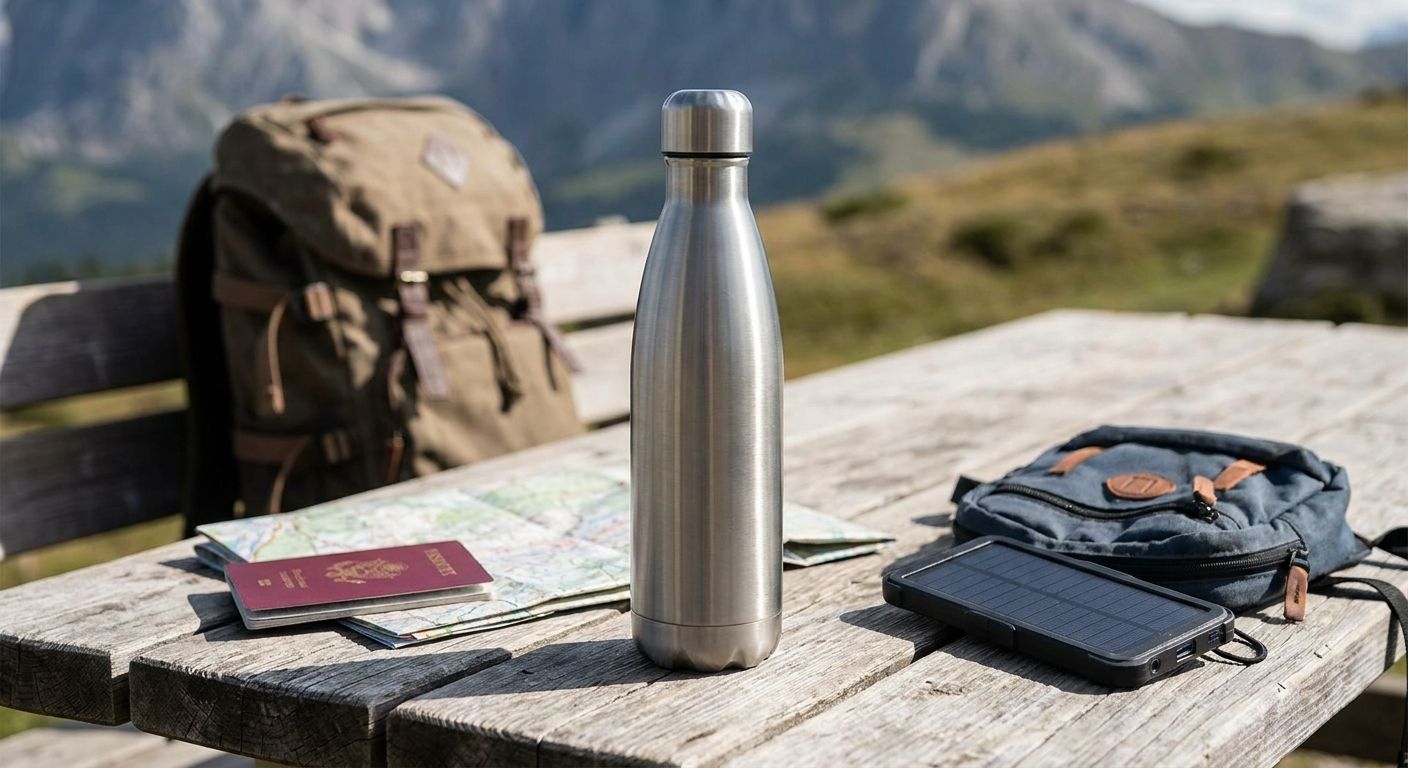
Stainless steel holds temperature and survives drops better than the plastic housings some UV bottles still use around the electronics. If you want cold water at hour eight of a flight, insulation matters as much as the UV function.
Charging port and cable type
USB-C has become close to universal on 2026 electronics, so a UV bottle still shipping with a proprietary or micro-USB cable is one more charger to pack. Match it to what you're already carrying.
Waterproof rating on the electronics housing
The UV mechanism sits right next to water by design, so a housing without a stated waterproof rating is a gamble. Look for an explicit IP rating in the spec sheet rather than a vague "splash resistant" claim.
Top picks by bottle type
Self-cleaning cap bottles — the low-maintenance pick. The UV element lives entirely in the lid, triggered by a single button, with most models running that 60-80 second cycle mentioned above. Best for daily commuters and frequent flyers who refill from filtered or municipal sources. Buy if convenience matters more than deep sterilization.
Full-submersion UV bottles — the deep-clean pick. A UV rod extends into the full cavity of the bottle, treating water and the inner walls in one pass, typically in 90 seconds to 3 minutes depending on volume. Best for backcountry travel and countries with unreliable tap water. Consider it if you're headed somewhere the water source itself is in question, not just the bottle's cleanliness.
UV wand plus separate reusable bottle — the flexible pick. The UV element detaches and works in any open container, from a hotel glass to a hydration bladder. Best for travelers who don't want to commit to one bottle shape. Consider for multi-purpose trips; skip if you want a single grab-and-go item.
Insulated UV bottles — the all-day hydration pick. These add double-wall stainless steel around the UV core, holding cold water for roughly 12-24 hours depending on the model's insulation spec. Best for long flights and hot climates where you want both sterilization and temperature retention. Buy if you're already choosing between a UV bottle and a separate insulated flask — this merges both.
What to avoid
- Bottles with no stated UV-C wavelength. If the listing doesn't mention 254nm or a wavelength in the 200-280nm range, you can't confirm it's doing germicidal work at all.
- Batteries with no printed Wh rating. Airport security and airline staff can pull an unlabeled lithium battery from your carry-on in 2026, rating unknown or not.
- Plastic housings around exposed UV elements with no IP rating listed. This is where cheap bottles fail first, usually within a few months of daily travel use.
Comparison table
| Type | Cycle time | Battery need | Best for | Verdict |
|---|---|---|---|---|
| Self-cleaning cap | 60-80 sec | Small, easy 100Wh compliance | Daily commuters, filtered taps | Buy |
| Full-submersion | 90 sec-3 min | Moderate, check Wh rating | Backcountry, unclear water sources | Consider |
| UV wand + bottle | 60-90 sec | Small, detachable | Multi-container travelers | Consider |
| Insulated UV bottle | 60-90 sec | Moderate | Long-haul flights, hot climates | Buy |
FAQ
Is a UV water bottle for travel actually effective in 2026?
Yes, when the UV-C wavelength sits in the 200-280nm range with 254nm being the standard germicidal figure used across the category. Effectiveness drops if the cycle is cut short or the water is visibly cloudy, since UV light needs a clear path to reach bacteria.
How long does a UV water bottle cycle take?
Most self-cleaning cap models run 60 to 80 seconds per cycle, while full-submersion designs take 90 seconds to 3 minutes. Longer cycles clean more surface area but slow you down at the gate.
Can I bring a UV water bottle in carry-on luggage?
Yes, as long as the battery stays within IATA's 100Wh cap for spare lithium-ion batteries, or up to 160Wh with prior airline approval. Check the printed watt-hour rating before your 2026 flight rather than assuming it's fine.
Is a UV water bottle better than a filter bottle for travel?
UV bottles kill bacteria and viruses rather than filtering particles, so they solve a different problem than a charcoal or hollow-fiber filter. For questionable tap water, a UV bottle handles the biological risk; it doesn't remove sediment or heavy metals the way a filter does.
Do UV water bottles need to be charged before every trip?
Most models hold a charge for dozens of cycles before needing a recharge, so a full charge before departure covers a multi-day trip. Pack the charging cable anyway since airport delays and extra refills add up fast.
What's the difference between cap-only and full-submersion UV bottles?
Cap-only UV bottles treat the mouthpiece and a thin layer near the opening, while full-submersion designs run a UV rod through the entire cavity. Full-submersion is the stronger choice for genuinely unclear water sources like rivers or unreliable taps.
Are stainless steel UV bottles worth the extra weight?
Yes if you want the water to stay cold for 12 to 24 hours and you want the housing to survive drops better than plastic. The tradeoff is a heavier bottle, which matters more on multi-day hikes than on flights.
One last thing
The detail most buyers miss isn't the UV cycle at all — it's the watt-hour rating on the battery. A UV water bottle for travel that looks identical to a competitor on the shelf can be an airport headache if that number isn't printed anywhere, so check the spec sheet before the packing list, not after security flags it.