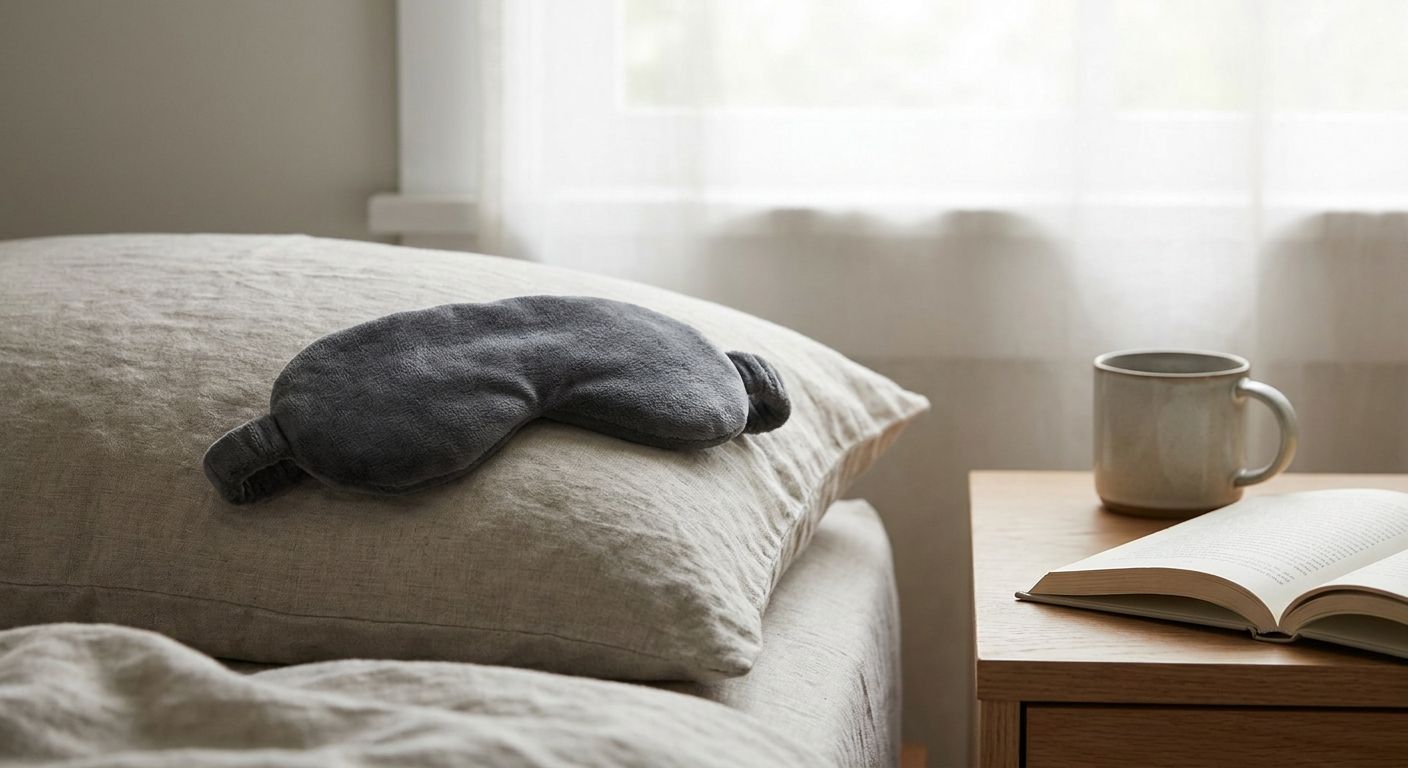
A weighted eye mask for insomnia is a sleep accessory that applies steady, even pressure across the eyes and forehead using glass beads or micro-pellets, with the aim of calming a racing nervous system fast enough to cut the time it takes to fall asleep. Insomnia sufferers need something different from the average light-blocking mask buyer: the problem usually isn't brightness, it's hyperarousal — a wired brain that won't downshift even in a pitch-black room.
- A weighted eye mask for insomnia works through deep pressure stimulation, not blackout alone — pick weight based on comfort, not marketing claims.
- Insomnia disorder is defined clinically as trouble sleeping 3+ nights a week for 3+ months — a mask alone won't fix that pattern.
- Pair the mask with a wind-down routine; a heated neck massager or heated neck pillow can address the muscle tension that keeps insomniacs awake.
- Test free methods first — consistent bedtime, no screens, breathing drills — before spending on gear.
- Buy: for occasional sleeplessness. See a doctor: for chronic insomnia that outlasts a few weeks.
Why weighted eye masks matter for insomnia sufferers
Insomnia sufferers aren't usually fighting a bright bedroom — they're fighting a nervous system stuck in alert mode. A regular sleep mask blocks light; it does nothing for the racing thoughts or the tense shoulders that come with 2026's always-on work culture. The weight is the point: deep pressure stimulation, the same principle occupational therapists have used for decades with sensory-sensitive patients, is now sold to adults as a bedtime tool.
That distinction matters when you're choosing a product. If your insomnia is driven by tension headaches or neck stiffness from a desk job, a heated neck massager for tension headaches addresses a different trigger than an eye mask does, and the two aren't interchangeable. A weighted eye mask for insomnia calms visual and facial tension; it doesn't touch a knotted trapezius.
If you're still checking the clock at 3 a.m. three nights a week for three months, that's not a bad stretch of weeks — that's insomnia disorder, and no accessory fixes that on its own.
“If you're still checking the clock at 3 a.m. three nights a week for three months, that's not a bad week — that's insomnia disorder.”
How to actually use a weighted eye mask to fix insomnia
Identify what's keeping you awake
Before buying anything, separate the trigger. A weighted eye mask helps with racing thoughts and light sensitivity — it does nothing for pain, snoring partners, or a room that's too hot.
- Track three nights: note whether you're anxious, in physical pain, too hot, or just wired from screens
- Rule out sleep apnea or restless leg syndrome if you snore or move constantly — these need medical attention, not gear
- Check if caffeine after 2pm is the actual culprit
- Note whether shoulder or neck tension is present when you lie down
Try the free fixes before you spend a dollar
Insomnia sufferers searching for a weighted eye mask in 2026 are often one step past the free interventions that work for most people first.
- Fix your wake time, not just your bedtime — a consistent wake time resets the body clock faster
- Cut screens 60 minutes before bed; blue light delays melatonin release
- Try 4-7-8 breathing (inhale 4, hold 7, exhale 8) for three cycles
- Keep the room below 20°C — cooler rooms support deeper sleep
- Write down tomorrow's to-do list if racing thoughts are the issue
Match the mask weight to your comfort, not the marketing
Weighted eye masks are typically sold in light, medium, and heavy fill options. Heavier isn't automatically better for insomnia — a mask that feels restrictive raises anxiety rather than lowering it.
- Start with a lighter fill if you've never used a weighted product before
- Look for adjustable straps so the mask doesn't dig into your temples
- Check the fill material — glass beads mold to your face better than plastic pellets
- Avoid masks with hard seams pressing directly on closed eyelids
- Test it sitting up for 10 minutes before committing to a full night
Address the tension that's actually keeping you up
If neck or shoulder tightness is part of your nightly struggle, an eye mask alone won't solve it. This is where heat therapy earns a place in the routine, not as a prerequisite but as a second layer once you've ruled out simpler fixes.
- Run a heated neck massager for tension headaches for 10-15 minutes before the eye mask goes on
- Try a heated neck pillow for shoulder tension if you carry stress in your upper back
- Check the best heated neck massager for neck pain if desk posture is the root cause
- Keep heat sessions short and end them well before lights-out so you're not overheated in bed
Build a repeatable wind-down stack
Insomnia responds better to a routine than to any single product. Stack the mask with two or three other consistent cues so your body learns the sequence means sleep.
- Same order every night: dim lights, heat therapy if needed, eye mask, bed
- Keep the routine under 20 minutes total — long routines become another thing to dread
- Avoid checking your phone once the mask is on
- Use the same scent or sound cue nightly to reinforce the pattern
Track results for two weeks before judging it
One good night doesn't prove the mask works, and one bad night doesn't prove it fails.
- Log sleep onset time each night for 14 nights
- Note whether nights with the full routine beat nights without it
- Track morning grogginess, not just time asleep
- Drop any step that doesn't correlate with better nights
Know when to stop self-treating
If insomnia has lasted three months with symptoms three or more nights a week, that meets the clinical threshold for insomnia disorder under DSM-5 criteria — a mask, a routine, or heat therapy won't override that.
- See a GP if sleeplessness persists past 4-6 weeks despite consistent effort
- Ask about cognitive behavioral therapy for insomnia (CBT-I), the first-line clinical treatment
- Flag any daytime impairment — falling asleep at your desk, missed deadlines
- Mention any medication changes that coincided with the sleep disruption
Comparing sleep aid options for insomnia sufferers
| Option | Best for | Key limitation |
|---|---|---|
| Weighted eye mask | Racing thoughts, light sensitivity, mild anxiety at bedtime | Does nothing for physical pain or apnea |
| Contoured cooling mask | Puffiness, hot sleepers, migraine-prone users | No calming pressure effect |
| Heated neck massager | Tension headaches and upper-back tightness before bed | Not a light-blocking or pressure tool |
| White noise machine | Light sleepers disturbed by household noise | Doesn't address visual or muscular triggers |
| CBT-I (with a clinician) | Chronic insomnia lasting 3+ months | Requires appointments, not an instant fix |
Verdict: a weighted eye mask for insomnia is a reasonable first step for occasional sleeplessness driven by racing thoughts, but it's not a substitute for CBT-I if the problem has run past three months.


Common mistakes insomnia sufferers make with weighted eye masks
- Buying the heaviest mask available, assuming more weight equals more calming — it often just feels restrictive and raises anxiety instead of lowering it
- Treating the mask as the only intervention while still scrolling on the phone 20 minutes before lights-out
- Ignoring physical tension in the neck and shoulders that no eye mask can reach
- Expecting a single night's result to prove or disprove the routine instead of tracking two weeks
- Skipping medical advice when the pattern meets the three-month, three-nights-a-week threshold for insomnia disorder
FAQ
Does a weighted eye mask actually help with insomnia?
A weighted eye mask can help with insomnia driven by racing thoughts or light sensitivity because the pressure engages a calming sensory response. It does not treat insomnia caused by pain, apnea, or chronic clinical insomnia lasting three or more months.
How heavy should a weighted eye mask be for sleep?
Start with the lightest fill option available and only move to medium or heavy if the light version feels ineffective. A mask that feels restrictive raises anxiety instead of calming it, which defeats the purpose for insomnia sufferers.
Is a weighted eye mask better than a regular sleep mask for insomnia?
A weighted eye mask adds deep pressure stimulation on top of the light-blocking a regular mask already provides, which matters if your insomnia is driven by a wired nervous system rather than just brightness. If light is your only problem, a regular mask does the same job for less money.
Can a heated neck massager help with insomnia too?
A heated neck massager can help insomnia linked to tension headaches or tight shoulders from desk work, addressing a different trigger than an eye mask does. Running one for 10-15 minutes before bed is a common pairing with a weighted eye mask.
How long does it take for a weighted eye mask to work?
Some people notice calmer breathing within the first few nights, but a fair trial for judging whether it's helping insomnia is about two weeks of consistent use. Track sleep onset time nightly rather than judging off a single night.
When should I see a doctor instead of trying a weighted eye mask?
See a doctor if sleeplessness has lasted three or more months with disrupted sleep at least three nights a week, which meets the clinical definition of insomnia disorder. At that point, cognitive behavioral therapy for insomnia (CBT-I) is the recommended first-line treatment, not a sleep accessory.
Are weighted eye masks safe for claustrophobic people?
Test a weighted eye mask sitting upright for 10 minutes before wearing it overnight if you're prone to claustrophobia. Adjustable straps and lighter fill weights reduce the restrictive feeling that can trigger discomfort.
What's the difference between a cooling mask and a weighted eye mask for sleep?
A cooling mask targets puffiness, heat, and migraine relief without applying pressure, while a weighted eye mask uses pressure specifically to calm the nervous system. Insomnia driven by anxiety responds better to the weighted option; insomnia from overheating responds better to cooling.
One last thing
The weighted trend didn't start in a sleep lab — it started in occupational therapy, where deep pressure stimulation has been used for years to calm sensory-sensitive patients. The same physiological input now sold as a bedtime accessory in 2026 is decades old in clinical use, which is worth knowing before you pay a premium for a "sleep-specific" version. If tension is part of your nightly struggle, pairing the mask with a heat therapy at home routine addresses the muscular half of the problem the mask can't reach.