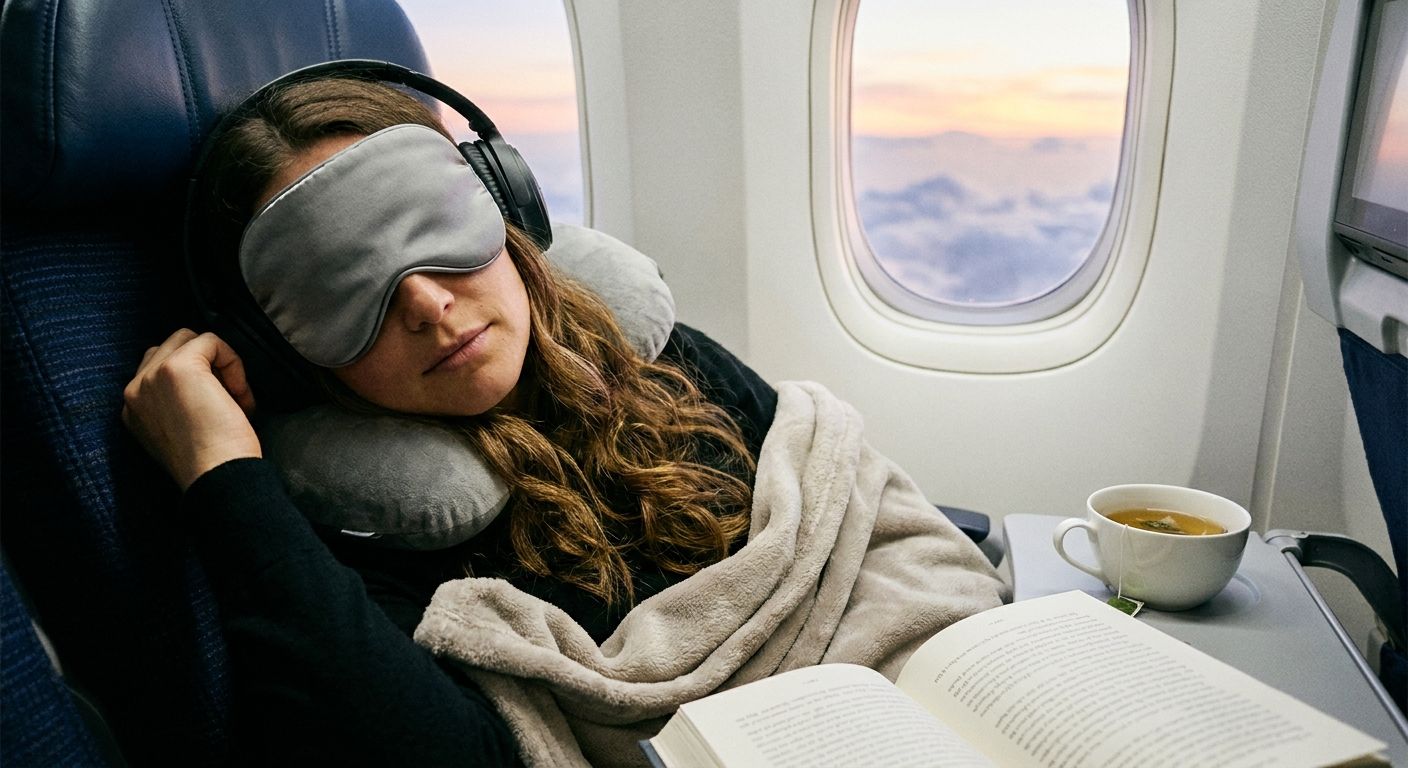
Frequent flyers need an eye mask for travel sleep that blocks 100% of cabin light, holds its shape through an eight-hour flight, and doesn't smear your makeup before landing. This segment sleeps on someone else's schedule, in a seat that reclines six inches if you're lucky, under lights that flick on for meal service at the worst possible moment. A generic sleep mask bought for home use rarely survives that environment.
- The best eye mask for travel sleep blocks cabin light fully and stays contoured so lashes never get crushed.
- Weighted eye masks add gentle pressure that calms pre-flight anxiety on red-eye flights in 2026.
- Pair your eye mask with a heated neck massager for travel to relax shoulders before landing.
- Skip flat foam masks on long-haul routes; they let light leak in at the nose bridge within hours.
Why eye mask for travel sleep matters for frequent flyers
Cabin humidity sits around 10-20% on most commercial flights, well below the 30-60% your body is used to on the ground, and that dryness alone makes it harder to fall and stay asleep. Add cabin lighting cycles that don't match your destination's time zone and you get a sleep environment actively working against you.
Frequent flyers search for eye mask for travel sleep far more than casual travelers because the problem repeats every trip: red-eye departures, meal service lights, seatback screens two rows over. A mask that solves this once needs to solve it every single flight, which is why fit and durability matter more here than for a mask used only at home.
Block cabin light before you set an alarm on sleep
Light is the single biggest disruptor of in-flight sleep, more than noise for most travelers. Before anything else, get the mask fit right.
- Check for a nose bridge gap by holding the mask up to a window
- Look for a contoured or molded shape rather than flat fabric
- Confirm the strap adjusts without digging into the back of your head
- Test it lying down, not standing, since fit changes with gravity
- Avoid masks with exposed seams that press into your eye socket when you turn on your side
Choose an eye mask shape that matches how you sleep
Side sleepers and back sleepers need different mask geometry, and this is where most travelers buy the wrong one. A flat mask that works fine for a back sleeper will get crushed and shift within an hour for someone who rolls onto their side.
- Contoured/molded masks for side sleepers who need eye-socket clearance
- Flat fabric masks for back sleepers who want minimal bulk
- Weighted masks for anyone who wants light pressure to calm pre-flight anxiety
- Cooling gel masks for red-eye flights where puffiness on arrival matters
- Masks with built-in headphones for travelers who also want white noise
Pair the mask with a full travel wind-down routine
An eye mask alone won't undo a stressed neck and shoulders from six hours in economy. Frequent flyers who sleep best on planes treat the mask as one piece of a short pre-sleep routine, not the whole solution.
- Dim your own seatback screen at least 20 minutes before you plan to sleep
- Do a two-minute shoulder and neck stretch before reclining
- Use a heated neck massager for travel to ease tension before you put the mask on
- Keep a compact routine so it fits in the seat pocket, not the overhead bin
- Skip caffeine for at least four hours before your planned sleep window
Time your mask use to the destination time zone
Jet lag responds to light exposure timing, and your eye mask is one of the few tools you control mid-flight. Put it on and take it off based on your destination's clock, not your departure city's.
- Calculate destination bedtime before boarding and set a phone reminder
- Put the mask on at that time even if cabin lights are still on
- Remove it 30-60 minutes before your destination's morning light hours
- Combine with a short walk in the aisle to reset your body clock
- Avoid removing the mask every time a flight attendant walks past
Protect your skin and makeup during long flights
Cabin air dries out skin fast, and a mask that rubs or slides adds friction on top of that. This matters more for frequent flyers doing back-to-back trips where skin never fully recovers between flights.
- Choose a mask with a smooth, non-abrasive lining against the skin
- Apply a light, non-greasy moisturizer before putting the mask on
- Avoid masks with rough elastic straps that snag hair
- Remove makeup before the flight rather than sleeping in it under a mask
- Pack a travel-size UV water bottle to stay hydrated through the flight, since dehydration shows up on skin faster in cabin air
Pack the mask so it survives the trip
A mask crushed flat in a suitcase loses its shape fast, and a contoured mask that's been sat on stops blocking light properly.
- Store it in a hard or semi-rigid pouch, not loose in a bag
- Keep it in your carry-on, never checked luggage
- Air it out between flights rather than sealing it in plastic
- Wash it on the schedule the fabric label recommends
- Replace it once the elastic loses tension, usually the first sign it's done
Beauty and wellness gadgets built for travel follow the same packing logic. Vital by Napio designs its travel gadgets, from the cordless hair straightener for travel to compact heated accessories, around the same carry-on-first constraint frequent flyers apply to an eye mask.
Combine with heat and other sensory cues for red-eye flights
Red-eyes are the hardest sleep environment frequent flyers face: departure late, arrival early, and a body clock that hasn't caught up. Sensory cues beyond light-blocking help signal sleep faster.
- Layer the eye mask with earplugs or noise-cancelling headphones
- Use a light neck wrap or scarf if the cabin runs cold
- Keep the same mask and routine every red-eye so your body recognizes the cue
- Avoid screens for the first 15 minutes after putting the mask on
- Set cabin crew expectations by mentioning you'd prefer not to be woken for the drink service
Types of travel eye masks compared
| Option | Best for | Key limitation |
|---|---|---|
| Contoured/molded mask | Side sleepers on long-haul | Bulkier to pack than flat masks |
| Flat fabric mask | Back sleepers, minimal packing space | Light leaks in at nose bridge over time |
| Weighted mask | Travelers with pre-flight anxiety | Can feel too warm on shorter flights |
| Cooling gel mask | Red-eye flights, reducing puffiness | Needs to be pre-chilled or activated before boarding |
| Mask with built-in headphones | Travelers who also want white noise | Adds bulk and a charging step to your routine |
Contoured masks win for side sleepers on red-eyes; flat masks win for back sleepers who pack light. There's no single best shape across every seating position.
Common mistakes frequent flyers make with eye masks
- Buying a mask sized for home use. Home masks aren't built for the pressure and heat of a reclined economy seat for eight-plus hours.
- Ignoring the nose bridge gap. This is the number one reason travelers say their mask "doesn't work" when the shape simply doesn't fit their face.
- Skipping a wind-down routine. Putting the mask on cold, straight after boarding, rarely produces real sleep; a short routine beforehand matters more than the mask itself.
- Packing it loose in a suitcase. A crushed mask loses its shape and stops blocking light within a few trips.
- Using destination time zone as an afterthought. Travelers who put the mask on by departure-city clock instead of destination clock make jet lag worse, not better.
FAQ
What's the best eye mask for travel sleep in 2026?
For most frequent flyers in 2026, a contoured or molded eye mask with a wide adjustable strap works best because it blocks light fully without pressing on the eyes during side-sleeping. Flat fabric masks work better for back sleepers who want minimal bulk.
Is a contoured eye mask better than a flat one for red-eye flights?
Contoured masks are generally better for red-eye flights because they hold shape against a reclined seat and don't get crushed when you turn onto your side. Flat masks are lighter to pack but tend to shift and let light in at the nose bridge over a long flight.
How much does a good travel eye mask cost?
Prices vary widely by material and design, so check current listings for the specific mask type you're considering rather than assuming one price point. Weighted and cooling gel masks typically sit at a higher price point than basic flat fabric masks.
Can an eye mask help with jet lag?
An eye mask helps manage jet lag when you time its use to your destination's day-night cycle rather than your departure city's clock. Light exposure timing is one of the main levers for resetting your body clock on long-haul travel.
Should I pair an eye mask with earplugs on flights?
Yes, pairing an eye mask with earplugs or noise-cancelling headphones blocks both major sleep disruptors on a flight: cabin light and engine or cabin noise. Most frequent flyers who sleep well on planes use both together, not one alone.
How do I stop an eye mask from smudging makeup during travel?
Remove makeup before your flight rather than sleeping under a mask with it on, since friction between the mask lining and makeup causes smudging and can irritate skin over a long flight. A smooth, non-abrasive mask lining reduces friction further.
Do weighted eye masks work for anxiety on flights?
Weighted eye masks use gentle, even pressure across the eyes and brow, a sensation some travelers find calming before and during flights, similar to how weighted blankets are used for anxiety on the ground. They can run warmer than lightweight masks, which matters on shorter or warmer flights.
How often should I wash a travel eye mask?
Follow the fabric care label on your specific mask, but frequent flyers using a mask on back-to-back trips should wash it more often than an occasional traveler would, since cabin air and skin oils build up fast. Airing it out between flights helps in between washes.
One last thing
The detail most travelers skip is the nose bridge gap, and it's the single biggest reason a mask that worked fine at home fails on a plane. Hold any mask up to a window before you buy it; if light comes through at the bridge of your nose, it will wake you up somewhere over the Pacific at 3am destination time. Frequent flyers who build a short pre-sleep routine around the mask, rather than treating it as a standalone fix, report better results across 2026's long-haul routes than those relying on the mask alone.