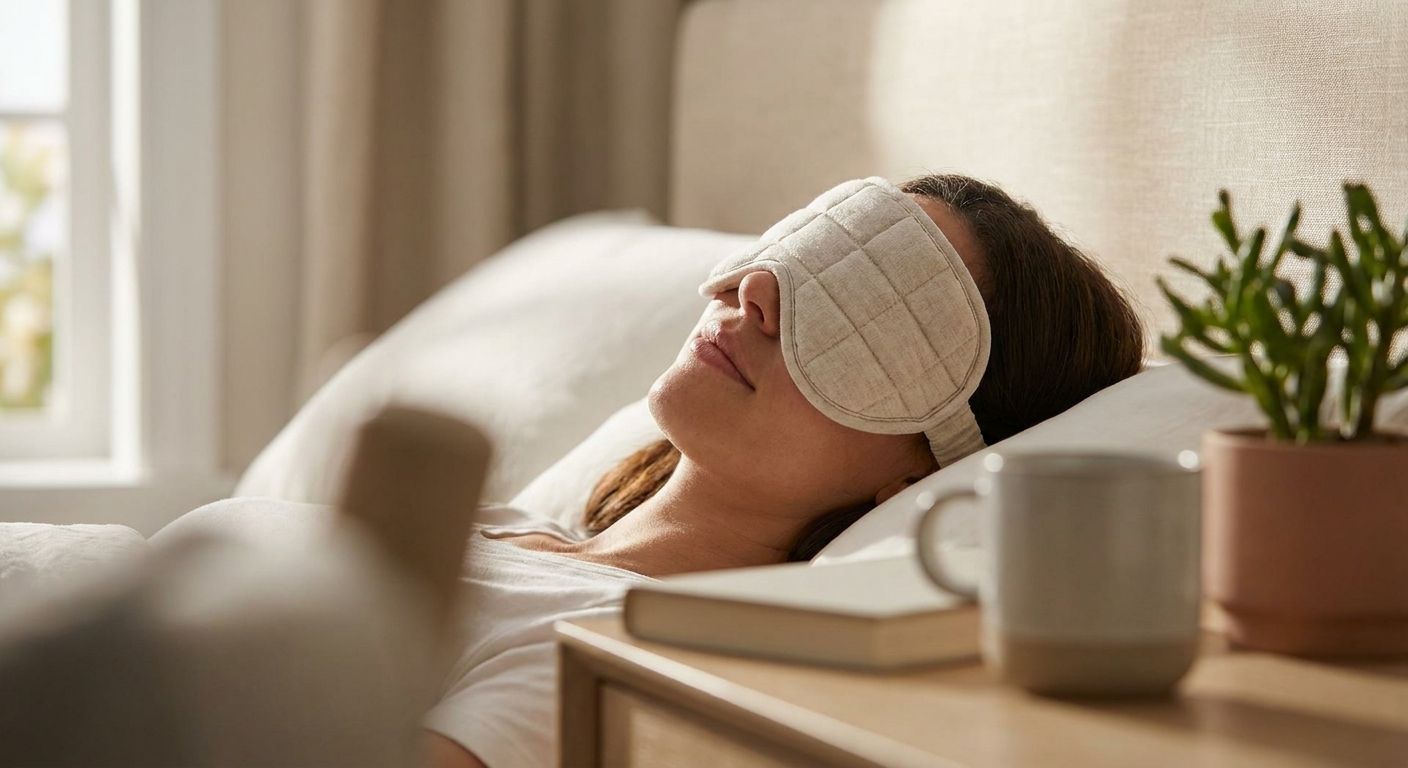
Weighted sleep masks for migraine sufferers combine total blackout with steady, even pressure across the eyes and temples, built to cut light-triggered pain and help you drop off faster mid-attack. This guide breaks down what actually works, what's marketing padding, and how to pair the mask with tools that address the neck tension driving a chunk of migraine attacks in the first place.
- A weighted sleep mask for migraines works through blackout plus 0.5-1.2 lb of even orbital pressure, not just fabric over your eyes.
- Buy a contoured, bead-filled mask with an adjustable strap - Best for nightly use and side sleepers.
- Skip heated combination masks if photophobia, not sinus pressure, drives your migraines - heat on closed eyes often worsens throbbing.
- Pair the mask with 15-20 minutes of neck heat therapy for tension-linked attacks; the mask alone can't touch shoulder and neck muscle tightness.
- Test any new mask during a normal nap first, never for the first time mid-migraine.
Why this matters for migraine sufferers
Migraine attacks run 4 to 72 hours untreated, and photophobia - light sensitivity - is one of the core diagnostic symptoms, not a side complaint. That's why total blackout, not "pretty dim," is the baseline requirement for anyone shopping this category in 2026. A mask that leaks light at the nose bridge or temple seams fails at the exact moment your eyes are most reactive.
Weighted sleep masks add a second mechanism on top of blackout: steady, even pressure across the orbital bone and brow. Some migraine sufferers report this pressure feels different from a flat fabric mask, though it won't touch the muscular tension in your neck and shoulders that triggers a large share of attacks. This segment isn't shopping for general sleep comfort - they're buying pre-emptively or mid-crisis, so fit and how fast they can grab the mask in a dark room matter more than color or print.
If neck tension is part of your pattern, a mask alone won't fix the trigger. Worth checking what Napio stocks for heat-based neck relief before assuming the mask is your only tool for an attack.
Block every source of light in your room first
Do this before you spend money on a mask - a light-tight room does half the job for free.
- Blackout curtains or a folded towel wedged across window gaps
- Cover LED lights on chargers, smoke detectors, and routers with tape
- Turn the phone screen face-down, not just to silent mode
- Close the door fully; hallway light under the gap still counts
- Test the room at night before you're mid-migraine, never during one
Choose the right weight and fill for your face
Most weighted sleep masks fill with glass beads or plastic micro-pellets and land between 0.5 lb (about 227g) and 1.2 lb (about 550g). Heavier isn't automatically better for migraines - too much weight concentrated on the orbital bone adds pressure exactly where the throbbing already sits.
- Start at the lighter end, 0.5-0.7 lb, if you've never used a weighted mask before
- Look for contoured eye cups so weight doesn't press directly on closed eyelids
- Get a fully adjustable strap, not just elastic - swelling changes head size mid-attack
- Avoid a hard nose bridge piece; it becomes a pressure point inside 10 minutes
- Prioritize a washable outer cover over a fixed, non-removable one
Time the mask to the first warning sign, not the peak
- Keep the mask in the same spot every night so you're not hunting for it during aura
- Put it on at the first flicker of aura or light sensitivity, before pain peaks
- Combine with a dark, quiet room within the first 15-20 minutes of onset
- Don't wait until the headache is unbearable before reaching for it
Pair pressure therapy with temperature therapy
A mask handles light and orbital pressure. It does nothing for the neck and shoulder tightness that triggers or worsens a large share of migraine attacks. Heat applied to the trapezius and base of the skull for 15-20 minutes works through a separate mechanism entirely - loosening the muscle tension a mask can't reach.
- Apply heat before the mask, not during, so you're not managing two devices in the dark
- Target the base of the skull and both shoulders, not just the front of the neck
- Keep heat sessions to 15-20 minutes; longer isn't more effective
- A heated neck massager built for tension headaches covers this without a hot towel setup
- Track whether heat, the mask, or both together actually shortens the attack
Test the mask before an attack hits
- Wear it for a normal nap first, not your worst migraine
- Check for slippage after 20 minutes of side-sleeping
- Confirm the strap doesn't dig in over a 2-hour stretch
- Note any pressure points around the temples the next morning
Clean and store the mask between uses
- Wash the removable cover weekly, more often if you sweat during attacks
- Wipe the inner shell with a damp cloth; never fully submerge a bead-filled mask
- Store it flat, not folded, so the fill stays distributed evenly
- Keep it in the same drawer or bedside spot every time, tied to the timing step above
Track what works across three migraine cycles
- Log time-to-relief with the mask alone versus mask plus heat therapy
- Note whether the weight helped or added pressure pain at the temples
- Track wash frequency against fill clumping inside the mask
- Revisit strap tension monthly - straps stretch with regular use
Weighted sleep mask options for migraine sufferers
| Option | Best for | Key limitation |
|---|---|---|
| Bead-filled weighted mask | Nightly use, side sleepers | Beads can shift unevenly after months of use |
| Gel-cooling weighted mask | Daytime migraines, heat-triggered attacks | Cooling effect fades after 20-30 minutes |
| Heated combination mask | Sinus-linked head pain, not photophobia-led migraine | Adds heat to the eyes, which some migraine sufferers find worsens throbbing |
| Contoured ear-pocket mask | Side sleepers needing a full blackout seal | Bulkier, less packable for travel |
Bead-filled contoured masks win for most migraine sufferers - they hold blackout and pressure without adding heat to a symptom heat can worsen. Buy. Heated combination masks are a Skip for classic migraine with photophobia; they're built for sinus pressure, a different condition entirely.
Common mistakes migraine sufferers make with weighted sleep masks
- Buying the heaviest mask available, assuming more pressure means more relief - it adds pain at the temples instead.
- Treating the mask as the only tool, ignoring the neck and shoulder tension a mask can't touch. Heat therapy for neck pain works through a separate mechanism and closes that gap.
- Skipping the test-run and reaching for a brand-new mask mid-attack, when unfamiliar strap tension becomes its own irritant.
- Never washing the mask, letting oil and product buildup reduce the light seal within weeks.
- Choosing a mask with a hard nose bridge for "extra blackout," which becomes the first thing that hurts once a migraine sets in.
FAQ
What's the best weighted sleep mask for migraines?
A contoured, bead-filled mask in the 0.5-0.7 lb range with a fully adjustable strap works best for most migraine sufferers in 2026. Avoid hard nose bridges and heated versions if photophobia, not sinus pressure, is your main symptom.
Is a weighted sleep mask better than a regular eye mask for migraines?
A weighted mask adds even pressure across the orbital bone on top of blackout, which some migraine sufferers find helps with throbbing. A regular mask only blocks light, so it's a downgrade if pressure relief matters to you.
How much weight should a migraine sleep mask have?
Most weighted masks run 0.5 to 1.2 lb (roughly 227g to 550g). Start at the lighter end if you've never used one, since too much weight on the orbital bone can add pain rather than relieve it.
Can a weighted sleep mask replace migraine medication?
No. A weighted sleep mask manages light sensitivity and adds orbital pressure; it does not address the underlying neurological mechanism of a migraine. Treat it as a comfort tool alongside whatever your medical plan already includes.
How long can I wear a weighted sleep mask during an attack?
Most masks are rated for overnight wear, but check for slippage or strap dig-in after 2 hours during your first test run. If temples feel sore after 20 minutes, the mask is too heavy or too tight for your face.
Do weighted sleep masks help with light sensitivity?
Yes, provided the mask achieves a full blackout seal at the nose bridge and temples. A mask that lets in light around the edges gives no photophobia benefit regardless of weight.
Should I combine a weighted mask with heat therapy?
Combine them if neck or shoulder tension is part of your migraine pattern. Apply 15-20 minutes of heat to the trapezius and base of the skull before the mask, since the two tools address separate triggers.
How do I clean a weighted sleep mask?
Wash the removable cover weekly and wipe the inner shell with a damp cloth. Never submerge a bead-filled mask in water - it ruins the fill distribution and the seal quality.
One last thing
The masks that get returned most aren't too light - they're too heavy in the wrong spot. A 1.2 lb mask with weight distributed evenly across the whole eye area feels lighter in practice than a 0.7 lb mask that concentrates its weight on a hard nose bridge. Buying in 2026, check the fill distribution before the total weight number on the box - it tells you more about whether the mask survives an actual migraine attack than the number alone.