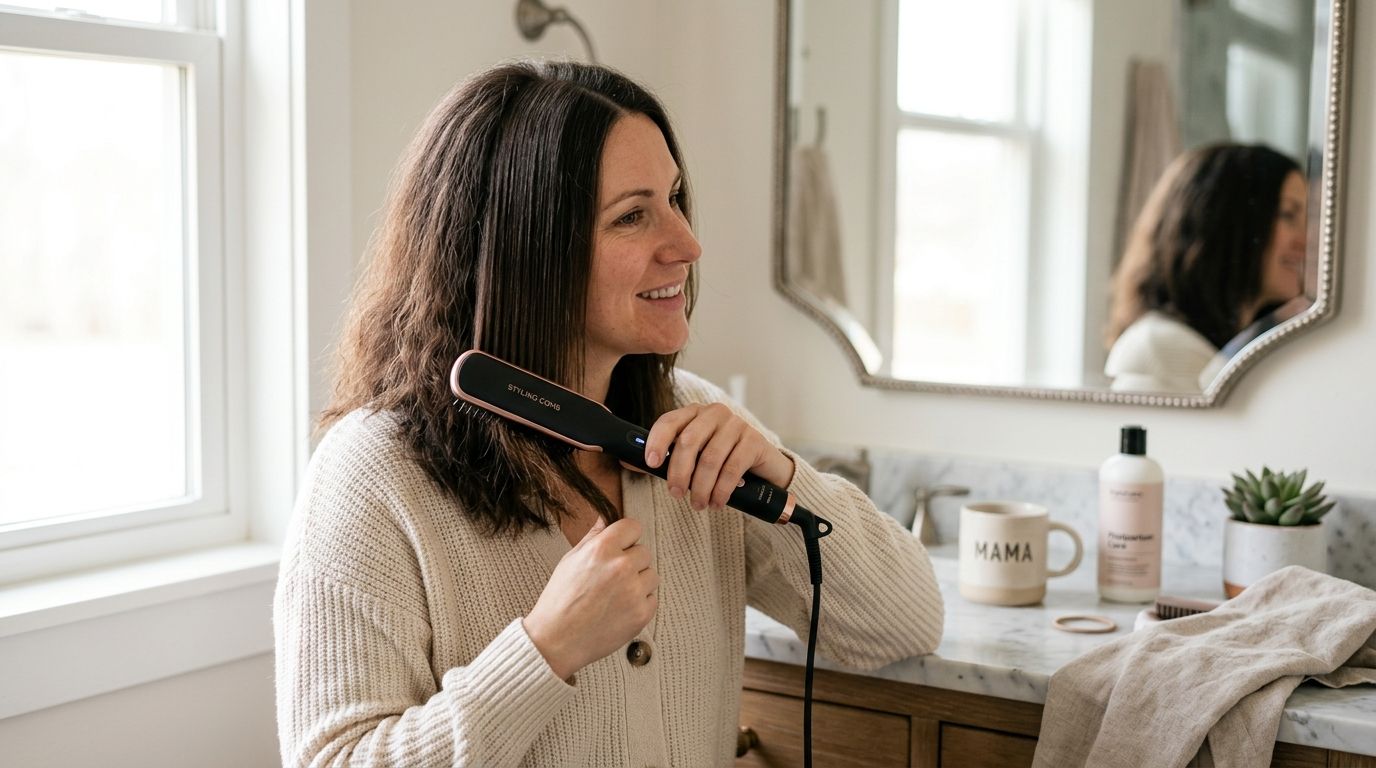

Hot comb for locs and twist maintenance is a heat styling routine that smooths new growth, knocks down frizz along each parting, and sets edges without pulling the twist pattern apart underneath. Locs and twists hold their shape differently than loose natural hair, so the heat, the angle, and the timing all need to change to protect the base of the style rather than just the strand.
- A hot comb for locs works best at 150-180degC on retwist day, never on soaking-wet hair.
- Vital by Napio's electric hair straightening comb heats in under 60 seconds and skips the stove-and-stand routine.
- Sectioning before you apply heat is the single biggest factor in even results across twists.
- Ceramic plates cause less friction on loc bases than metal-tooth stove combs.
- Space retouch sessions 10-14 days apart to stop heat build-up at the root.
Why hot combs matter for locs and twist maintenance
Locs and twists trap moisture and product buildup at the base far more than loose hair does, which means the same heat setting that smooths a straight section can scorch a loc root if it sits there too long. New growth is also coarser and more resistant than the rest of the loc, so it needs enough heat to lay flat without scorching the fragile point where the loc meets the scalp.
The Vital by Napio electric hair straightening comb is built around adjustable heat and a comb-tooth pass rather than a flat plate clamp, which matters for locs because you're smoothing frizz and edges, not flattening the whole strand. A hot comb for locs is a maintenance tool, not a restyling tool, and treating it that way is what keeps loc integrity intact through 2026 and beyond.
How to hot comb locs and twists without frying your roots
Section your locs or twists before you touch heat
Working loc by loc with no plan is how you end up hitting the same section three times and the rest not at all.
- Split hair into four quadrants with clips before you start
- Work one row at a time, front to back
- Keep unclipped sections twisted or banded so they don't dry out mid-session
- Set a timer per quadrant so no single area gets overheated from repeat passes
Detangle and cleanse the scalp first
Heat on top of buildup just bakes product residue into the loc instead of smoothing it out.
- Clarify with a residue-free shampoo before any heat session
- Blot hair to 80% dry, never bone dry and never dripping
- Loosen any shed hair or debris at the root with your fingers
- Apply a lightweight heat protectant along new growth only
Set the right temperature for your hair type
Coarse, tightly coiled new growth needs more heat than the rest of a mature loc, and guessing at the dial is how roots get damaged.
- Fine or color-treated new growth: 130-150degC
- Medium-coarse natural texture: 150-170degC
- Coarse, wiry regrowth: 170-185degC
- Check the full breakdown on how to pick the right hot comb temperature for your hair type before your next retwist
- A cordless model with digital temperature display removes the guesswork stove combs can't offer
Smooth new growth with slow, single passes
Repeated passes over the same spot are the fastest way to weaken a loc at the root.
- One slow pass per section, roughly 3-4 seconds of contact
- Comb from root to about an inch past the scalp, not the full loc length
- Never double back over a section that's already smooth
- Let the comb do the work; don't press down harder to compensate for low heat
Seal edges and baby hairs last
Edges and fine hairline hair are thinner than the rest of the head and burn faster.
- Drop the temperature 15-20degC lower than the rest of the session
- Use the narrow comb teeth, not the wide-tooth side, for hairline precision
- Work in short, half-second passes only
- Finish with a light-hold edge product, applied cool
Cool down before you re-twist
Re-twisting hot hair locks in tension at a stage when the strand is still soft and more prone to snapping.
- Let each section air-cool for 60-90 seconds before palm-rolling or twisting
- Avoid clipping hot sections flat against the scalp
- Check that the comb has fully cooled before storage, and see how to clean a heated hair straightening comb so buildup doesn't transfer heat unevenly next time
Space out your sessions to protect the loc
Daily or every-other-day heat on the same roots is the number one cause of thinning at the base in loc wearers.
- Retouch new growth every 10-14 days, not more often
- Alternate a heat-free retwist (just gel or cream) between heat sessions
- Track session dates so you're not guessing at frequency
- Give any section showing thinning or dryness a full month off heat
Comparison: hot comb options for locs and twists in 2026
| Option | Best for | Key limitation |
|---|---|---|
| Stove-heated metal hot comb | Traditionalists comfortable with open-flame heating | No temperature control, easy to overheat roots |
| Electric ceramic hot comb (Vital by Napio) | Regular retouch maintenance without a stove | Requires charging or plug access before each session |
| Flat-iron straightening brush | Silk press on loose sections, not loc roots | Not built for narrow loc partings or edge work |
| Salon-only heat retouch | Locs needing shaping alongside color or trims | Costs add up with 10-14 day retouch cycles |
Verdict: an electric ceramic hot comb wins for regular loc and twist maintenance because it holds a steady, adjustable temperature that a stove comb can't match. Salon retouches still make sense for shaping or color work layered on top of routine maintenance.
Common mistakes locs and twists wearers make with a hot comb
- Combing wet or dripping hair. Steam builds under pressure and can cause more scalp irritation than dry heat alone.
- Using the same temperature on new growth and mature loc. Mature loc sections handle heat differently and don't need the higher setting new growth requires.
- Skipping the cool-down before re-twisting. This is the single most common cause of breakage reported anecdotally by loc wearers who retouch too aggressively.
- Ignoring buildup at the root. Product residue combined with heat is what causes the burnt-hair smell people mistake for scalp damage.
- Retouching more than once a week. Frequent heat at the same root point is the fastest route to thinning, regardless of comb quality.
FAQ
Is a hot comb safe for locs?
Yes, a hot comb is safe for locs when used at 150-180degC on partially dry hair, spaced 10-14 days apart. Daily use or full-wet application is what causes root damage, not the tool itself.
How often should you hot comb locs?
Retouch new growth every 10-14 days at most. More frequent heat at the same root point is the leading cause of thinning reported by loc wearers.
What temperature should a hot comb be for natural hair?
Coarse natural new growth typically needs 170-185degC, while finer or color-treated hair does better at 130-150degC. Check the full temperature-by-texture guide for your specific hair type.
Can you use a hot comb on wet twists?
No, hair should be blotted to roughly 80% dry before any heat pass. Fully wet hair traps steam against the scalp and increases the risk of burns.
Is an electric hot comb better than a stove hot comb for locs?
An electric ceramic hot comb holds a consistent, adjustable temperature that a stove comb cannot replicate, which matters more for locs than for loose hair because loc roots are more heat-sensitive. Stove combs still work but carry a higher risk of overheating.
Will a hot comb loosen my twist pattern?
A hot comb smooths frizz and new growth without unraveling the twist itself when passes stay short and controlled. Pressing too hard or repeating passes over the same section is what causes the twist to loosen.
How do you stop a hot comb from burning your edges?
Drop the temperature 15-20degC lower for edges than the rest of the head and use short, half-second passes with the narrow comb teeth. Edge hair is thinner and burns faster than the rest of the head.
Do you need heat protectant before using a hot comb on locs?
Yes, a lightweight heat protectant applied to new growth only reduces heat stress at the point locs are most vulnerable. It is not needed along the mature loc length itself.
One last thing
Most heat damage reported by loc wearers doesn't happen at the loc itself, it happens in the first inch of new growth closest to the scalp, exactly where people apply the most pressure trying to get regrowth to lay flat. Ease off the pressure there before you increase the temperature.