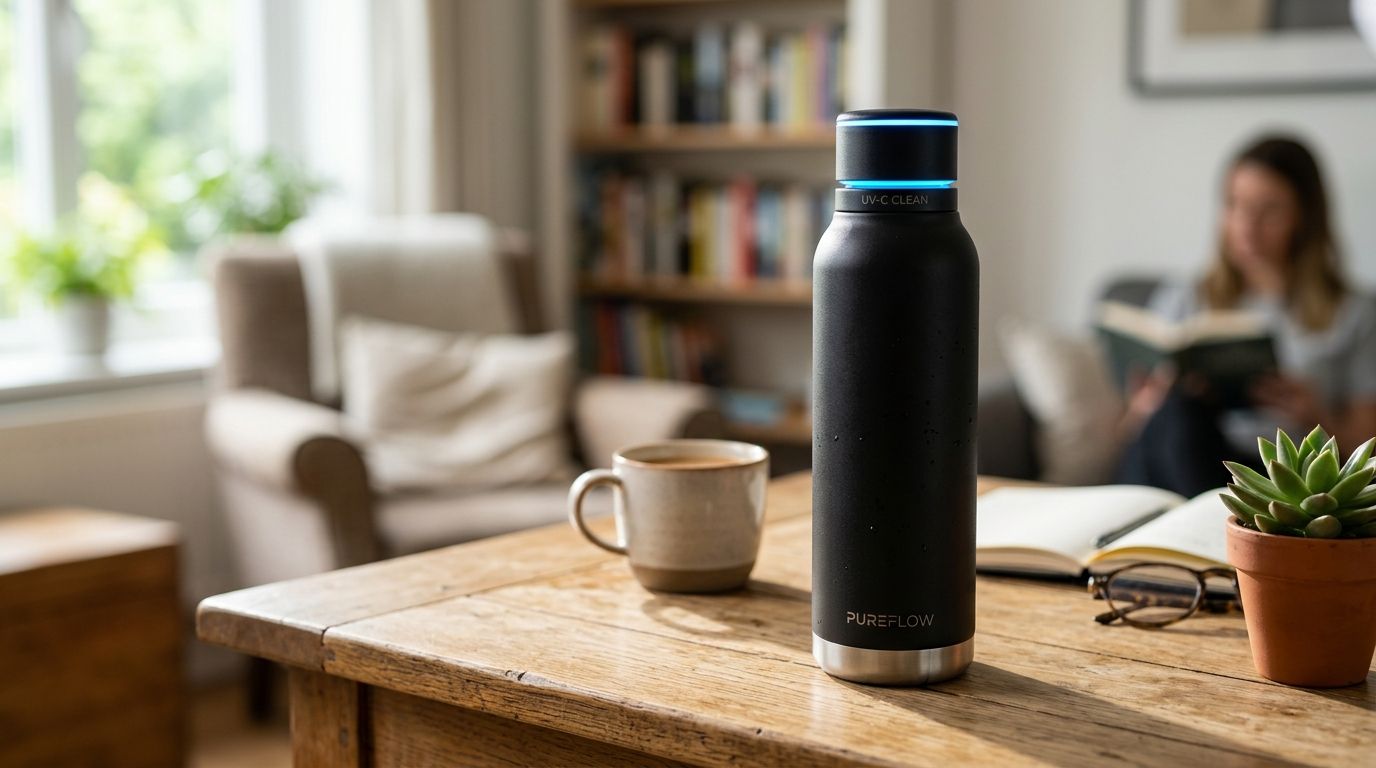
The best self-cleaning water bottle for eliminating odour in 2026 isn't the one with the most features — it's the one whose UV-C cycle matches how often you actually refill and rinse it. Best overall: a UV-C LED self-cleaning bottle you run once a day at home. Best for travel: a compact UV-C bottle slim enough for a seat pocket. Best budget option: a single-button UV-C bottle built for the office desk with no separate charging dock.
- UV-C LED self-cleaning bottles use light near 254 nanometers to break down odour-causing bacteria, not fragrance or extra scrubbing.
- The daily-use UV-C bottle is the best self-cleaning water bottle for eliminating odour in 2026 because its cycle runs automatically every 4 to 6 hours.
- Travel, gym, kids, office and outdoor use each need a different self-cleaning bottle design — there's no single best option for every situation.
- UV-C sterilises the water and bottle walls but doesn't purify untreated trail water — pair it with a filter on unclear sources.
Why this matters
A water bottle left half-full at room temperature turns into a bacteria culture within about 24 hours — that's what produces the sour, metallic smell you notice by the second or third refill, not the plastic itself. Dish soap and a bottle brush only reach surfaces you can physically touch; the threads under the lid and the inside of a straw stay wet and untouched between washes.
UV-C light at a wavelength near 254 nanometers breaks down bacterial DNA on contact, which is why a bottle built around a UV-C LED knocks out odour that a manual wash misses. Not every "self-cleaning" bottle sold in 2026 actually uses UV-C — some rely on a scented cap that masks smell instead of killing what's causing it. Napio's breakdown of how a UV-C self-cleaning water bottle actually works covers the mechanism in more detail before you buy.
What makes the best self-cleaning water bottle
- UV-C cycle coverage — does the light actually reach the lid threads and the straw, or just the main chamber
- Cycle length and frequency — a bottle that cleans itself every few hours beats one you have to remember to trigger
- Charging setup — magnetic dock vs USB-C cable changes how likely you are to keep using it
- Mouth width and material — a wide mouth lets you hand-wash between UV cycles for a genuine deep clean
- Fit for the use case — a gym bottle and a kids' bottle solve different problems even with the same core tech
- Honesty about limits — UV-C kills bacteria, it doesn't filter sediment or chemicals from untreated water
At a glance: self-cleaning water bottles ranked by use case
| Type | Best for | Standout feature | Key limitation |
|---|---|---|---|
| UV-C LED bottle, daily use | Home and office refills | Full lid and straw exposure every cycle | Needs a charging dock nearby every few days |
| Compact UV-C travel bottle | Flights, hotels, unfamiliar water | Slim profile fits carry-on pockets | Smaller reservoir means more refills per day |
| UV-C bottle for the gym | Post-workout shake residue | Wide mouth handles ice and powder | Heavier once filled, no hands-free strap |
| UV-C bottle for kids | School lunchboxes, family use | Single-button cycle a child can run | Smaller capacity than adult bottles |
| UV-C bottle for office desks | Forgetting to wash for days | Auto-timer runs without input | Charging cable easily left behind |
| UV-C bottle for hiking | Trail refills from taps or huts | Rugged casing rated for drops | Doesn't filter untreated backcountry water |
1. UV-C LED self-cleaning bottle: best for daily use
A UV-C LED sits in the lid and fires a short cleaning cycle every few hours, whether you've just refilled or the bottle's been sitting on your desk since lunch. It's built for the exact pattern — the same bottle in rotation for weeks — that grows odour-causing bacteria fastest. Napio's guide to the best self-cleaning water bottle for daily use walks through setup.
Daily-use bottle pros:
- Cycle runs on its own, no daily hygiene routine required
- Reaches lid threads and the collar a bottle brush can't touch
- Rechargeable battery typically covers several days between charges
Daily-use bottle cons:
- Charging dock takes up counter space
- Won't fix odour from a straw that's already cracked or worn
Best for: anyone refilling the same bottle daily at home or a desk. Verdict: Buy.
2. Compact UV-C self-cleaning bottle: best for travel
A slimmer UV-C bottle trades reservoir size for a profile that fits an airport seat pocket or a hotel nightstand. The cleaning cycle matters more on the road, since travel means refilling from water sources you didn't choose. See Napio's best UV water bottle for travel picks for a closer look.
Travel bottle pros:
- Slim enough for carry-on pockets and cup holders
- Quick single-button cycle you can run at a gate
- Handles unfamiliar tap water between refills
Travel bottle cons:
- Smaller reservoir means more refills across a travel day
- Battery drains faster with more cycles run per day
Best for: flights, hotel stays, and unfamiliar water sources. Verdict: Buy.
3. UV-C self-cleaning bottle for the gym: best for post-workout odour
Protein powder and electrolyte residue cling to bottle walls harder than plain water does, which is why gym-specific self-cleaning bottles run a stronger cycle and pair it with a wide mouth for ice and powder. A self-cleaning water bottle for the gym is built around that residue problem specifically.
Gym bottle pros:
- Wide mouth handles ice, powder scoops, and quick rinses
- Stronger cycle tuned for shake and electrolyte residue
- Cuts down on the smell that builds up in a closed gym bag overnight
Gym bottle cons:
- Heavier once filled than a standard sports bottle
- Most models skip a hands-free carry strap
Best for: daily gym bags and post-workout shakes. Verdict: Buy.
4. UV-C self-cleaning bottle for kids: best for school and family use
Kids' self-cleaning bottles simplify the cycle to one button and shrink the capacity to lunchbox size. The tech is the same UV-C principle, scaled down and made harder to break.
Kids' bottle pros:
- One-button cycle simple enough for a child to run
- Lighter shell than adult UV-C bottles
- Capacity fits standard lunchboxes
Kids' bottle cons:
- Shorter battery life given the smaller internal components
- An adult still needs to confirm the cycle actually ran
Best for: school lunchboxes and shared family use. Verdict: Hold — solid for supervised use, but younger kids need a parent checking the cycle daily.
5. UV-C self-cleaning bottle for office desks: best budget option
The office-desk version strips the tech down to an auto-timer with no app and no separate charging routine to think about — it just runs. That simplicity is what makes it the most accessible entry point into self-cleaning bottles in 2026.
Office bottle pros:
- Simplest cycle of the category, nothing to configure
- Auto-timer runs without you pressing anything
- Easy to leave at a shared or hot desk
Office bottle cons:
- Relies on remembering the charging cable if you move desks
- Less durable if knocked off a desk repeatedly
Best for: people who forget to wash a bottle for days at a time. Verdict: Buy.
6. UV-C self-cleaning bottle for hiking and outdoors: best for trail use
Outdoor self-cleaning bottles trade sleekness for a rugged casing rated to survive drops and rough handling in a pack. The cycle still targets bacteria, which matters when you're refilling from taps or hut water rather than sealed bottles.
Hiking bottle pros:
- Casing built to survive drops and pack abrasion
- Cycle handles bacteria from taps and treated trail sources
- Tougher seals resist leaking under pack pressure
Hiking bottle cons:
- Doesn't filter sediment or chemical contaminants from untreated water
- Rugged shell adds pack weight over a standard bottle
Best for: trail refills from treated or tap sources. Verdict: Buy with a filter as backup on unclear water sources.
How we ranked
Each type was scored against the six criteria above: UV-C coverage, cycle frequency, charging setup, mouth width, use-case fit, and honesty about what UV-C can't do. No two entries share a "best for" slot on purpose — the daily-use bottle and the travel bottle solve different problems even though the core tech is identical.
“If a self-cleaning cycle takes longer than 90 seconds, the UV-C lamp inside is too weak to matter.”
Which self-cleaning water bottle should you choose?
If you're not sure which use case applies, default to the UV-C LED daily-use bottle — it covers the most common pattern (one bottle, refilled repeatedly, sitting around for hours between drinks) better than any of the specialised versions. Swap to the travel or gym version only once you've identified a specific gap the daily bottle doesn't cover. Napio treats the self-cleaning water bottle category the same way it treats its other wellness gadgets in 2026: match the tool to the actual routine, not the other way around.
FAQ
What is the best self-cleaning water bottle for eliminating odour in 2026?
A UV-C LED bottle that runs its cleaning cycle automatically every 4 to 6 hours wins overall for eliminating odour in 2026, because it targets the bacteria buildup that causes smell rather than masking it with scent.
How does a self-cleaning water bottle remove odour?
UV-C light at a wavelength near 254 nanometers breaks down bacterial DNA inside the bottle and lid, which removes the source of the smell instead of covering it with fragrance.
Is a UV-C self-cleaning bottle better than washing a normal bottle by hand?
UV-C reaches the lid threads and straw interior that a bottle brush physically can't touch, so it catches odour sources hand-washing misses, though hand-washing is still useful for visible residue.
How often do you need to run a self-cleaning cycle?
Most UV-C self-cleaning bottles are designed to run every 4 to 6 hours automatically, so odour never has time to build up between refills.
Can a self-cleaning water bottle replace a water filter?
No — UV-C kills bacteria but doesn't remove sediment or chemical contaminants, so on untreated trail or backcountry water you still need a filter alongside a self-cleaning bottle.
Are self-cleaning water bottles safe for kids?
Yes, kids' versions use the same UV-C principle scaled to a single-button cycle and a smaller shell, though an adult should confirm the cycle actually ran each day.
How long does a UV-C self-cleaning bottle's battery last?
Battery life varies by model and how many cycles run per day, with daily-use bottles typically covering several days between charges under normal use.
Do self-cleaning bottles work with stainless steel bodies, not just plastic?
Yes, the UV-C mechanism sits in the lid and works independently of the bottle body material, so stainless steel and plastic versions both benefit from the same cleaning cycle.
One last thing
The smell people blame on the bottle usually lives in the straw or spout gasket, not the main chamber — the part most self-cleaning bottles' UV-C light reaches least effectively. Twist off and rinse the straw separately once a week even with a UV-C bottle running daily; skipping that one step is the most common reason a "self-cleaning" bottle still smells off in 2026.