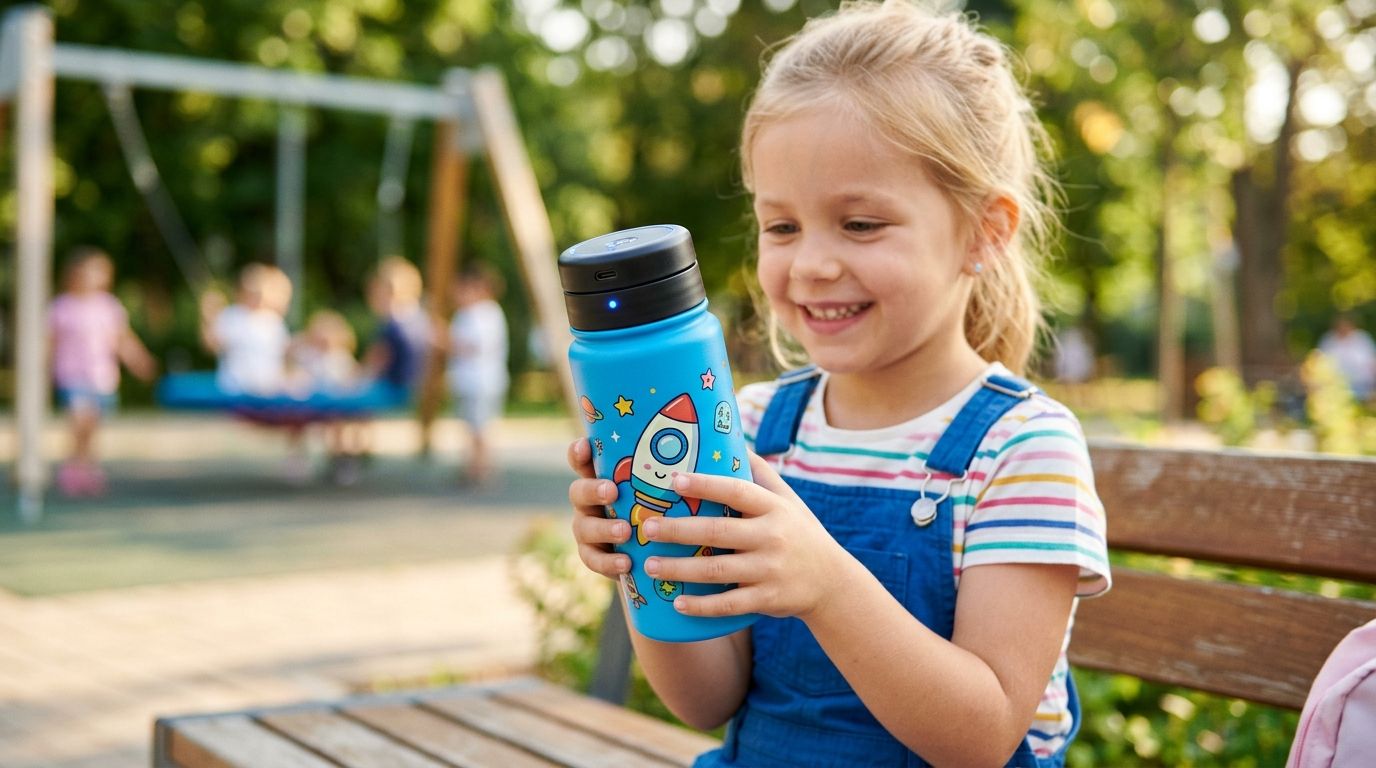
Kids' UV-C self-cleaning water bottles use short bursts of ultraviolet light to break down bacteria and biofilm inside the bottle, which means fewer scrubbing sessions and less mould creeping up the straw. A kid's bottle spends its life in a backpack for a full school day, gets dropped on concrete, and gets shared for "just one sip" with a friend — so the cleaning system has to survive rougher handling than an adult's desk bottle ever sees.
- A UV-C self-cleaning water bottle for kids uses the same 254-280 nanometer germicidal light band as adult models, in a smaller one-button format.
- Vital by Napio's guide on using a UV self-cleaning water bottle explains the cycle in steps a school-age child can follow.
- Manual rinsing still matters in 2026 — UV-C handles the water chamber, not the lid threads or straw exterior.
- Best for parents packing lunches 5 days a week who don't want to hand-wash bottles every night.
Why this matters for kids
A kid's bottle isn't treated gently. It rolls around the bottom of a backpack next to a half-eaten sandwich, sits capped through a 6-8 hour school day, and often gets refilled from a shared bubbler. That combination — warmth, moisture, infrequent washing — is exactly the environment bacteria and mould need inside a narrow bottle neck no toothbrush can reach.
UV-C light in the germicidal range (roughly 254-280 nanometers) damages the DNA of bacteria so they can't reproduce, which is why water treatment plants have used the same wavelength band for decades. A UV-C self-cleaning water bottle for kids brings that principle down to a size a seven-year-old can hold one-handed and operate with one button, instead of a chemical tablet or a scrub brush an adult has to manage every night.
The honest answer for most families: a UV-C bottle for kids is worth it if hand-washing keeps slipping down the priority list, and skippable if you already run bottles through the dishwasher every night. Read the mechanism in this breakdown of how UV-C self-cleaning bottles kill bacteria before deciding.
Set up the daily routine
Rinse it by hand first, every day
Before any UV-C cycle, the manual step still matters — light treats what's in the water, it doesn't scrub what's stuck to the walls.
- Rinse with warm water and a drop of dish soap each evening
- Use a bottle brush on the neck and base once a week
- Air-dry upside down overnight with the cap off
- Check the seal for cracks or discolouration monthly
Run the UV-C cycle after every refill
This is where the technology earns its keep — a single button press replaces the nightly scrub.
- Fill with clean tap or filtered water first
- Press the cycle button and wait for the cycle to finish
- Confirm the indicator light change before handing it back to the child
- Re-run the cycle if the bottle sat unused for more than a day
The step-by-step guide to using a UV self-cleaning water bottle walks through the button sequence in a format simple enough to print and stick on the fridge for younger kids.
Teach the child the one-button routine
Kids follow habits faster than instructions, so attach the cycle to an existing habit instead of adding a new one.
- Pair the button press with packing the school bag
- Put a coloured sticker on the button so younger kids find it fast
- Practise at home for a week before school starts
- Skip bottles that need a long button hold — smaller hands fatigue faster
Choose the right size and material for the child's age
A bottle built for an adult's grip and an adult's daily water intake is the wrong fit for a six-year-old.
- Pick a smaller capacity sized for small hands over a full-size adult bottle
- Confirm the material is BPA-free plastic or stainless steel, not a coated finish that chips
- Look for a straw or spout a young child can seal their lips around without spilling
- Avoid fiddly multi-part lids that get lost at school
Pack it for school, sport, and camp
The bottle's job changes depending on where it goes, and the cleaning routine has to travel with it.
- Run a cycle before school pickup, not only at bedtime
- Pack a spare cap or straw for sports days
- For weekend hikes or school camp, check the UV-C water bottle guide for hiking and outdoors for refill etiquette at taps and streams
- Keep a backup manual-clean bottle for camp days with no power access
Deep-clean the cap and straw weekly
UV-C treats the water chamber; it doesn't reach the outside of the straw or the underside of the cap where lips touch.
- Soak the straw in warm soapy water once a week
- Wipe the cap threads with a cotton bud dipped in vinegar solution
- Replace the straw or spout when it discolours or the child chews through it
- Treat a lingering odour after cleaning as a spot the wash missed
Keep it charged on a schedule
A UV-C bottle with a flat battery is just an expensive normal bottle, so charging is a parent task, not a kid task.
- Charge on Sunday night as part of weekly school prep
- Keep the charging cable in one fixed spot, not loose in a drawer
- Check the battery indicator before the school week starts
- Rotate in a backup bottle on charging night
Comparing the cleaning options for kids' bottles
| Option | Best for | Key limitation |
|---|---|---|
| Hand wash and brush nightly | Families with an existing dishwashing routine | Needs parent effort every night, easy to skip |
| Dishwasher-safe bottle | Households running the dishwasher daily anyway | Doesn't reach inside a narrow straw well |
| Chemical cleaning tablets | Occasional deep clean, not daily use | Residue taste, less suitable for young kids |
| UV-C self-cleaning bottle for kids | Parents packing lunches 5 days a week who want a one-button routine | Still needs a weekly manual clean of cap and straw, plus charging |
For families weighing a UV-C bottle against other daily-use formats, this comparison of the best self-cleaning water bottle for daily use covers which suits an adult desk routine versus a kid's school bag.
Common mistakes parents make
- Buying an adult-size bottle and expecting a kid to manage the button. Smaller hands need a lighter press and an obvious indicator light.
- Skipping the weekly straw soak because the UV-C cycle feels like it covers everything. It doesn't reach the straw exterior.
- Forgetting to charge before Monday and sending the child to school with a bottle that can't run its cycle.
- Ignoring the odour test. A bottle that smells off after a cycle has a build-up problem light alone won't fix.
- Choosing style over grip size. A bottle a child can't hold one-handed comes home half-full every day.
FAQ
Is a UV-C self-cleaning water bottle safe for kids to use themselves?
Yes, UV-C bottles for kids run the light inside a sealed chamber, so a child pressing the button is not exposed to the light. Supervise the first week to build the habit correctly.
How often should a kid's UV-C bottle run its cleaning cycle?
Run the cycle after every refill, which for a school-age child usually means once or twice a day. A bottle left unused overnight should get a fresh cycle before the next fill.
Does UV-C clean the straw and cap too?
No, UV-C light treats the water inside the main chamber, not the straw exterior or the cap threads. Those need a manual wash with warm soapy water at least once a week.
Is UV-C self-cleaning better than a dishwasher for kids' bottles?
UV-C is faster for daily use because it runs in seconds without a full wash cycle, but a dishwasher reaches surfaces the light cannot touch. Many families use both: dishwasher weekly, UV-C daily.
What age is right for a UV-C self-cleaning bottle?
Single-button UV-C bottles suit kids from around age 5 once they can manage a press-and-wait routine. Younger children usually still need a parent to run the cycle.
Can a UV-C water bottle go to school camp or through airport security?
An empty bottle passes screening the same as any water bottle, and the electronics fit a standard backpack. Check the camp packing list for device restrictions before departure.
Does the UV-C light damage the bottle over time?
No, germicidal UV-C affects bacterial DNA, not stainless steel or BPA-free plastic. Wear on a kid's bottle in 2026 comes from drops and scratches, not the light cycle.
One last thing
The part parents overlook most: the UV-C cycle only ever treats the water sitting in the chamber at the moment you press the button. A bottle refilled from a shared school bubbler picks up new bacteria the second the cap comes off again, so the habit that matters in 2026 isn't buying the bottle — it's running the cycle after every refill, not just once at bedtime.