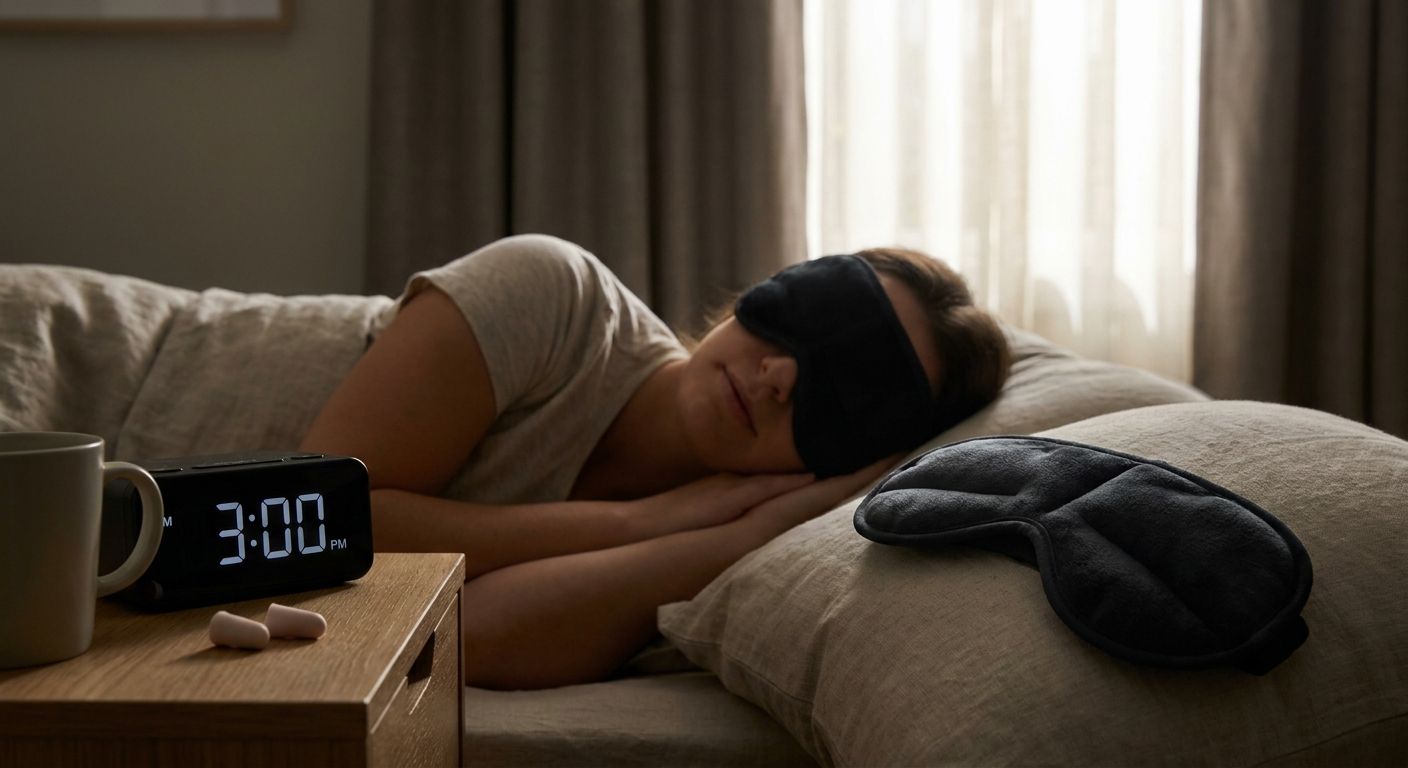
Blackout eye mask for shift workers is a contoured, light-blocking sleep mask built to help night-shift and rotating-shift employees fall asleep during daylight hours by cutting the light signals that keep the body's internal clock stuck on alert. Shift workers sleep against biology, not with it, and a bedroom that looks dark to the eye is often still bright enough to suppress melatonin and cut sleep short.
- A contoured blackout eye mask for shift workers blocks 100% of light at the eye socket, not just dims it.
- Weighted masks add gentle pressure that helps shift workers stay asleep through daylight noise and interruptions.
- Room blackout curtains alone rarely work for shift sleep; pairing them with a mask closes the remaining light gaps.
- Napio's weighted sleep mask for migraines and eye mask for travel sleep both suit rotating-shift schedules in 2026.
Why blackout eye masks matter for shift workers
Shift work forces sleep into hours the body was never built for. Daylight leaking through blinds, hallway light under a bedroom door, or a phone screen across the room is enough to signal "stay awake" to the brain, even with eyes closed.
A standard sleep mask that sits flat against the face often gapes at the nose bridge and temples, letting light in exactly where it matters most. Shift workers searching for a blackout eye mask are usually past the point of tolerating a mask that half-works — they need one that seals.
Step-by-step: choosing and using a blackout eye mask on shift
Block every light gap around your eyes
A mask that blacks out the room but not your eye sockets isn't doing its job. Check for these before buying:
- Contoured cups that sit off the eyelids instead of pressing flat against them
- A nose bridge seal that closes without pinching
- Adjustable straps that sit above the ears, not across them
- No stitched seams directly over the eye line where light can sneak through
Choose contoured over flat fabric
Flat fabric masks are cheap but they crush eyelashes and let light in at the edges within an hour. Contoured cup masks cost more upfront but hold their shape through a full 8-hour sleep block. Napio's eye mask for travel sleep uses a cupped design built for exactly this kind of unbroken daytime sleep.
Time your mask use to your commute, not the clock
Shift workers who put the mask on only once in bed lose the first 20-30 minutes to eyes adjusting to darkness. Put it on before you leave work, on the train, in the car as a passenger, or the moment you walk in the door:
- Keep the mask in your work bag, not just your nightstand
- Pair it with earplugs on the commute home to start winding down early
- Avoid checking your phone once the mask goes on
Weight it if you keep waking up
A flat mask does nothing once you're asleep — it can't stop daylight creeping in as the sun shifts through the afternoon. A weighted mask adds light pressure across the eyes and forehead that some shift workers find keeps them asleep through those hours. Napio's weighted eye mask for insomnia and its weighted sleep mask for migraines both use this added weight, which also helps on days when a shift-work headache is part of the problem.
Combine the mask with room blackout, don't rely on it alone
A mask fixes the light at your eyes. It does nothing about light hitting the rest of the room, which still leaks through eyelids at the edges over hours. Stack these together:
- Blackout curtains or a temporary blackout blind on the bedroom window
- A towel rolled along the bottom of the door frame
- Phone on airplane mode or in another room
- A sign on the front door for deliveries and visitors
Keep the mask clean
A mask worn daily against the face for 6-8 hours picks up oil, makeup and sweat fast. Wash it on the schedule the product care label gives you and rotate between two masks if your shift pattern is back-to-back nights, so one is always clean and dry.
Match the strap to how you actually sleep
Side sleepers crush a mask's strap and cups against the pillow within minutes, which either wakes them or breaks the seal. Look for a low-profile strap and a mask specifically shaped to survive side-sleeping pressure rather than one designed for sleeping flat on your back.
Comparison: blackout options for shift workers
| Option | Best for | Key limitation |
|---|---|---|
| Flat fabric sleep mask | Occasional daytime naps | Gaps at nose and temples let light through within the hour |
| Contoured cup eye mask | Nightly shift sleepers wanting a full seal | Needs a case to protect the cup shape in a bag |
| Weighted eye mask | Shift workers who wake mid-sleep from light or tension | Adds weight some people find too warm in summer |
| Blackout curtains alone | Renters wanting a cheap first fix | Doesn't stop light at the eye if the mask isn't used too |
A contoured, weighted blackout eye mask is the strongest single fix for shift workers who wake up mid-sleep from daylight — it seals where flat masks gap and adds pressure a curtain can't.
Common mistakes shift workers make with blackout masks
- Buying a flat mask because it's cheaper, then replacing it within a month once the seal fails at the temples.
- Putting the mask on only in bed, losing the first half hour of sleep to eyes still adjusting.
- Skipping room blackout entirely, assuming the mask alone handles a whole bedroom's worth of afternoon sun.
- Never washing the mask, which turns a comfort item into a skin irritant after weeks of nightly wear.
- Ignoring sleep position, then blaming the mask when it slips off two hours into a day-sleep block.
FAQ
What's the best blackout eye mask for shift workers in 2026?
A contoured, weighted eye mask that seals fully at the nose and temples works best for shift workers in 2026, since flat fabric masks gape and let daylight through within the first hour of sleep.
Do weighted eye masks actually help shift workers sleep longer?
Weighted eye masks add gentle, even pressure across the eyes and forehead, which some shift workers find helps them stay asleep through daytime light and noise compared to a standard flat mask.
Is a blackout eye mask enough on its own for daytime sleep?
No. A mask only blocks light at your eyes; blackout curtains or a blind on the bedroom window are still needed to stop daylight from lighting up the rest of the room during an 8-hour day-sleep block.
How often should shift workers wash a sleep mask?
Wash a nightly-use sleep mask on the schedule listed on its care label, and rotate between two masks if you work back-to-back night shifts so one is always clean while the other dries.
Can a blackout eye mask help with shift-work headaches?
A weighted eye mask designed around light pressure across the forehead, such as Napio's weighted sleep mask for migraines, is built for exactly this combination of light sensitivity and shift-work headache.
What's the difference between a flat mask and a contoured one?
A flat mask presses fabric directly onto closed eyelids and gaps at the nose bridge and temples; a contoured mask uses raised cups that sit off the eyelid and seal fully around the eye socket.
Should side sleepers buy a different mask than back sleepers?
Yes. Side sleepers need a low-profile strap and a mask shaped to survive pillow pressure, since a mask built for back-sleeping tends to shift or break its seal within minutes on a side sleeper.
Does mask colour or fabric weight matter for shift work?
Fabric weight matters more than colour: a heavier, contoured fabric holds its shape and seal through a full daytime sleep block, while thin, light fabric loses its shape and lets light in after an hour or two.
One last thing
Most shift workers replace their eye mask two or three times before they realise the mask was never the whole fix — the room was. Seal the eyes with a contoured, weighted mask and seal the window with blackout fabric, and the two problems that were fighting your sleep in 2026 stop competing with each other.