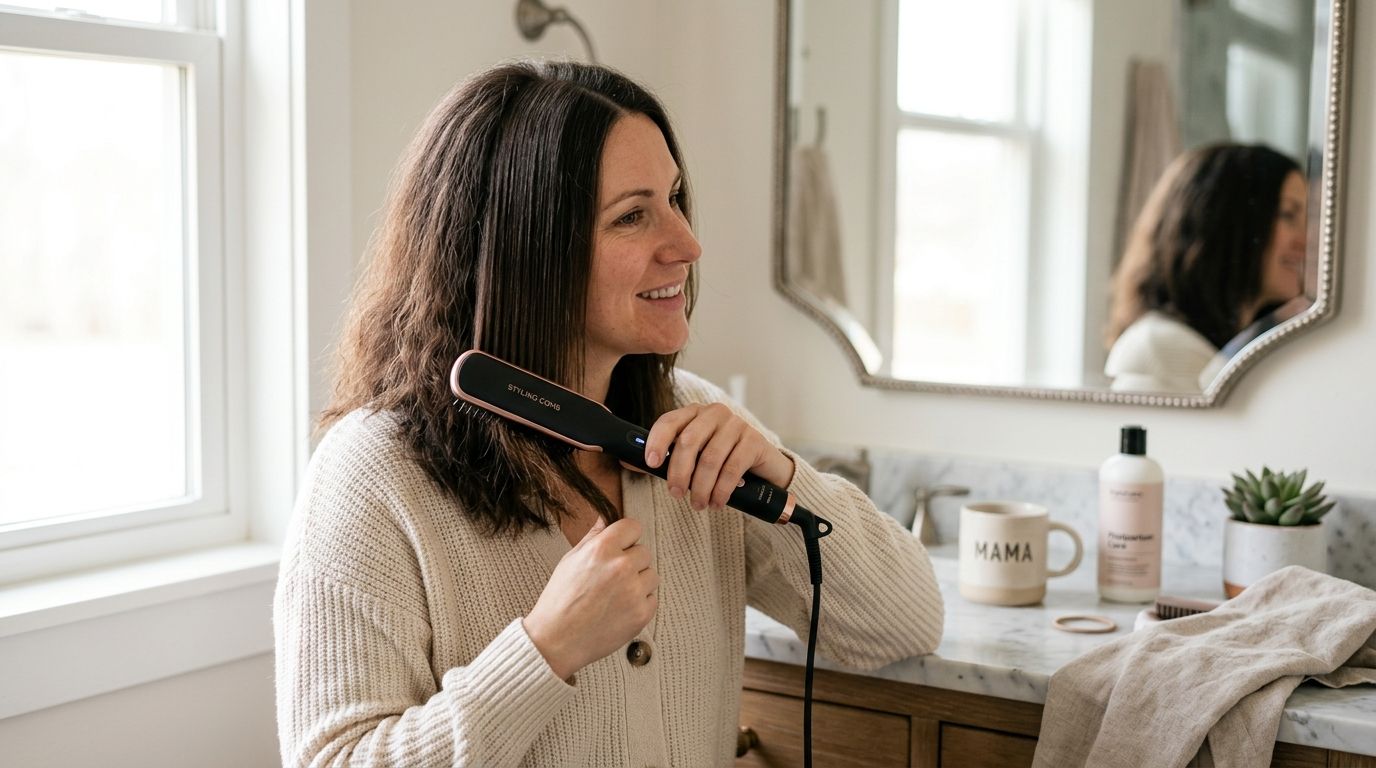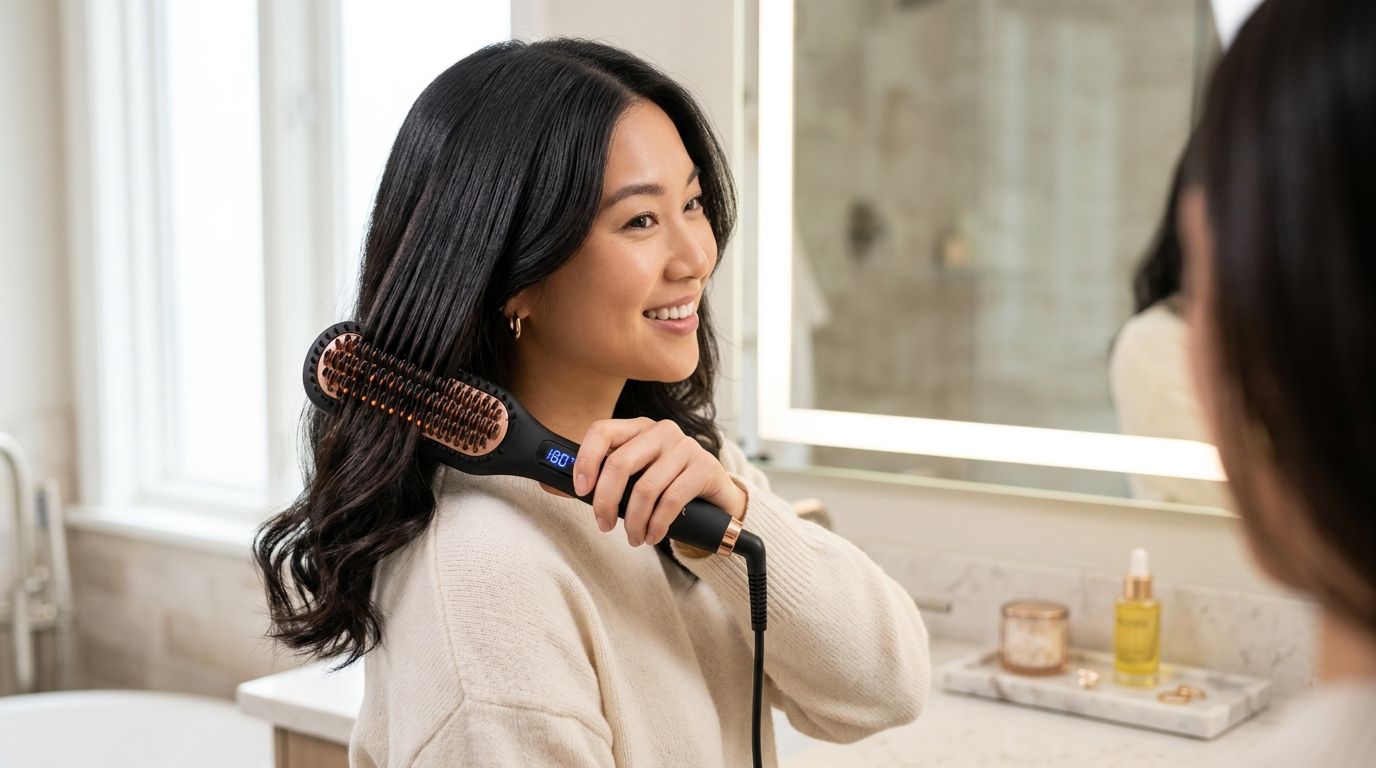
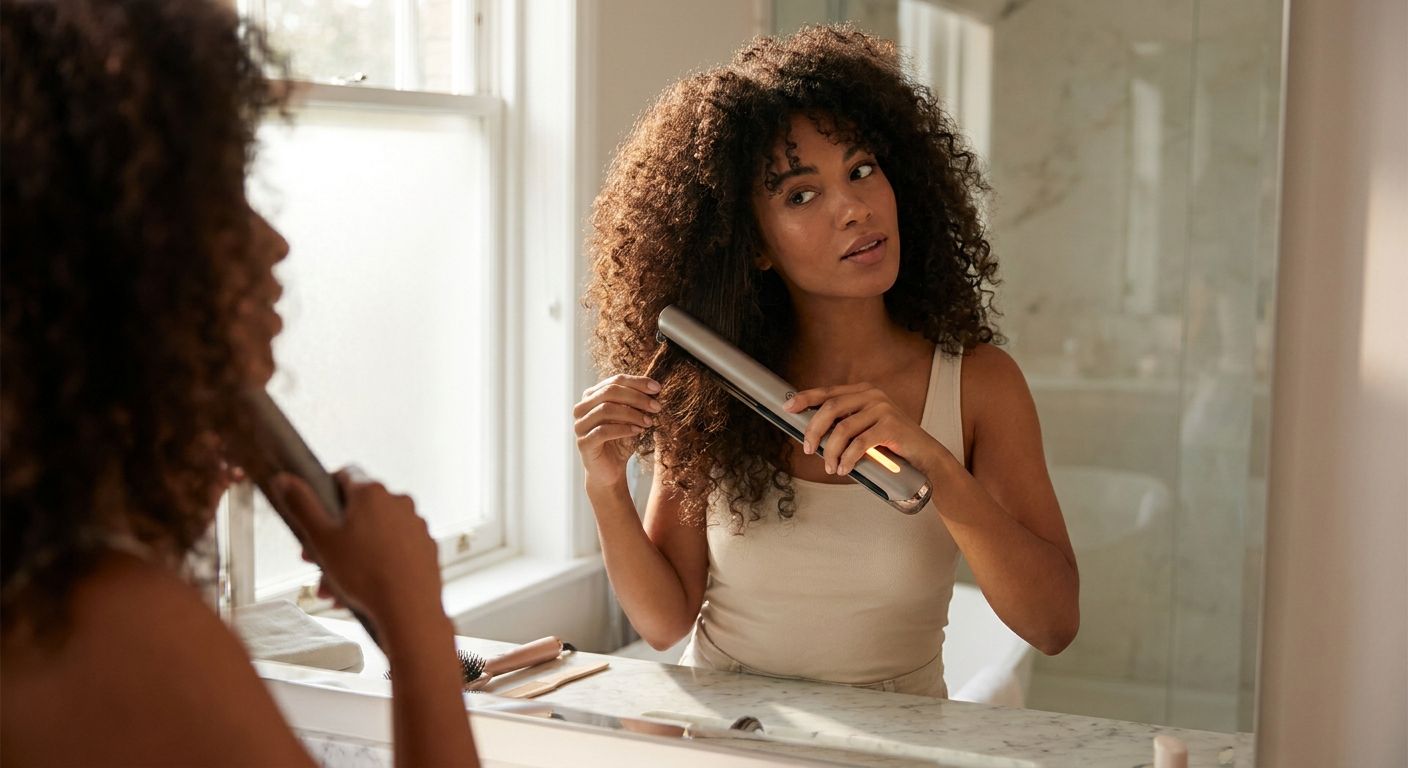
A cordless hair straightener for curly hair works best when it pairs adjustable heat control with narrow, rounded plates that can glide through spirals without snagging or leaving flat patches. Curly and coily hair needs a different approach than straight hair: more passes at lower heat beats one aggressive pass at max temperature, and plate shape matters as much as wattage.
- A cordless hair straightener for curly hair needs rounded plates and heat control below 200°C to avoid flat, damaged sections.
- Napio's hair straightening comb suits curly hair that needs slower, sectioned passes rather than one fast drag.
- Cordless models under 60g of hand fatigue matter for thick 3A-4C curl types with long styling sessions.
- Heat protectant and detangling before styling cut breakage more than any tool spec.
- Cordless beats corded for curly hair mainly on control at the roots and crown, not on raw heat output.
Why cordless hair straightener matters for curly hair
Curly hair (2A through 4C on the standard hair typing system) resists heat transfer unevenly across a section — the outer curl smooths before the inner core does, which is exactly how you end up with crispy ends and a limp middle. A cordless tool gives you the maneuverability to tilt, rotate, and follow the curl's natural bend instead of forcing hair flat against a fixed cord angle.
The search behavior around "cordless hair straightener for curly hair" skews toward people who've already tried a standard flat iron and found it either too harsh on texture or too clumsy near the scalp. That's a repeat-buyer signal, not a first-timer one — most people landing on this query already own one straightener and are troubleshooting a specific frustration: frizz regrowth, uneven results, or damage they can see.
Curly hair also holds more moisture per strand than straight hair, which means it takes longer to reach styling temperature and is more prone to steam-related heat spikes if the plates clamp down on damp sections. That single fact should reshape how you shop and how you use whatever hair straightening comb for curly hair you land on.
Assess your curl pattern before you buy
Curl type dictates heat tolerance more than porosity alone, even though most buying guides skip this step entirely.
- Check your curl pattern against the 2A-4C classification system before shopping
- Loose waves (2A-2C) tolerate lower heat settings and fewer passes
- Tight coils and kinks (3C-4C) usually need more passes at moderate heat rather than one high-heat pass
- Fine curly strands burn faster than thick curly strands at the same temperature
- Note your hair's current condition — color-treated or previously heat-damaged curls need a lower ceiling regardless of curl type
Prioritize plate material and heat range for curls
Ceramic and tourmaline-coated plates distribute heat more evenly across a section than bare metal, which matters more on curly hair because of how unevenly curls contact flat plates.
- Look for adjustable heat dials, not single fixed-temperature switches
- Keep styling temperature under 200°C for fine or damaged curls
- Rounded or slightly curved plate edges reduce the crease line curly hair leaves at the clamp point
- Narrower plates (under 25mm) work better on tight coils than wide plates built for long straight hair
- A cordless hair straightener for curly hair with rounded barrel styling, like Napio's electric straightening comb, handles the smoothing pass without a flat crease
Pick a cordless model with fast, consistent heat recovery
This is where a lot of budget cordless tools fall apart on curly hair specifically — battery-powered plates lose heat mid-pass and never fully recover before you clamp the next section.
- Check reviews for mentions of heat drop during back-to-back sections, not just max temperature claims
- Favor tools with a heat-up indicator so you're not guessing when it's ready again
- A slower recovery time forces more passes per section, which is the opposite of what curly hair needs
- Weight matters over a full head of coily hair — anything over 300g gets noticeably tiring by the crown
Section your hair before straightening
Curly hair without sectioning is the single biggest cause of uneven results, cordless tool or not.
- Split hair into four to six sections depending on density and length
- Clip each section away from the rest so you're not re-heating already-styled hair
- Start at the nape and work upward — the crown holds heat differently and should go last
- Keep sections no wider than the plate itself; wider sections mean multiple uneven passes
Use a heat protectant every time, no exceptions
Curly hair loses moisture faster under direct heat than straight hair because the strand's natural bends create more surface area exposed to the plates.
- Apply a heat protectant spray or serum to damp, not wet, hair
- Let hair air-dry or blow-dry to at least 90% before straightening — wet hair under a hot plate causes steam damage
- Reapply protectant on regrowth sections if you're touching up mid-day
- Skip protectant only if the label explicitly states it's not required — most curly-hair formulas are
Master the technique: slow passes beat fast passes
The instinct to drag fast to "get it over with" is exactly backwards for curly hair.
- Clamp the section, then move the tool slowly and steadily from root to tip in one continuous motion
- Rotate the tool slightly as you pull through to follow the curl's natural bend rather than forcing it flat
- Never go back over the same section more than twice in one session
- Let each section cool before touching it — curly hair sets its new shape as it cools, not while hot
Clean and maintain the tool between uses
Product buildup on plates is worse for curly hair than for straight hair because more styling product (creams, gels, protectants) gets applied per section.
- Wipe plates with a damp microfiber cloth after every use once fully cooled
- Deep-clean monthly with a cloth lightly dampened in isopropyl alcohol to lift residue
- Never submerge a cordless straightener in water — check the specific guide on cleaning a heated hair straightening comb before your first deep clean
- Inspect the charging port for lint or hair buildup, which shortens battery life over time
Build a low-heat maintenance routine between full sessions
Full straightening every day accelerates damage on curly hair faster than almost any other hair type because of how often the curl pattern has to be re-fought.
- Stretch full straightening sessions to two or three times a week where possible
- Use overnight silk wraps or bonnets to preserve the straightened style longer
- Touch up only root regrowth or frizz spots rather than re-straightening the full head
- Reference preventing heat damage with a straightening brush for damage-reduction habits that apply across tool types
Comparing cordless straightener options for curly hair
| Option | Best for | Key limitation |
|---|---|---|
| Cordless straightening comb | Curly and coily hair needing rounded-plate control | Slower per-section pass than a flat wide iron |
| Standard corded flat iron | Long straight or loosely wavy hair | Cord limits angle control near the scalp and crown |
| Heated straightening brush | Fine, low-density curls needing volume with smoothing | Not built for tight coils or 4A-4C texture |
| Ceramic travel mini-iron | Touch-ups and root regrowth, not full sessions | Small plate width means many passes for a full head |
A cordless hair straightener for curly hair, especially one with narrow rounded plates and adjustable heat, wins for curl-pattern control that a flat wide iron simply can't match.
Common mistakes curly-haired users make with cordless straighteners
- Skipping the heat protectant because "it's just a touch-up" — regrowth sections are often the most heat-sensitive part of the head
- Straightening damp hair to save time — this is the fastest route to steam damage on curly strands specifically
- Using the same heat setting year-round — humidity changes how much heat curly hair needs to hold a straight style
- Ignoring plate width — a wide flat-iron plate on tight coils forces multiple uneven passes instead of one clean glide
- Never deep-cleaning the plates — buildup on a cordless tool used on curly hair (more product per section) degrades results within weeks, not months
FAQ
What's the best cordless hair straightener for curly hair?
The best option for curly hair uses rounded, narrow ceramic plates with adjustable heat under 200°C, since curls need slower, sectioned passes rather than one fast drag. Look for consistent heat recovery between sections, since battery-powered plates that cool mid-pass force extra passes on already-fragile curl patterns.
Is cordless better than corded for curly hair?
Cordless wins on maneuverability near the scalp and crown, where a cord restricts the angle needed to follow a curl's bend. Corded tools generally hold higher sustained wattage, so the tradeoff is control versus raw heat output.
How hot should a straightener be for curly hair?
Keep curly hair under 200°C, and lower for fine or previously damaged curls. Coarse, dense 4A-4C coils can tolerate slightly higher settings but still benefit more from multiple moderate-heat passes than one high-heat pass.
Can you use a cordless straightener on wet curly hair?
No. Hair should be at least 90% dry before any heat styling tool touches it, cordless or corded. Wet hair under a hot plate causes steam damage, which shows up as frizz and breakage weeks later.
How often can you straighten curly hair without damage?
Two to three full sessions a week is a reasonable ceiling for most curl types in 2026, with touch-ups on regrowth or frizz spots in between. Daily full straightening compounds damage faster on curly hair than on straight hair because of how often the curl pattern has to be re-fought.
Do cordless straighteners work as well as plugged-in ones?
For curly hair specifically, a well-built cordless tool with fast heat recovery performs comparably, since the real advantage on curls is plate shape and section control rather than sheer wattage. Battery life and heat recovery speed are the two specs that separate a good cordless straightener from a frustrating one.
What plate width is best for tight curls?
Plates under 25mm handle tight coils and kinks better than the wide plates built for long straight hair, since narrower plates follow the curl's bend instead of forcing multiple uneven passes. Wider plates are better suited to loose waves or straight hair sections.
Does a heat protectant matter more for curly hair?
Yes, curly hair loses moisture faster under direct heat because its natural bends expose more surface area to the plates. A heat protectant applied to damp hair before drying reduces that moisture loss more than any single tool feature.
One last thing
Most curly-hair straightening damage isn't caused by the tool at all — it's caused by re-straightening the same section twice in one sitting because the first pass "didn't look right." Walk away, let it cool, and check it again in five minutes before you go back in with more heat; curly hair sets its shape as it cools, not while it's hot, so a second hot pass on a section that just needed to cool down is pure damage with no styling benefit.