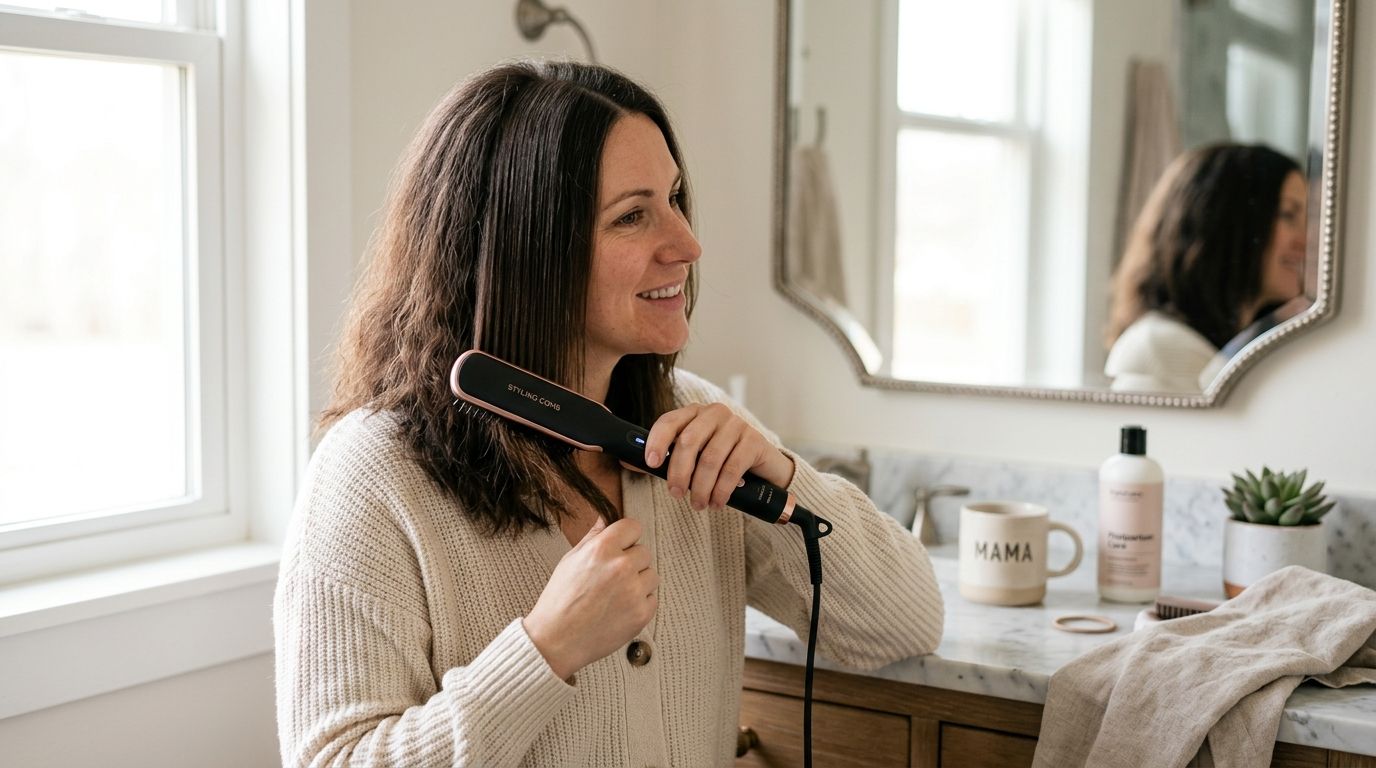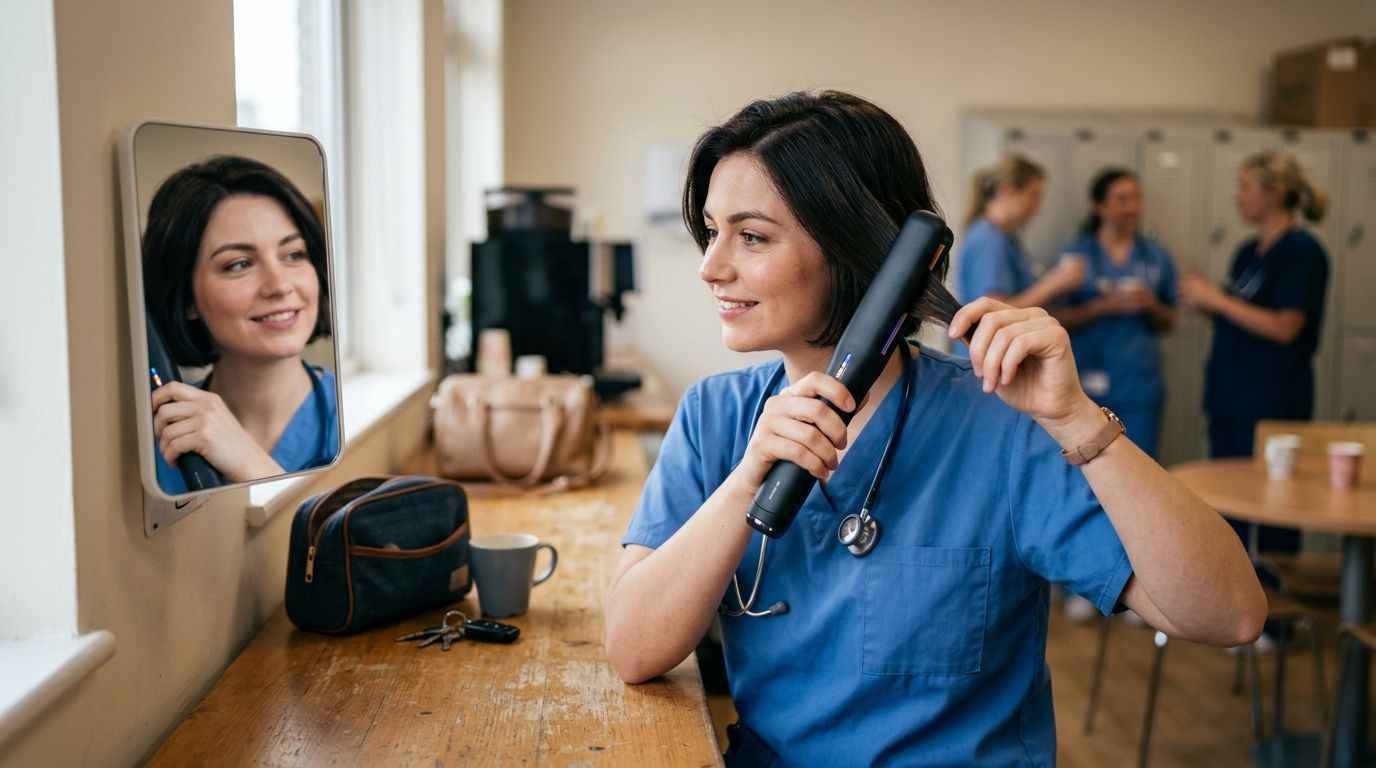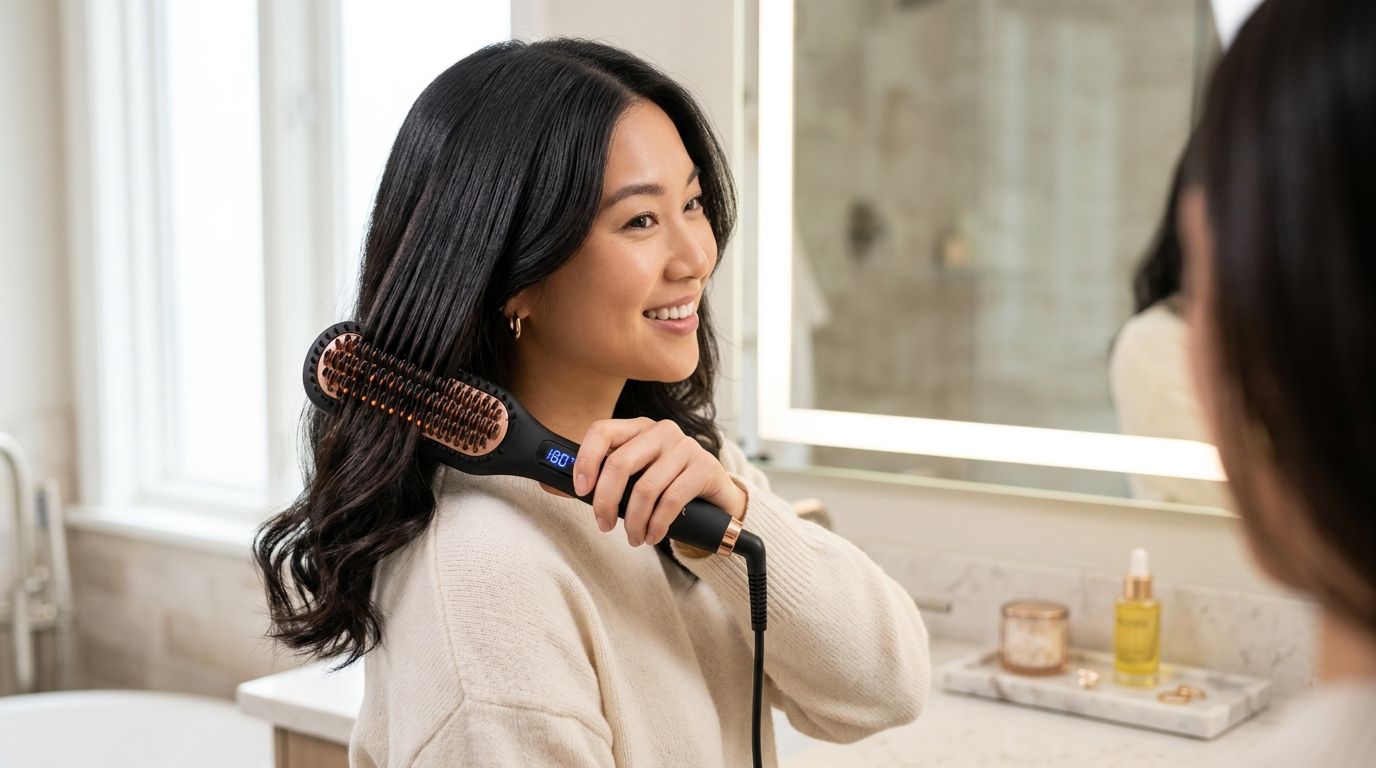
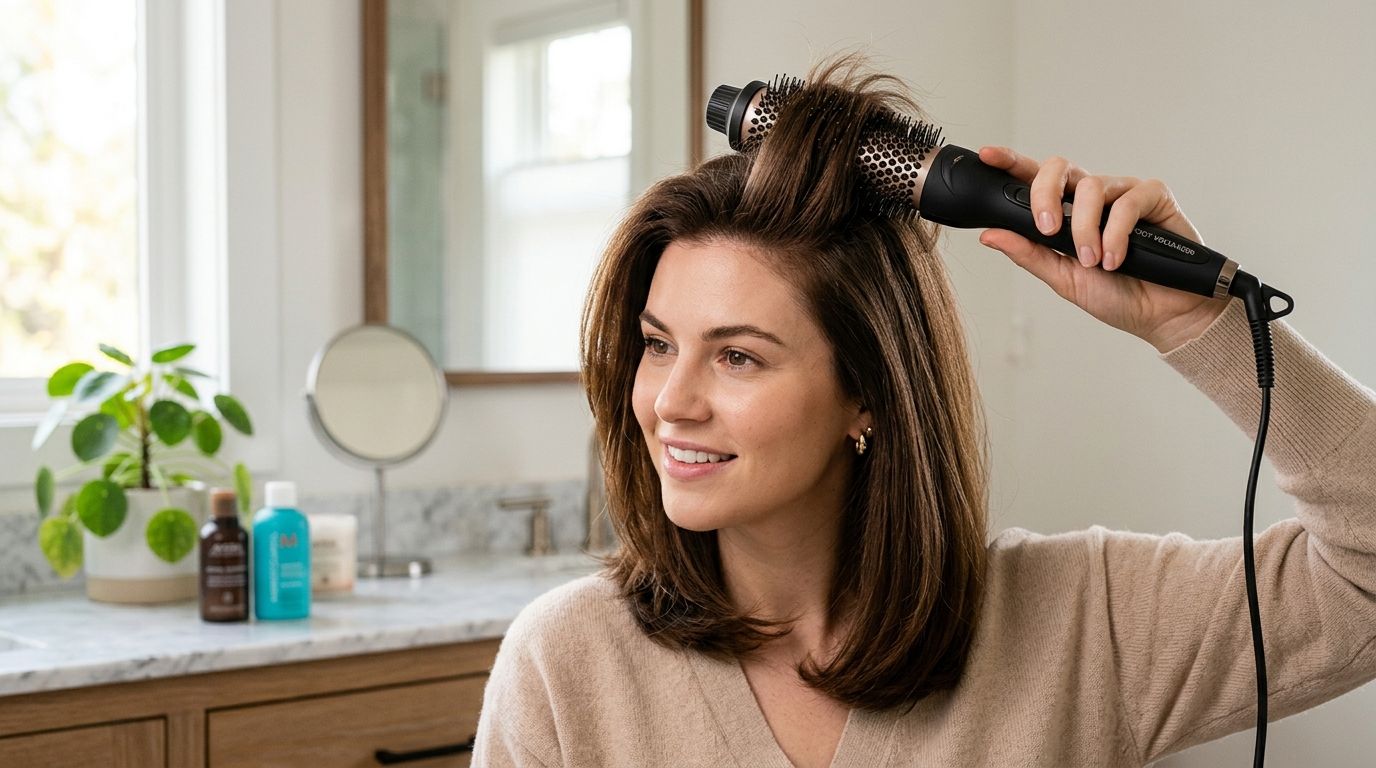
Fine, flat-rooted hair loses its lift within hours because gravity pulls thin strands flat before any product has a chance to set. A heated hair brush for root volume fixes that by lifting hair at the base while it's warm and locking the shape in as it cools. This guide is written for flat, fine-to-medium hair that needs lift at the scalp without teasing, rollers, or a full blow-out every morning.
- A heated hair brush for root volume lifts hair at the base while warm, then holds the shape as it cools — mousse alone can't do that.
- Fine hair needs 150-160°C and a narrower barrel for tight root lift, not a wide barrel built for length.
- Hold heat at the root for 2-3 seconds, then let the section cool lifted for 3-5 seconds. That cooling window is where volume is made.
- Napio's heated hair brush guides for 2026 split by hair condition — damaged, colour-treated, thick and frizzy each need a different setting.
- Section nape-up in 3-4cm panels. Styling top-down is why crown volume collapses by lunchtime.
Why this matters for flat, fine-rooted hair
Fine hair has fewer cuticle layers per strand than coarse hair, so it holds less structural memory once it's been pressed flat. That's the whole problem. You can pile on mousse, flip your head upside down, and blast the roots with a dryer, and by 2pm the shape has surrendered again because nothing physically reset the direction the hair grows out of the scalp.
Heat does reset it. A heated brush pulls the root away from the head at an angle, holds it there while the hair is pliable, and the strand cools into that new position. That's the mechanism. Everything else in this guide is about executing it without frying hair that has no margin for error.
The people searching for a heated hair brush for root volume aren't chasing shine or length. They want lift that survives a full workday, and that changes which tool, which temperature, and which technique actually make sense. A heated hair brush for beginners is usually the right entry point because it merges brushing and heat into one pass — no separate blow-dry-then-iron sequence to learn.
“If you're holding a heated brush at the root for more than five seconds, you're adding damage, not volume.”
How to build root volume with a heated hair brush
Six steps. Do them in order. Skipping the sectioning step or the cooling step is responsible for most of the flat-by-afternoon complaints about heated brushes in 2026.
Start on dry, detangled hair
Heated brushes are dry-hair tools. Wet or damp hair turns the heat into steam inside the strand, which damages the cuticle and produces no lift at all.
- Dry hair fully before any heated brush touches it
- Detangle from the ends upward, not the roots down
- Remove any heavy oil or leave-in cream from the root area first
- Apply heat protectant to roots and mid-lengths, then let it dry off completely
- Check that the brush plates are clean — product residue transfers heat unevenly
Section your hair before you touch the heat
Root volume fails most often because people style the whole head as one mass and the brush never gets a clean angle at the scalp.
- Clip hair into four sections: two front, two back
- Work each section from the nape upward, never top-down
- Keep panels 3-4cm wide so the root gets even contact
- Use flat clips instead of claw clips so hair doesn't crease before styling
- Save the crown for last — it holds heat and shape the longest when styled fresh
Choose the right heat setting for your hair type
Fine hair scorches faster than thick hair because there's less mass to absorb the energy. Setting a heated brush too hot for root volume wrecks the cuticle long before it builds any lift.
- Start at 150-160°C for fine, flat or colour-treated hair
- Move up to 170-180°C only for medium-thickness hair that resists shape
- Anything above 190°C is for thick, coarse hair — most root-volume users never need it
- Read the breakdown on how to choose the right heat setting for a straightening brush if you're unsure which band you fall into
- Strand-test on the underside of the head before styling the visible sections
Work the brush against the direction of growth
This is the step that creates lift rather than just smoothness. Most people brush with the fall of the hair, which is exactly the wrong direction for volume.
- Slide the brush in at roughly 90 degrees to the scalp, not flat against it
- Lift the panel up and away from the head as you draw the brush through
- Give each root 2-3 seconds of heat contact and no more
- Release the panel while it's still warm, in the lifted position
- Only re-pass sections that have genuinely gone flat — never reheat hair that's already holding
Lock the volume as it cools
Hair sets its final shape during the cooling phase, not the heating phase. Racing to the next section is the single most common reason root lift collapses before midday.
- Hold the lifted panel for 3-5 seconds after the brush comes away
- Use the cool-air setting if your tool has one, or a handheld fan if it doesn't
- Keep fingers out of the root area until it's fully cool
- Clip the crown upward while you finish the rest of the head, then release it last
- Do a final cool-down pass across the crown before touching any product
Finish with a light hold, then leave it alone
Heavy creams and oils drag fine hair flat within the hour. The job of product here is to preserve what the heat already built, not to create the volume itself.
- Apply texture spray to roots only, never mid-lengths
- Skip serums and oils anywhere near the root on volume days
- Dry shampoo at the roots the night before adds grip for the next morning
- Set with light-hold hairspray from about 20cm away
- Resist running your fingers through the roots — friction undoes the set faster than humidity
At night, tie hair loosely at the nape rather than in a tight ponytail, and use a silk or satin pillowcase to cut down root friction. Next morning, a single pass at 150°C on the flattened panels restores the shape without a full re-style.
Comparing your options for root volume in 2026
| Option | Best for | Key limitation |
|---|---|---|
| Heated volumising brush | Fine or flat-rooted hair wanting daily lift | Root angle takes a few sessions to master |
| Round hot brush (blow-dry style) | Thick or long hair styled straight after washing | Two-handed technique, slow for quick touch-ups |
| Hot rollers | Event styling or overnight sets | Bulkiest to store, longest set time of the group |
| Straightening comb | Smoothing frizz and pressing lengths | Smooths the root flat instead of lifting it |
| Teasing comb | Emergency lift with no tool and no power | Repeated backcombing roughs the cuticle over time |
| Volumising mousse or root spray alone | Heat-free recovery days | Delivers the least root lift of any method here |
Verdict: a heated hair brush wins for fine, flat-rooted hair that needs lift every single day, because it's the only option on this list that resets the root angle in under a minute per section. Hot rollers and teasing combs still have a place for one-off occasions, but neither survives as a daily habit — rollers cost too much time, teasing costs too much cuticle.
If your hair is processed, keep the temperature honest. Check heated hair brush for color-treated hair before you push past 160°C, since colour-treated strands lose internal moisture faster under heat and show it as brassiness and split ends within weeks.
For panels that stay stubbornly flat even at 180°C, the barrel and pass count matter more than the temperature. The heated hair brush for thick, frizzy hair guide covers the sizing that fine-hair technique deliberately avoids.
Common mistakes people with fine hair make
- Using a barrel that's too wide. A large barrel designed for length physically can't get a clean 90-degree angle at the root of fine hair.
- Holding heat at the root too long. Five seconds or more per section, repeated daily, thins fine hair over a few months. Two to three seconds is the whole window.
- Skipping heat protectant because the tool feels gentle. Anything above 150°C benefits from protection on fine hair, regardless of how the brush is marketed.
- Styling top-down. By the time you reach the back, the crown has already dropped. Nape-up, crown-last, every time.
- Loading product before the hair cools. Spraying warm roots flattens the shape you just built and leaves the product sitting in a clump at the scalp.
One last thing
The step almost everyone skips is the cooling phase, and it's the one that decides whether your volume lasts three hours or nine. Hair is pliable while warm and permanent once cool, so the three to five seconds you spend holding a lifted section after the brush leaves it does more for root volume in 2026 than any product on your shelf. Napio's heated hair brush guides all repeat this for a reason — it's free, it takes almost no time, and it's the difference between a style that holds and a style that surrenders by lunch.