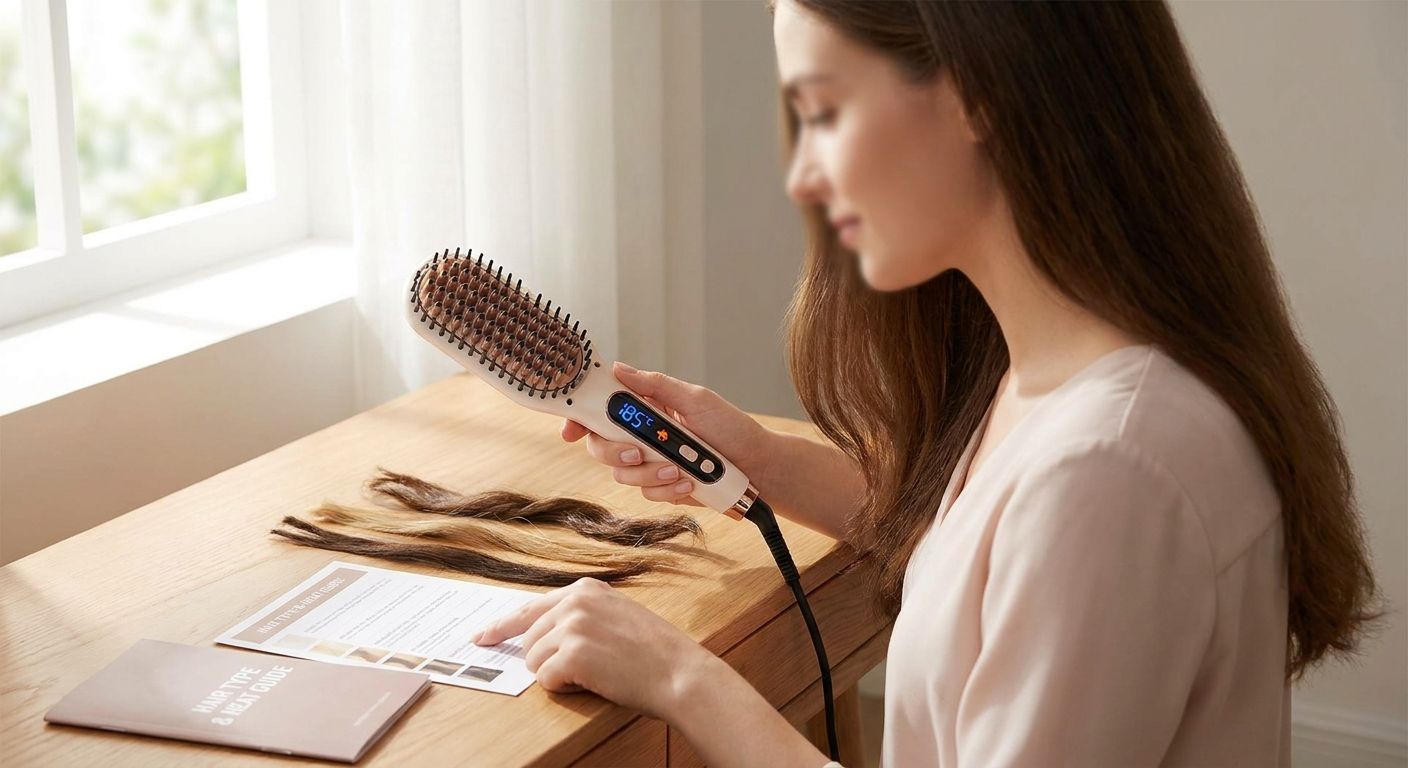
The right heat setting for a straightening brush is 180°C (356°F) for most hair types, with fine or damaged hair sitting lower at 130-180°C and thick, coarse, or curly hair needing 200-230°C to get a straight result. That number only holds if you're pairing it with slow, single passes — cranking the dial higher to compensate for rushed styling doubles the damage without making hair any smoother.
- The right heat setting for a straightening brush is 130-180°C for fine or damaged hair, 200-230°C for thick or curly hair.
- Going above 200°C on fine or color-treated hair causes visible damage within weeks, not months.
- An electric hair straightening comb with a precise dial beats a fixed-heat brush because you can match the setting to the section you're working on.
- Slow, single passes at a lower setting straighten hair better than fast, repeated passes at a higher one.
Why this matters
Most people set their straightening brush to "high" once and never touch it again. That's how fine hair ends up frizzy and brittle by mid-2026, while thick hair never actually gets straight because the setting was never hot enough to begin with.
The heat setting for a straightening brush isn't a style preference — it's the difference between one pass doing the job and five passes frying the cuticle. Get it right and you cut styling time in half. Get it wrong and you're rebuilding damage every wash day. The electric hair straightening comb works on the same principle: match the temperature to the hair, not the other way around.
What's the right heat setting for a straightening brush?
The setting that works depends entirely on hair type, thickness, and how much processing the hair has already been through. Here's how the ranges break down.
| Hair Type | Recommended Setting | Why |
|---|---|---|
| Fine, thin, or color-treated | 130-180°C | Low heat threshold, damages fast above this |
| Medium texture | 180-200°C | Balances smoothness with minimal heat exposure |
| Thick, coarse, or curly | 200-230°C | Needs more heat to break the hydrogen bonds |
Start at the lower end of your range and only move up if the first pass doesn't leave hair straight. One slow pass beats three fast ones at any setting.
Fine or damaged hair: 130-180°C
Fine and chemically treated hair (bleached, relaxed, or heavily colored) has a lower heat tolerance because the cuticle is already compromised. Setting a straightening brush above 180°C on fine or damaged hair accelerates breakage and leaves ends looking dry within a few sessions.
Run it slow at the lower end of this range. If you're not getting a straight result at 160-170°C, the fix is a slower pass, not more heat. The straightening brush for fine, thin hair is built around this exact range for that reason.
Medium hair: 180-200°C
Medium-texture hair with no major chemical processing sits comfortably in the middle. This range straightens most wavy-to-straight hair types in one or two passes without pushing into damage territory.
If hair reverts to its natural texture within a couple of hours at 190°C, the issue is usually pass speed or product buildup, not the setting itself.
Thick, coarse, or curly hair: 200-230°C
Thick and coarse hair — especially tightly curled or coily textures — needs the higher end of the range to break the hydrogen bonds that hold the natural curl pattern. Anything under 200°C on this hair type usually means multiple passes, which does more cumulative damage than one pass at the correct higher setting.
The cordless straightener for thick hair is calibrated to hold heat at this range through dense sections, where a lower-wattage tool loses temperature mid-pass and forces a second run.
Why the ideal heat setting varies
Hair doesn't respond to heat uniformly, and a handful of factors decide where in the range you should actually sit:
- Hair porosity — high-porosity hair (common after color or bleach) absorbs heat faster and damages at lower temperatures
- Chemical processing — relaxed, permed, or bleached hair should stay near the bottom of its range regardless of thickness
- Strand density — more strands per section means more heat needed to reach every strand evenly
- Plate or bristle spacing — tighter spacing distributes heat more evenly, letting you use a lower setting for the same result
- Number of passes — each repeated pass at the same setting adds cumulative heat exposure, even if the number on the dial hasn't changed
- Humidity — high humidity days often need 10-20°C more to hold a straight result, especially on curl-resistant hair
Related questions
How do I know if my straightener is too hot?
Hair that feels dry, brittle, or makes a sizzling sound on contact is a sign the setting is too high for that hair type. Visible steam beyond the first pass usually means there's still too much moisture in the hair or the setting is set higher than the hair type needs.
Can I use a straightening brush on wet hair?
No — straightening brushes are designed for dry or towel-dried hair, and applying heat settings above 130°C to wet hair causes the water inside the strand to boil, which is one of the fastest ways to damage hair permanently. Always dry hair fully before using any heated styling tool.
Does the heat setting affect how long hair stays straight?
Yes, but not in the way most people assume — a correctly matched setting for the hair type holds a straight result longer than an overly high setting, because damaged hair reverts to frizz faster than healthy hair. Thick hair styled at 220°C typically holds longer than the same hair rushed through at 180°C with three extra passes.
FAQ
What heat setting should I use on a straightening brush for fine hair?
Fine or damaged hair should stay at 130-180°C on a straightening brush, closer to the lower end if the hair is color-treated. Going higher speeds up breakage without improving the straightening result.
What's the best heat setting for thick or curly hair?
Thick, coarse, or curly hair needs 200-230°C to break the curl pattern in one pass. Lower settings usually mean multiple passes, which causes more damage over time than one pass at the correct higher heat.
Is 200°C too hot for a straightening brush?
200°C is appropriate for medium-to-thick hair but too hot for fine, thin, or color-treated hair, which should stay under 180°C. The right answer depends on hair type, not a single fixed number.
How often should I use a straightening brush without damaging my hair?
Using a straightening brush at the correct heat setting for your hair type 2-3 times a week is generally manageable in 2026, provided you're using heat protectant and slow, single passes. Daily use at the higher end of any range compounds damage regardless of hair type.
Does a cordless straightening brush heat differently than a corded one?
Cordless tools can lose temperature faster mid-pass on dense or thick sections if the battery output drops, which sometimes means running a slightly higher starting setting to compensate. Corded tools generally hold a steady setting through longer styling sessions.
Can the wrong heat setting damage color-treated hair faster?
Yes, color-treated hair has a compromised cuticle and damages faster at any setting above 180°C. Staying at the lower end of the fine-hair range protects color vibrancy as well as strand health.
Should I lower the heat setting in humid weather?
No, humid conditions usually call for a slightly higher setting, up to 20°C more, to hold a straight result. Lowering the heat in humidity tends to cause reversion within an hour.
One last thing
Most of the damage people blame on "too high a heat setting" actually comes from running the same section through three or four times because the first pass wasn't slow enough. In 2026, the fix that actually works isn't dropping the temperature — it's slowing the pass and using the correct setting for the hair type once. A straightening brush set correctly for the hair, used slowly, in a single pass, beats a lower setting run five times every single time.