
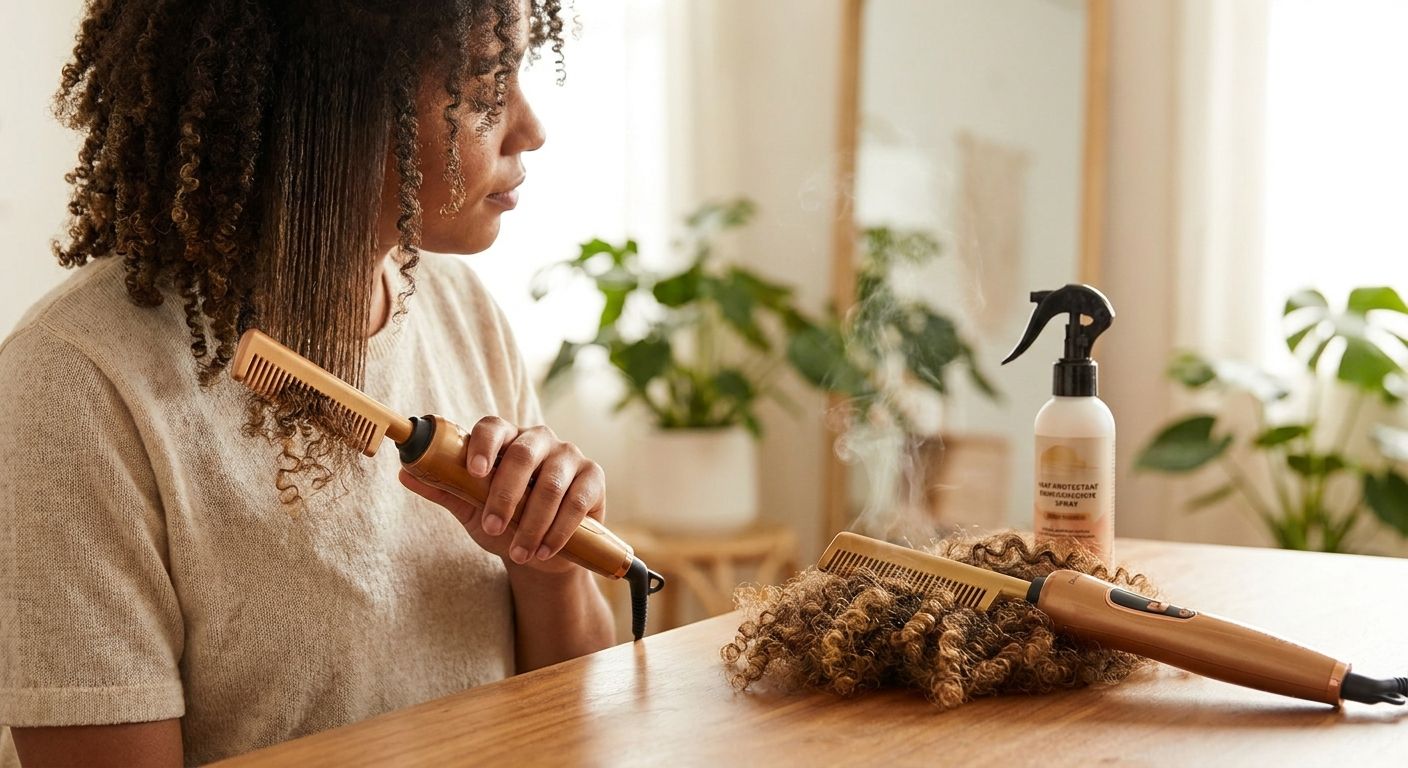
Transitioning natural hair hot combs are heated styling tools designed to press two different textures — relaxed ends and new natural growth — into one smooth line without snapping the hair where they meet. That meeting point, the demarcation line, is the weakest part of the strand during a transition, and it's the reason a hot comb built for uniform hair often does more harm than good here.
- A ceramic electric hot comb set below 180°C protects the demarcation line better than a flat iron in 2026.
- Transitioning natural hair needs two heat settings on one head — lower for new growth, slightly higher for relaxed ends.
- Detangling before every press matters more than the comb you buy; snagged hair breaks at the demarcation line first.
- Vital by Napio's electric hair straightening comb uses adjustable heat for exactly this two-texture problem.
- Clean the comb plates after every session — product buildup on transitioning hair scorches faster than on single-texture hair.
Why hot combs matter for transitioning natural hair
Relaxed ends and new curl growth don't respond to heat the same way. New growth is more porous and drier at the root, so it scorches at temperatures relaxed ends tolerate fine. The demarcation line sits between the two, and it's already under mechanical stress from the texture mismatch before a single hot comb touches it.
Most women transitioning in 2026 aren't chasing a bone-straight press for months at a time — they're managing a blend, doing wash-and-go weeks between the odd smooth-out. That changes what "good" looks like in a hot comb: adjustable heat and gentle plate pressure matter more here than raw speed. A hot comb built for natural and afro hair texture already accounts for coarser, drier new growth — that's the starting point for a transitioning routine, not a straightener designed for fine, already-processed hair.
Check Vital by Napio before you start a transition routine, because the comb you pick shapes every step below.
Prep your hair before the heat touches it
Skipping prep is the single biggest reason transitioning hair breaks at the demarcation line. Heat doesn't cause most of the damage — tangled, dry hair meeting heat does.
- Detangle from ends to roots with a wide-tooth comb, never the hot comb itself
- Wash and deep condition 24-48 hours before pressing, not the same day
- Apply a heat protectant spray to the demarcation line specifically, not just the ends
- Air-dry or blow-dry on low heat to at least 90% dry before any hot comb touches the hair
- Section into four to six parts and clip — pressing one thick section at a time is what breaks strands
Set two heat zones for two textures
Running one heat setting across relaxed ends and new natural growth is a mistake specific to transitioning hair — nobody with fully natural or fully relaxed hair has this problem.
- Test heat on a small section first if you're using a stove-heated comb with no dial
- Keep new growth sections around 160-175°C; it's more porous and burns faster
- Relaxed ends can usually handle up to 190°C without scorching, but start lower and work up
- Use a comb with adjustable digital heat rather than a single fixed setting
- Never press the same section twice in one pass to compensate for a low setting — raise the temperature instead
A manual, no-gadget approach works here too: some women do a lower-heat blow-dry stretch first, then only hot-comb the roughest sections for a fraction of the time. That cuts total heat exposure across the head. Once heat management becomes the bottleneck, a comb with real temperature control — like the option covered in this guide to the best hot comb for natural hair — is the faster path, but it's a tool for a routine you've already built, not a substitute for one.
Protect the demarcation line on every pass
This line is where 90% of transition breakage happens, and it needs its own step, not a mention inside general heat protection.
- Apply a leave-in or heat serum directly to the demarcation line before each section is pressed
- Slow the comb down through this zone — don't drag it at the same speed as the rest of the strand
- Skip back-to-back passes over the same demarcation section; one clean pass beats three rushed ones
- Feel for resistance with your fingers before pressing — tangled strands at this line snap under heat
- Trim visibly thinned or split ends near the line every 8-10 weeks, not just at the final big chop
Press new growth, not just the ends
A lot of transitioning routines default to smoothing the ends and barely touching the roots, which leaves an obvious texture break instead of a blend.
- Start each section at the root and work down in one continuous motion
- Use smaller sub-sections near the crown, where new growth is usually coarsest
- Slow the pass through the root area — this is where curl pattern fights the comb hardest
- Re-check root sections after cooling; heat that looked sufficient warm often reverts once hair cools
- Learn the exact hand angle and pressure that works for your density using a step-by-step walkthrough like how to use an electric hair straightening comb
Cool and seal before you move on
Hair sets its new shape while cooling, not while hot. Moving to the next section too fast undoes the press you just did.
- Let each pressed section cool fully before clipping it away from the rest
- Avoid touching or re-combing a section in the first 60 seconds after pressing
- Use a cool-shot setting if your comb has one, especially in humid Australian summer months
- Apply a light oil after cooling, not before — oil applied pre-heat can cause uneven scorching
Clean the comb after every transitioning session
Buildup on the plates transfers straight back into the hair on the next pass, and transitioning hair — with more product layered on for the demarcation line — accumulates residue faster than single-texture hair.
- Unplug and let the comb cool fully before cleaning it
- Wipe plates with a damp microfiber cloth after every single-texture-only session, and after every transitioning session without exception
- Use isopropyl alcohol on a cotton pad for stubborn product buildup, never abrasive scrubbers
- Check the full routine in how to clean a heated hair straightening comb if buildup starts affecting glide
Track your transition timeline
A hot comb routine that worked at month 2 of a transition won't work at month 10, because the ratio of relaxed-to-natural hair keeps shifting.
- Photograph the demarcation line monthly to track how far it's moved down the strand
- Re-test heat settings every 8 weeks as new growth increases in volume
- Plan trims around the line's movement, not a fixed calendar date
- Expect the number of sections you press to increase as more of the head goes natural
Comparing your options for transitioning hair
| Option | Best for | Key limitation | Verdict |
|---|---|---|---|
| Ceramic electric hot comb, adjustable heat | Two-texture blends, demarcation-line control | Slower than a flat iron on full-head presses | Buy |
| Heated straightening brush | Quick touch-ups on looser curl patterns | Less precise at the root than a comb | Situational |
| Standard flat iron | Fully natural or fully relaxed hair, not blends | Fixed plate width struggles with root sections | Skip for transitioning hair |
| Stove-heated traditional hot comb | No-electricity backup styling | No temperature control, high scorch risk on new growth | Skip |
Common mistakes women make transitioning with a hot comb
- Using one heat setting for the whole head. New growth and relaxed ends need different temperatures — one setting always overcooks one texture.
- Skipping protectant on the demarcation line specifically. General heat protectant on the ends doesn't cover the weakest point of the strand.
- Pressing wet or damp hair. Steam from residual moisture causes reversion and hidden heat damage under the surface.
- Waiting too long between trims. A neglected demarcation line thins out until it snaps under normal styling, not just heat.
- Increasing heat instead of slowing down. When a press isn't taking, the fix is usually pace and pressure, not a hotter plate.
FAQ
What's the best hot comb for transitioning natural hair in 2026?
A ceramic electric hot comb with adjustable heat between 160°C and 190°C works best for transitioning natural hair, because it lets you run separate temperatures for new growth and relaxed ends on the same head.
Is a hot comb better than a flat iron for transitioning hair?
A hot comb is better for transitioning hair because its narrower plate targets root sections and the demarcation line more precisely than a flat iron's wider, fixed plate.
How often should I hot comb transitioning hair?
Limit hot comb sessions on transitioning hair to once every 1-2 weeks, with cooler settings on new growth each time, to avoid repeated stress on the demarcation line.
Does hot combing damage the demarcation line?
Hot combing can damage the demarcation line if the same heat setting is used across both textures or if the section isn't detangled first; used with lower heat and protectant, the risk drops significantly.
Should I use heat protectant before every hot comb session?
Yes, heat protectant should go on before every session, applied directly to the demarcation line and not just the ends, since that's where transitioning hair breaks first.
Can I hot comb wet transitioning hair?
No, hot combing wet or damp transitioning hair causes steam damage and reversion; hair needs to be at least 90% dry before any heat pass.
How long does a natural hair transition usually take?
Transitions vary widely by person and by how much length is retained between trims, so timelines depend on the individual's trim schedule and growth rate rather than a fixed number.
What heat setting is safe for new natural growth?
New natural growth is more porous than relaxed hair, so keep it in the 160-175°C range on an adjustable hot comb to avoid scorching.
One last thing
The demarcation line doesn't fail because of one bad press — it fails from the accumulation of small mismatches: one setting too hot, one section pressed twice, one skipped trim. Fix the routine at that line specifically, and the rest of a transition gets easier every single month of 2026.