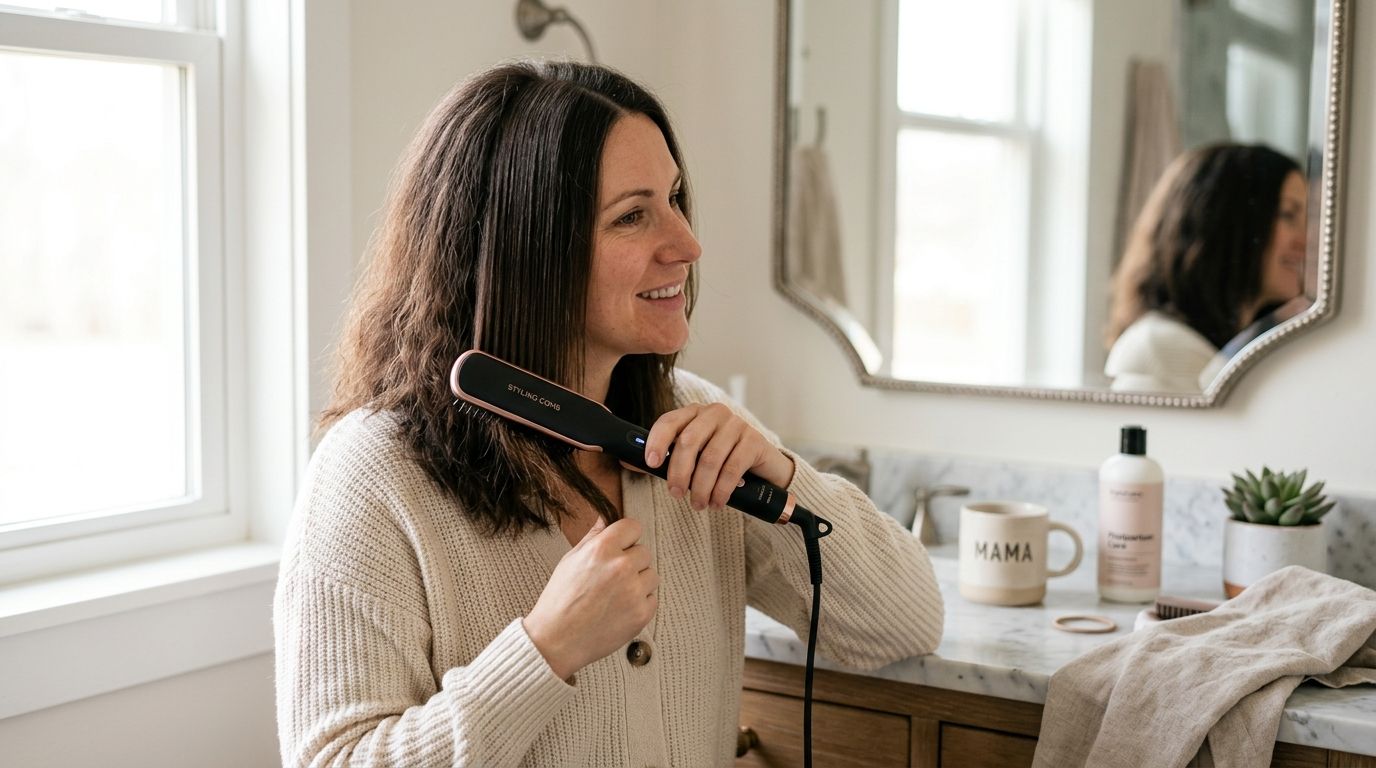
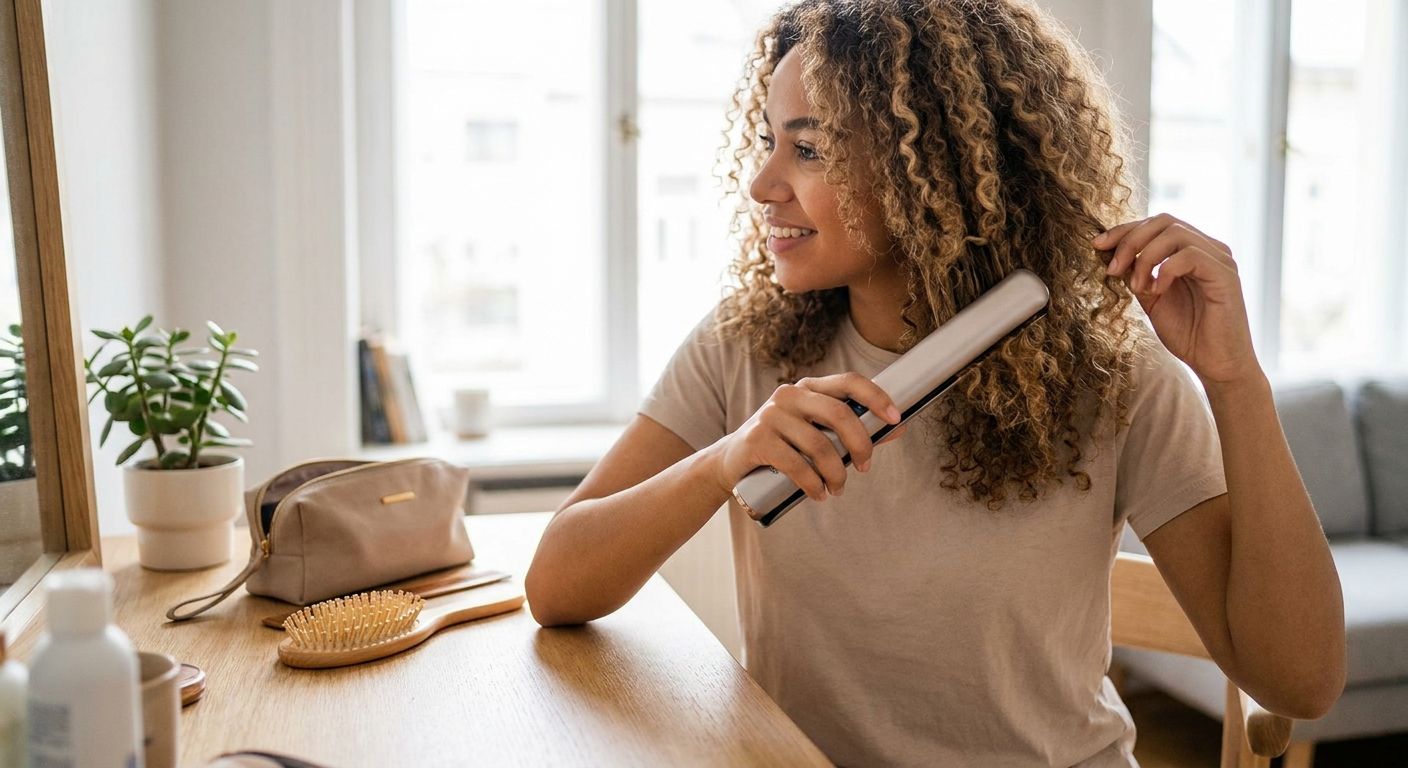
Curly hair fries fast under direct heat, and a cordless straightener that runs hot with no clamp control turns waves into frizz in one pass. The best cordless hair straightener for curly hair in 2026 controls heat at the plate, not just at the dial, and lets you work section by section instead of dragging a hot iron through a tangle.
- Vital by Napio Cordless Hair Straightening Comb wins overall for curly hair needing root-to-tip control without a cord.
- Ceramic cordless flat irons handle thick, coarse curls best but run hotter and demand more care.
- Heated straightening brushes suit fine, thin curls that damage easily above 180°C.
- Mini cordless straighteners are the pick for travel and quick touch-ups, not full restyles.
- Cordless tools typically run 20-30 minutes per charge, enough for one full head of curls.
Why this matters
Curly hair is more porous than straight hair, which means it absorbs heat faster and holds onto damage longer. A straightener built for straight hair at 200°C+ will scorch a curl pattern that needs closer to 170-185°C to relax without breaking.
Cordless straighteners solve a real problem for curly hair: no cord means no fighting the coil while you section and clamp. But cordless also means a battery, and a battery that dies mid-head leaves you with half-straight, half-curly hair and no plug nearby. The right pick balances heat control, battery life, and plate design for the curl pattern you actually have.
Getting this wrong compounds. Heat damage on curls doesn't show up as one bad hair day — it shows up as split ends, reduced curl bounce, and a texture that stops holding style at all. Preventing heat damage starts with picking a tool that matches your curl type, not just the cheapest cordless option on the shelf.
Visit Vital by Napio to see the full range of heated styling tools before you commit to one pick.
What makes the best cordless hair straightener for curly hair
- Adjustable, curl-safe heat range — settings that stay in the 170-185°C zone rather than defaulting to 200°C+
- Battery life that covers a full head — 20-30 minutes minimum before a recharge is needed
- Plate or comb spacing built for curls — tighter spacing for coily hair, wider plates for loose waves
- Fast heat-up — under a minute to working temperature, so you're not standing around
- Even heat distribution — no hot spots that scorch one section while another stays cool
- Portability without sacrificing power — cordless shouldn't mean weak output
At a glance: best cordless straighteners for curly hair in 2026
| Item | Best for | Standout feature | Key limitation |
|---|---|---|---|
| Vital by Napio Cordless Hair Straightening Comb | Overall curly hair control | Comb-style plates keep heat close to the root for section-by-section styling | Not built for one-pass speed on very thick sections |
| Ceramic cordless flat iron | Thick, coarse curls | Sustained high heat output for stubborn texture | Runs hotter, needs closer heat-setting attention |
| Heated straightening brush | Fine, thin curls | Gentler, brush-style heat spread reduces snag and pull | Slower on dense curl patterns |
| Mini cordless straightener | Travel and touch-ups | Compact size fits a gym bag or carry-on | Smaller plates mean more passes on a full head |
| Wide-plate cordless straightener | Long, thick curls | Fewer passes needed across large sections | Bulkier, less precise near the hairline |
1. Vital by Napio Cordless Hair Straightening Comb: best for overall curly hair control
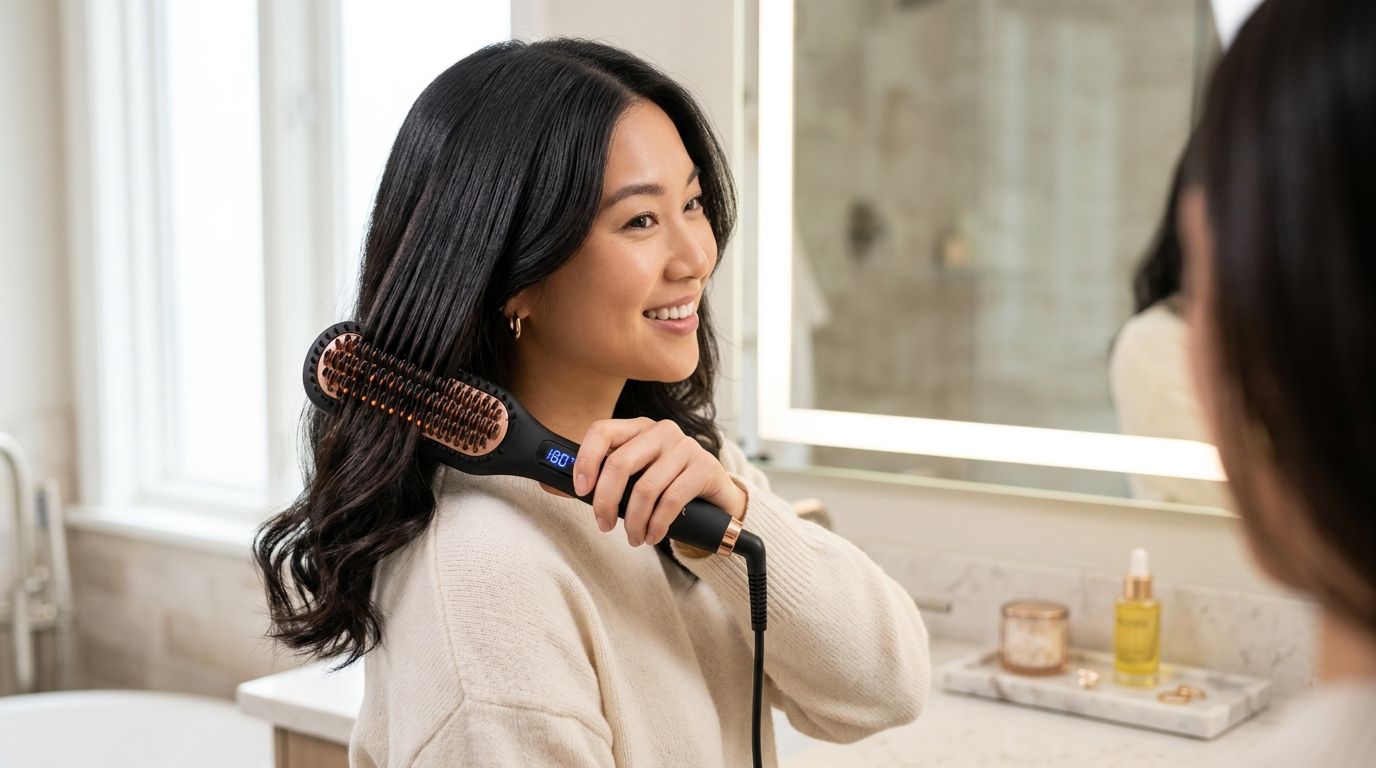
The cordless hair straightener for curly hair from Vital by Napio uses a comb design instead of flat plates, which means the heat runs along teeth close to the scalp rather than clamping the whole section at once. That matters for curls, where root-to-mid-length tension needs to be gentler than the ends.
Vital by Napio pros:
- Comb-style heating keeps you working section by section instead of yanking a full clamp through a curl
- Cordless build removes the tangle risk that comes with a coiled cord on curly hair
- Designed for at-home use without a salon-level learning curve
Vital by Napio cons:
- Comb styling takes longer than a flat iron on very thick, dense sections
- Not the fastest option if you're straightening a full head in under 10 minutes
Vital by Napio verdict: Buy — the comb format is the safer default for curly hair that reacts badly to full-clamp heat.
2. Ceramic cordless flat iron: best for thick, coarse curls
A ceramic cordless flat iron clamps and drags in one motion, which is faster than a comb but less forgiving on curl patterns that tangle easily. It earns its spot for thick, coarse curls that need sustained heat to relax at all.
Ceramic flat iron pros:
- Higher, more consistent heat output for resistant curl patterns
- Faster full-head styling than comb or brush formats
- Wide plate options cover more hair per pass
Ceramic flat iron cons:
- Easier to overheat fine or color-treated curls if the setting isn't dialed back
- Clamp pressure can snag looser curl patterns
Ceramic flat iron verdict: Buy — but only if your curls are genuinely coarse enough to need the extra heat.
3. Heated straightening brush: best for fine, thin curls
A heated straightening brush spreads heat across bristles instead of clamping, which reduces the pull that damages fine curls. It's the gentler pick when your curl pattern is thin and prone to breakage.
Straightening brush pros:
- Lower snag risk on fine, delicate curls
- Doubles as a smoothing tool between full straightening sessions
- Easier to control near the hairline and part
Straightening brush cons:
- Slower on thick or dense curl sections
- Less precise for a sharp, pin-straight finish
Straightening brush verdict: Hold if your curls are thick — go with a comb or flat iron instead. Buy if fine or thin describes your texture.
4. Mini cordless straightener: best for travel and touch-ups
A mini cordless straightener trades plate size for portability. It's not built to replace your main tool at home, but for travel it covers root touch-ups and frizz control without checked-bag hassle.
Mini straightener pros:
- Compact enough for a carry-on or gym bag
- Fast heat-up for quick fixes between meetings or flights
- Cordless battery avoids hunting for an outlet in a hotel room
Mini straightener cons:
- Small plates mean more passes on a full head of curls
- Battery runtime is tighter than full-size cordless models
Mini straightener verdict: Buy as a travel companion — Skip as your only straightener at home.
5. Wide-plate cordless straightener: best for long, thick curls
Wide plates cover more surface area per pass, which cuts down styling time on long, thick curl patterns. It's a specialist pick, not a generalist one.
Wide-plate straightener pros:
- Fewer passes needed across large sections of thick hair
- Efficient for long hair where speed matters
- Consistent heat spread across a bigger plate surface
Wide-plate straightener cons:
- Bulkier and harder to control near the hairline
- Overkill for short or fine curl patterns
Wide-plate straightener verdict: Buy for long, thick curls. Skip for short styles or fine hair.
How this list was ranked
Each item was measured against the criteria above: heat range safe for curls, battery runtime, plate or comb design matched to curl density, heat-up speed, even heat distribution, and portability. No item scored well on every criterion — that's the point of a decision tree, not a leaderboard. Pick the row that matches your actual curl pattern, not the top slot by default.
Which cordless straightener should you choose in 2026?
If you're not sure where you land, default to the Vital by Napio Cordless Hair Straightening Comb — the comb format is the safest starting point for curly hair because it limits how much heat touches any one section at once. Switch to a ceramic flat iron only once you know your curls are coarse enough to need the extra heat, and keep a mini cordless straightener in your bag for travel days regardless of which main tool you use.
FAQ
What's the best cordless hair straightener for curly hair in 2026?
The Vital by Napio Cordless Hair Straightening Comb is the best overall pick for curly hair because its comb-style plates work section by section instead of clamping the whole strand at once. Thick, coarse curls that need more sustained heat do better with a ceramic cordless flat iron.
Is a straightening brush better than a flat iron for curly hair?
A heated straightening brush is gentler and better suited to fine, thin curls, while a flat iron works faster on thick, coarse curl patterns. Neither is universally better — the right pick depends on curl density, not preference.
What temperature should I use on curly hair?
Curly hair generally does best between 170°C and 185°C, since curls are more porous and absorb heat faster than straight hair. Settings above that range raise the risk of breakage, especially on color-treated curls.
How long does a cordless straightener battery last?
Most cordless straighteners run for 20 to 30 minutes on a full charge, which covers one full head of curls before a recharge is needed. Recharge time is typically 90 to 120 minutes.
Can I use a cordless straightener on wet curly hair?
No. Heated styling tools are designed for dry or nearly-dry hair, and applying direct heat to wet curls causes far more damage than styling dry strands. Always fully dry curls before using a cordless straightener.
Is a comb-style straightener good for curly hair?
Yes. A comb-style cordless straightener spreads heat across teeth rather than clamping the whole section, which reduces tension on curl patterns prone to tangling and breakage.
What's the best cordless straightener for travel?
A mini cordless straightener is the best travel pick because it's compact enough for a carry-on and heats up fast for quick touch-ups. It's not meant to replace a full-size tool for complete restyles at home.
Do cordless straighteners damage curly hair more than corded ones?
Not inherently — damage comes from heat setting and technique, not the power source. A cordless tool set within the 170-185°C range is no more damaging to curls than a corded equivalent at the same temperature.
One last thing
The detail most people skip: curl pattern changes how much heat you actually need, not just how you style it. Type 2 waves relax at the lower end of the 170-185°C range, while type 3 and 4 curls often need the top of that range to hold straight at all — using the same setting across every curl type is the fastest way to over-process the sections that didn't need it.