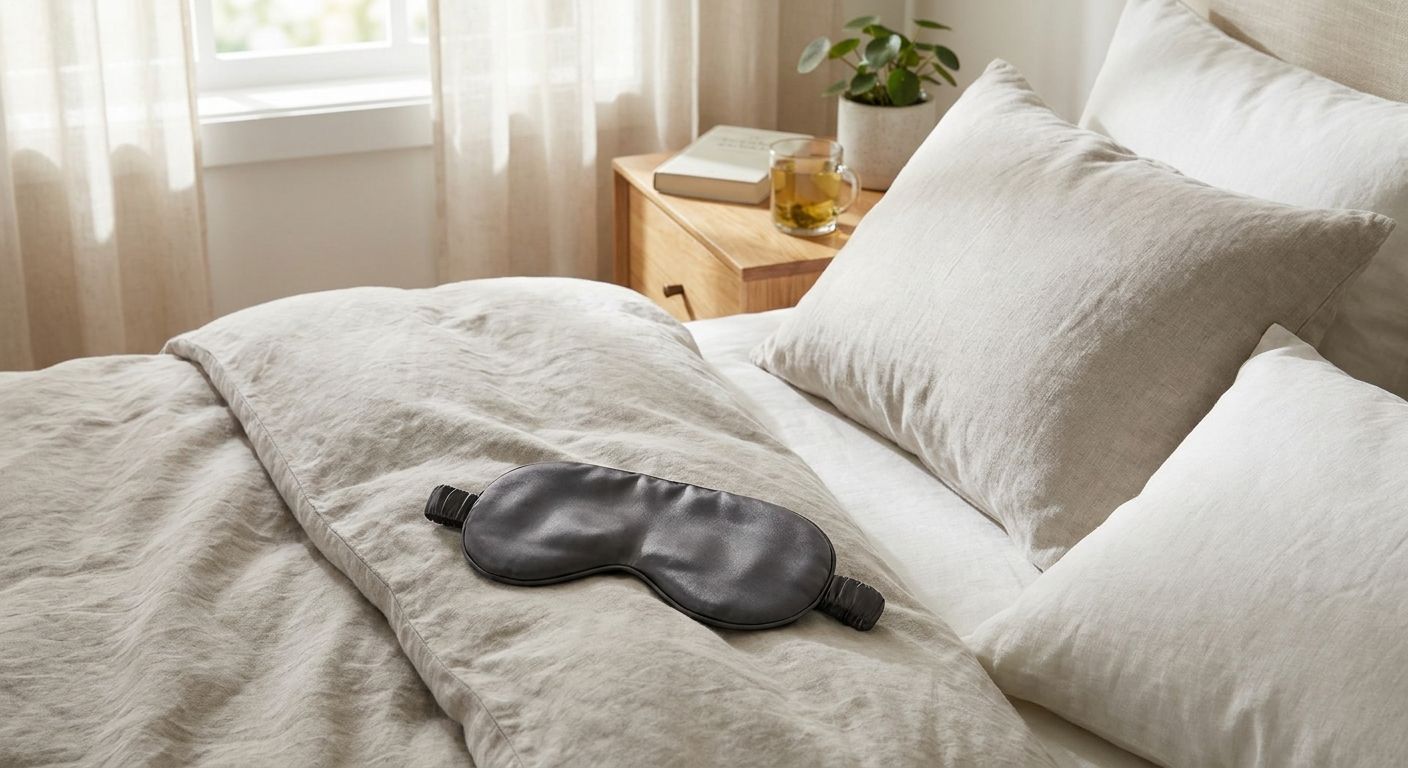
A weighted eye mask uses gentle, even pressure across your eyelids to help your body settle into sleep faster, and 2026 has more of them on the market than ever, from flat weighted styles to contoured migraine-specific designs. This guide ranks the main weighted eye mask types by the problem they actually solve, not by hype, so you can match the design to your sleep issue instead of guessing.
- The best weighted eye mask for deep sleep depends on your problem: insomnia, migraines, shift work or travel each need a different design.
- Classic weighted masks suit general insomnia; contoured styles suit migraine and sinus pressure sufferers.
- Blackout weighted masks work best for shift workers sleeping through daylight hours.
- Compact weighted masks trade some pressure depth for portability on flights and short trips.
Why this matters
A flat, unweighted sleep mask only blocks light. A weighted eye mask adds gentle deep-pressure stimulation, the same principle behind weighted blankets, and that pressure can slow a racing mind faster than darkness alone. Napio's sleep guides cover this territory closely because deep-pressure tools sit right next to the heat and posture devices Napio already writes about for recovery and rest.
The mistake most buyers make in 2026 is picking the mask with the nicest fabric instead of the one shaped for their actual problem. Someone dealing with tension-type migraines needs a completely different eyelid contour than someone doing night shifts and trying to sleep at 9am. Get the shape wrong and the mask ends up in a drawer within a fortnight.
What makes the best weighted eye mask for deep sleep
- Even weight distribution — glass beads or micro-pellets spread across the whole mask, not clumped at the bridge
- Full light seal — no gaps at the nose or temples where morning or artificial light leaks in
- Breathable cover fabric — cotton or bamboo blends that don't trap heat against the skin overnight
- Adjustable strap — Velcro or elastic that holds position through a full night without tightening around the ears
- Washable components — a removable cover matters more than people expect after a few months of nightly use
- Correct fill weight for your face — most weighted eye masks sit somewhere between 100 grams and 350 grams; too heavy and it slides, too light and it does nothing
At a glance
| Type | Best for | Standout feature | Key limitation |
|---|---|---|---|
| Classic weighted mask | General insomnia | Even pressure across both eyelids | Flat shape can rub eyelashes for stomach sleepers |
| Contoured weighted mask | Migraine and headache relief | Cups keep fill off eyelids, on brow and cheekbone | Bulkier, less packable for travel |
| Blackout weighted mask | Shift workers | Full-coverage seal blocks daylight | Needs strap re-adjustment for shorter naps |
| Travel weighted mask | Flights and short trips | Compact fold, adjustable strap | Lighter fill means less deep-pressure effect |
1. Classic weighted eye mask: best weighted eye mask for deep sleep and insomnia
A classic weighted eye mask is a flat pouch of evenly distributed glass beads or micro-pellets, secured with an adjustable strap, sitting directly over closed eyelids. It's the default starting point if you've never tried deep-pressure sleep tools before and just want to fall asleep faster and stay asleep longer. Napio's guide on the weighted eye mask for insomnia breaks down how the pressure mechanism works for people who lie awake for 30+ minutes most nights.
Classic weighted eye mask pros:
- Even, gentle pressure across both eyelids that can calm a racing mind before sleep
- Simple flat shape suits back and side sleepers
- Usually the most affordable weighted mask category, with washable straps and covers
Classic weighted eye mask cons:
- Flat design can rub eyelashes if you sleep on your stomach
- Little airflow underneath, so it runs warm by the second half of the night
- Not shaped for sinus or migraine pressure points
Best for: general insomnia and racing-mind nights. Verdict: Buy if your main problem is falling asleep, not headaches or daylight sleeping.
2. Contoured weighted eye mask: best weighted eye mask for migraine relief
A contoured weighted mask cups around the eye socket instead of lying flat, so the fill weight rests on the brow bone and cheekbone rather than directly on the eyelid. That matters if pressure on the eyeball itself makes a headache worse rather than better. Napio's weighted sleep mask for migraines guide covers which contour depths suit tension headaches versus migraine with aura.
Contoured weighted eye mask pros:
- Keeps direct weight off the eyelid, useful for headache-prone or migraine-prone sleepers
- Full-coverage cup blocks light from every angle, including the sides
- Often doubles as a light compress for sinus pressure
Contoured weighted eye mask cons:
- Bulkier shape doesn't pack flat, so it's a poor travel companion
- Rigid cup shape doesn't fit every face profile comfortably
- Higher price point than a basic flat mask in most ranges
Best for: migraine, tension headache or sinus-pressure sleepers. Verdict: Buy if headaches are part of your sleep problem; Skip if you just want basic light-blocking.
3. Blackout weighted eye mask: best weighted eye mask for shift workers
A blackout weighted mask combines a heavier, denser fill with an oversized, contoured seal designed to block daylight completely, not just dim it. Shift workers trying to sleep at 8am with sun coming through the blinds need this level of seal, not the light-blocking of a standard mask. The blackout eye mask for shift workers guide walks through why daytime sleep needs a different mask spec than nighttime sleep.
Blackout weighted eye mask pros:
- Full-coverage seal blocks daylight rather than just softening it
- Deeper weighted fill signals the nervous system to wind down against your body clock
- Wide strap distributes pressure so it doesn't dig in during a 7-8 hour daytime sleep
Blackout weighted eye mask cons:
- Heavier fill needs a firmer strap adjustment to avoid slipping
- Overkill and slow to settle for short 20-minute naps
- Larger profile can feel warm in a bright, unshaded bedroom
Best for: night-shift and rotating-shift workers sleeping through daylight. Verdict: Buy for regular shift workers; Hold if you only nap occasionally.
4. Travel weighted eye mask: best weighted eye mask for travel
A travel weighted mask trims fill weight and bulk down to something that folds flat into a carry-on pouch while keeping enough pressure to still feel like a weighted mask, not a paper-thin airline freebie. It's built for flights, trains and hotel stays where a bulky contoured mask just doesn't pack sensibly. The eye mask for travel sleep guide covers what to look for if you're sleeping upright on a plane rather than flat in bed.
Travel weighted eye mask pros:
- Compact fold suits a handbag, backpack or carry-on side pocket
- Adjustable strap works whether you're upright on a flight or lying flat in a hotel bed
- Lighter fill still delivers some deep-pressure effect without the bulk
Travel weighted eye mask cons:
- Lower fill weight means a milder pressure effect than a full-size classic or contoured mask
- Smaller profile can leave gaps at the temples on wider face shapes
- Not the right pick as your everyday at-home mask if insomnia is the main issue
Best for: flights, short trips and hotel stays. Verdict: Buy as a second, travel-specific mask; Skip as your only mask if you sleep at home most nights.
How we ranked these
Each type is ranked against the criteria above: weight distribution, light seal, breathability, strap adjustability, washability and correct fill weight for the stated use case. The order runs from broadest use case (general insomnia) down to the narrowest (travel), because that's how most people should actually shop: solve the main problem first, then add a travel-specific mask second if you need one.
Which weighted eye mask should you choose?
If you're not sure where to start, the classic weighted eye mask is the right first buy for most people chasing better deep sleep in 2026 — it's the most versatile shape and works for the widest range of sleepers. Move to a contoured mask only if migraines or sinus pressure are part of the picture, and add a blackout mask specifically if you work night shifts. A travel mask is a second purchase, not a replacement for whichever of the first three actually solves your main problem.
FAQ
What's the best weighted eye mask for deep sleep in 2026?
A classic weighted eye mask with evenly distributed fill is the best starting point for general insomnia, while contoured masks suit migraine sufferers and blackout masks suit shift workers. The right pick depends on which sleep problem you're solving, not a single universal winner.
Are weighted eye masks safe to sleep in every night?
Most weighted eye masks with a correctly sized fill, typically 100 to 350 grams, are fine for nightly use. Stop use if you notice eye irritation, headaches or pressure discomfort, and check with a doctor if you have an existing eye condition.
How much should a weighted eye mask weigh?
Most weighted eye masks fall between 100 and 350 grams. Lighter masks suit smaller faces or first-time users, while heavier fills suit people who want a stronger pressure sensation and don't mind more weight overnight.
Can a weighted eye mask help with migraines?
A contoured weighted mask that keeps fill off the eyelid and rests on the brow and cheekbone instead can ease tension headache and migraine discomfort for some sleepers. It works through pressure and full darkness rather than any medicated effect.
What's the difference between a weighted eye mask and a regular sleep mask?
A regular sleep mask only blocks light using a thin, unweighted fabric layer. A weighted eye mask adds deep-pressure stimulation from glass beads or micro-pellets, which is the main reason people switch from one to the other.
Do weighted eye masks work for shift workers?
Yes, a blackout weighted mask with a full-coverage seal is built specifically for shift workers sleeping through daylight hours. The denser fill and wider seal block daylight more completely than a standard weighted mask.
How do you clean a weighted eye mask?
Most weighted eye masks have a removable, machine-washable cover while the weighted insert itself should only be spot-cleaned or wiped, since submerging beads or pellets can damage the fill. Check the specific mask's care label before washing.
Is a weighted eye mask good for travel?
A compact travel weighted mask works well for flights and short trips because it folds flat and uses a lighter fill for portability. It trades some deep-pressure depth for a smaller packed size compared to a full classic or contoured mask.
One last thing
The detail most people skip: fill weight isn't the only variable, fill distribution matters just as much. A mask with 200 grams clumped near the bridge feels heavier and less comfortable than one with 250 grams spread evenly edge to edge. Before buying based on the weight number alone in 2026, check whether the listing or reviews mention even fill distribution, not just total grams.