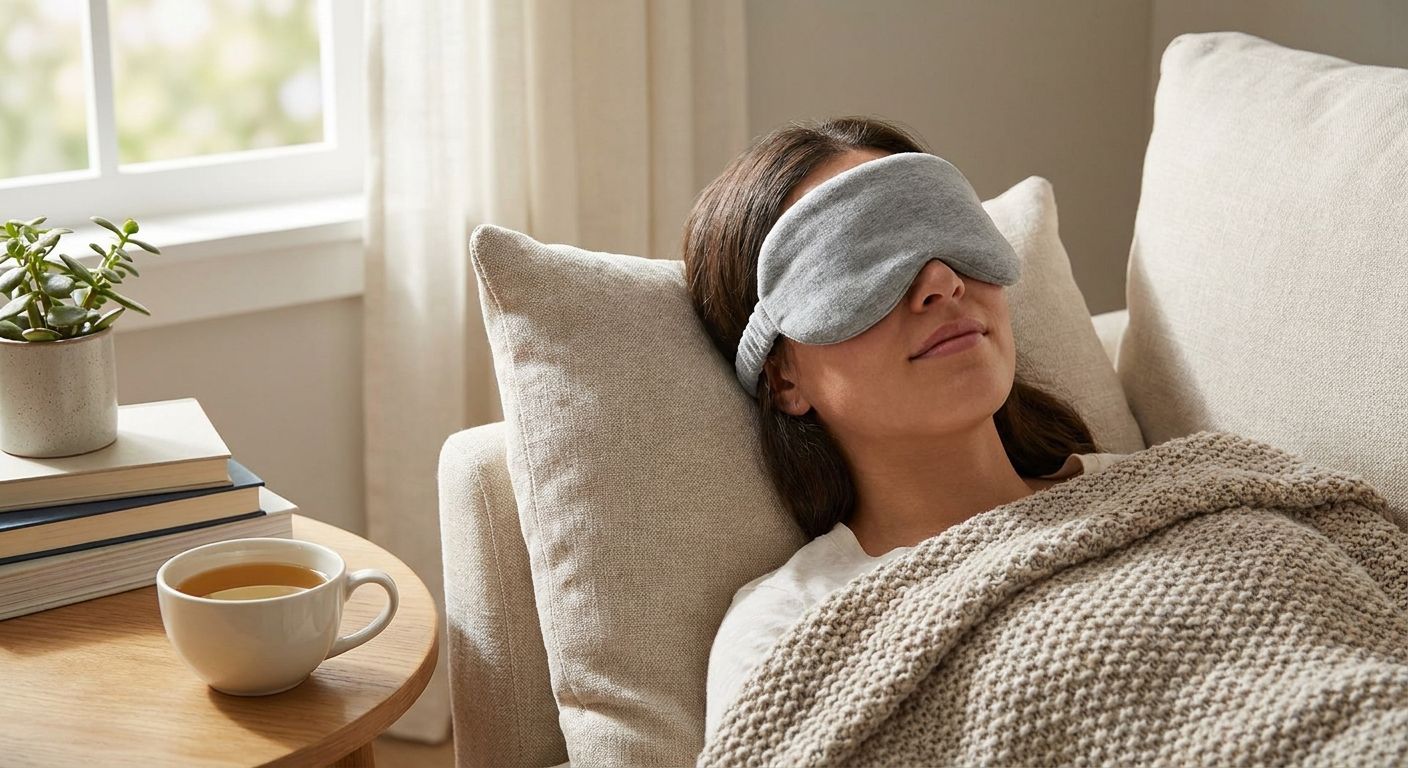
Anxiety at bedtime rarely responds to logic — you can't reason your way out of a racing mind at 11pm. A weighted eye mask works because it doesn't try to: the gentle, even pressure across your eyes and forehead triggers deep pressure stimulation, the same mechanism behind weighted blankets, and pairs it with full blackout darkness that removes the visual noise keeping your brain switched on. It's a wind-down tool, not a treatment, and it works best stacked on top of an actual bedtime routine.
- A weighted eye mask for anxiety works through deep pressure stimulation, the same calming mechanism used in weighted blankets.
- Blackout darkness plus gentle facial pressure gives your nervous system two separate signals to downshift, not one.
- Napio's weighted eye mask for insomnia pairs even weight distribution with full blackout coverage for nightly wind-down routines.
- It's a support tool for occasional stress and racing thoughts at night in 2026, not a substitute for anxiety treatment.
- Consistency matters more than the mask itself — nightly use trains the association between the mask and calm.
Why this matters
Anxiety and sleep feed each other. A wired brain delays sleep onset, a bad night raises next-day anxiety, and the cycle repeats until you're lying awake dreading the exact thing that's supposed to be restful. Most sleep aids target one half of that loop — a supplement calms the mind, a mask blocks light. A weighted eye mask for insomnia is one of the few tools doing both jobs from the same piece of fabric.
The demand for this specific category has grown alongside general interest in deep pressure products through 2026, as more people look for non-medication ways to manage bedtime stress. That doesn't make it a cure. It makes it a reasonable, low-effort addition to a routine that's already falling apart from overstimulation.
How a weighted eye mask helps with anxiety
The mechanism has two separate parts, and understanding both explains why the mask works better than a plain blindfold.
Deep pressure stimulation. Even, distributed weight across the eyes, brow and upper cheeks mimics the sensation of a hand resting gently on your face. This type of touch pressure is associated with a shift toward parasympathetic activity — the "rest and digest" side of your nervous system — which is the same principle behind weighted blankets, swaddling, and firm hugs. It's not sedation. It's a physical cue that tells your body it's safe to stop scanning for threats.
Total blackout. Anxious minds are hypersensitive to light leaking through blinds, phone notifications, or a glowing alarm clock. Full-coverage darkness removes that trigger entirely, which matters more for anxiety than most people assume — light exposure at the wrong time delays melatonin release and keeps the brain in a semi-alert state.
Put together, you get a mask that calms the body through pressure and calms the environment through darkness. That combination is why weighted options consistently outperform standard silk or foam sleep masks for people whose main problem is a racing mind rather than just light sensitivity.
| Feature | Standard sleep mask | Weighted eye mask |
|---|---|---|
| Blocks light | Yes | Yes |
| Applies deep pressure | No | Yes |
| Best for | Light sensitivity, travel | Anxiety, racing thoughts, migraines |
| Feel | Light, barely-there | Grounding, hug-like |
Verdict: if light is your only problem, a standard mask is enough. If your mind won't stop the moment the lights go out, the added weight is doing real work — buy the weighted version.
Why the calming effect varies
Not every weighted eye mask delivers the same result, and the difference usually comes down to a handful of design choices:
- Weight distribution — pressure concentrated only on the eyes feels different from weight spread across the eyes, brow, and cheekbones; broader distribution tends to feel more grounding.
- Blackout quality — gaps at the nose bridge or temples let light in and undercut the darkness half of the effect.
- Strap adjustability — a mask that's too tight creates tension instead of relief; one that's too loose shifts overnight and wakes you up.
- Material breathability — heavy synthetic fabric traps heat, which works against a calm nervous system rather than for it.
- Routine consistency — the calming association strengthens with repeated nightly use; a mask worn twice a month won't build the same effect as one worn every night.
- Pairing with breathing or a wind-down habit — the mask does more when it's the last step in a routine, not a standalone fix reached for mid-panic.
A blackout eye mask for shift workers faces an extra variable — daytime light is harder to block than nighttime light — so full-coverage design matters even more for anyone sleeping against their body clock.
“If your mind races the second the lights go out, weight and darkness are solving two different problems at once.”
Is a weighted eye mask good for anxiety?
A weighted eye mask is good for anxiety when the problem is a racing mind at bedtime, because the deep pressure stimulation gives your body a physical cue to relax that light-blocking alone doesn't provide. It works best as a nightly habit rather than an occasional reach during a panic spell, since the calming association builds over repeated use through 2026 and beyond.
How heavy should a weighted eye mask be for anxiety relief?
The weight should feel like gentle, even pressure — comparable to a hand resting lightly across your eyes — not a sensation of heaviness or restriction. Too much weight concentrated in one spot creates tension rather than calm, which is why distribution across the eyes, brow and cheeks matters more than the total weight itself.
Can a weighted eye mask replace anxiety medication or treatment?
No, a weighted eye mask cannot replace anxiety medication or treatment — it's a bedtime support tool that helps with the physical symptoms of a wired nervous system, not a clinical intervention. Anyone dealing with ongoing or severe anxiety should still talk to a healthcare provider; the mask is a complement to that care, not a substitute for it.
Does a weighted eye mask help with migraines too?
Yes, the same pressure-and-blackout combination that helps anxiety also helps migraine sufferers, since light sensitivity and physical tension are common migraine triggers. A weighted sleep mask for migraines applies the same principle specifically to headache relief, with the added weight offering gentle counter-pressure across the temples during an episode.
FAQ
Is a weighted eye mask good for anxiety?
A weighted eye mask is good for anxiety when a racing mind is the main problem at bedtime, since deep pressure stimulation gives the body a physical cue to relax. It works best used nightly rather than occasionally.
How does a weighted eye mask work for anxiety?
It works by combining deep pressure stimulation across the eyes and brow with full blackout darkness, addressing both the physical tension and the light-triggered alertness that keep an anxious mind awake. Neither element alone does both jobs.
What weight should an eye mask be for anxiety relief?
The weight should feel like gentle, even pressure rather than heaviness, distributed across the eyes, brow and cheeks. A mask that concentrates weight in one small area creates tension instead of calm.
Can a weighted eye mask help with racing thoughts at night?
Yes, a weighted eye mask can help with racing thoughts by shifting the nervous system toward a calmer state through touch pressure, though it works best paired with a consistent wind-down routine rather than used alone mid-panic.
Is a weighted eye mask better than a regular sleep mask for stress?
A weighted eye mask is better than a regular sleep mask for stress specifically, because it adds deep pressure stimulation on top of light blocking. A regular mask only solves the light half of the problem.
Can I use a weighted eye mask every night?
Yes, a weighted eye mask is designed for nightly use, and the calming effect tends to strengthen with repetition as the brain associates the mask with wind-down time. Breathable materials matter more the more often it's worn.
Does a weighted eye mask help with migraines and headaches too?
Yes, the pressure-and-darkness combination that helps anxiety also helps migraines, since light sensitivity and head tension are common triggers for both. Gentle counter-pressure across the temples is often the specific benefit migraine sufferers report.
Is a weighted eye mask safe with contact lenses or eye conditions?
Anyone with an existing eye condition or sensitivity should check with an eye care provider before adding pressure-based products, and contact lenses should generally be removed before sleep regardless of mask type. This isn't a universal-safe product for every eye condition.
One last thing
The part people skip is the routine, not the mask. A weighted eye mask thrown on mid-scroll, phone still lit up six inches from your face, won't do much — the calming effect depends on consistency and on removing the other stimulation competing for your attention. Put the mask on as the actual last step before lights-out, every night, for a couple of weeks before judging whether it's working. For travel or shift-work schedules where light control is harder to begin with, an eye mask for travel sleep built for full-coverage blackout does more of the work automatically. Check the current range on Napio for the full lineup of weighted and blackout options.