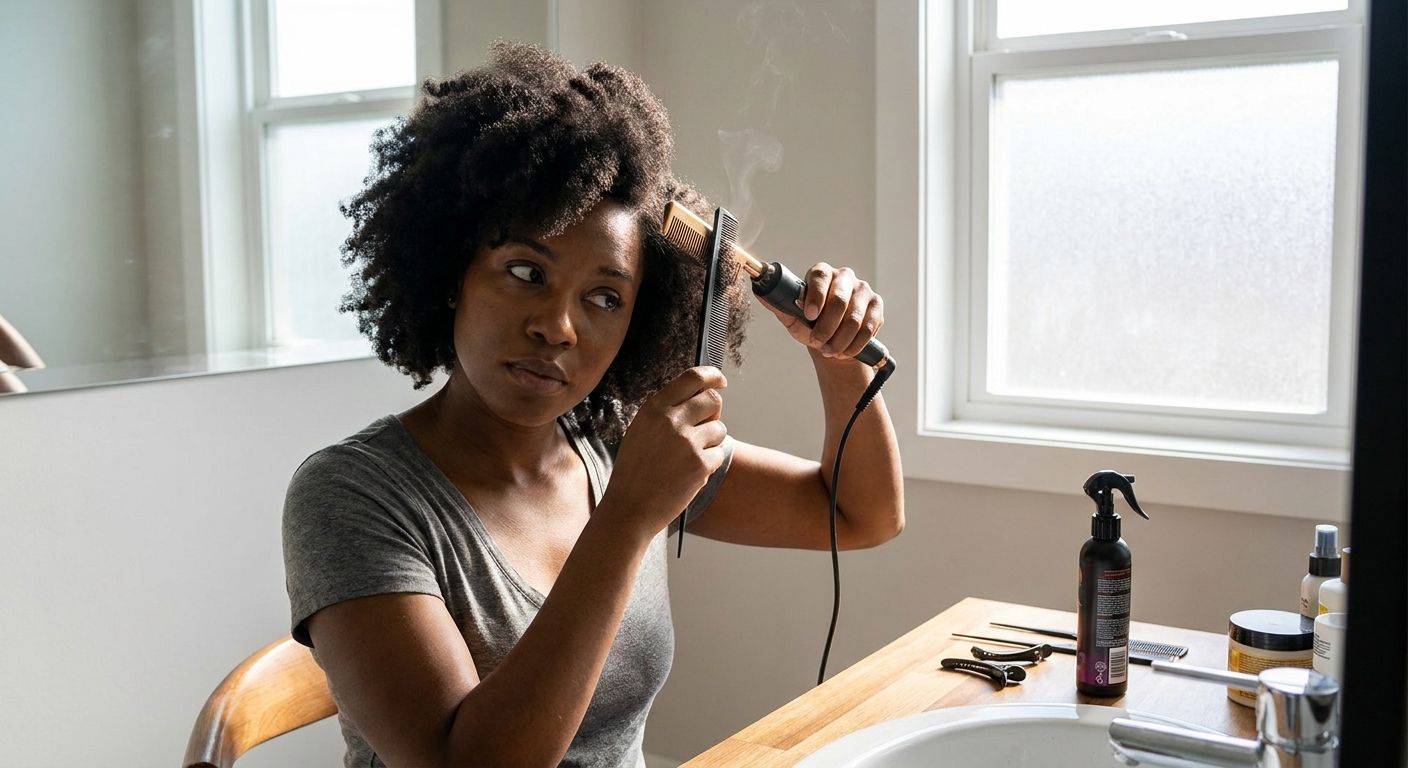
Hot combing 4c natural hair works when you dry the hair completely first, section it into pieces no wider than an inch, apply a heat protectant right before each section, and pass the comb through once at a moderate setting — never twice over the same spot. The part that actually ruins 4c hair isn't the comb itself; it's re-passing a section that didn't straighten the first time, which is where curl pattern and strand integrity get lost for good.
- How to use a hot comb on 4c natural hair: dry fully, section small, one pass per section at moderate heat.
- 4c strands are the most heat-sensitive natural hair type — skipping a protectant risks permanent curl loss.
- Re-passing the same section twice is the fastest way to fry 4c hair, no matter the comb.
- Detangled, product-free hair straightens on the first pass; buildup forces repeat passes and scorching.
Why this matters
4c hair has the tightest curl pattern and the highest shrinkage of any natural hair type, which means it also holds the most tension per strand under direct heat. A single pass on properly prepped hair does the job; a second or third pass on the same section is what turns a routine press into heat damage that shows up weeks later as thinning ends or a curl pattern that won't bounce back. Learning how to use an electric hair straightening comb properly on 4c strands specifically — not just natural hair in general — is what separates a clean silk press in 2026 from a slow burn.
How to use a hot comb on 4c natural hair, step by step
- Wash and deep condition, then blow-dry hair fully straight on a low or medium heat setting. Damp sections steam and scorch under a hot comb — dry hair is non-negotiable.
- Apply a heat protectant section by section, right before the comb touches that piece, not all over the head at once.
- Section the hair into pieces about an inch wide, clipping the rest out of the way, and work from the nape up to the crown.
- Set the comb to a moderate heat. Coarse, densely-curled 4c strands generally straighten in the mid-to-upper range of most combs' settings without needing the maximum dial.
- Glide the comb through each section once, close to the root without touching the scalp, pulling straight through to the ends in one continuous motion.
- Move to the next section and don't go back over hair you've already pressed unless a small piece was completely missed.
- Let each section cool before touching or re-clipping it — heat-styled hair sets as it cools, and handling it hot undoes the press.
- Seal with a light oil or serum once the full head is done, working from mid-length to ends only.
Comb heat setting matters more than pass count
An adjustable comb lets you drop the temperature for finer edges and raise it slightly for a denser crown section, which means you never need a second pass to compensate for a setting that was too low. Napio's best hot comb for natural hair picks are built around that adjustability rather than a single fixed heat, which is the actual variable that decides whether 4c hair needs one pass or three.
Why hot comb results vary on 4c hair
Same comb, same person, different results from week to week — here's what's actually driving that:
- Porosity: high-porosity 4c strands absorb heat fast and can scorch at settings that are fine for low-porosity hair on the same head.
- Density: thicker sections need a slower, single pass rather than a quick glide, or the comb won't fully reach the mid-section of the strand.
- Product buildup: leftover gel, butter, or edge control smokes under heat and coats the comb plates, forcing a repeat pass to finish the job.
- Comb plate quality: rougher plates snag on tight coils and drag, which is what makes people go back over a section that should've been done in one pass.
- Humidity: a fresh press pulls back toward its natural curl pattern faster on humid days, which has nothing to do with technique and everything to do with the air.
- Hair length: longer 4c hair means more total sections and more cumulative heat exposure per session, even at the same setting.
“If a section needs a second pass to straighten, the setting was wrong — not the hair.”
A comb built for this hair type takes some of that guesswork out. Napio's hot comb for natural and afro hair is designed around tight coil patterns specifically, which cuts down on the repeat-pass habit that does most of the actual damage on 4c strands.
Does a hot comb damage 4c natural hair?
A hot comb damages 4c natural hair when it's used on wet strands, set too high, or run over the same section more than once — the damage builds up over sessions rather than happening in one go. Used on fully dry hair with a heat protectant and a single pass per section, hot combing stays a manageable part of a 2026 natural hair routine rather than a source of breakage.
Is a hot comb better than a flat iron for 4c hair?
A hot comb reaches closer to the scalp and through tight coils that flat iron plates often skip on 4c hair, which makes it the stronger choice for root definition. A flat iron works faster once hair is already blown out straight, so most 4c routines end up using both tools for different stages of the same press rather than picking one over the other.
How do I stop 4c hair from reverting right after a press?
4c hair reverts fastest when it meets humidity or moisture before the press has fully cooled and set, so sealing with a light oil and wrapping the hair at night is what holds a style through the week. Avoiding heavy, water-based products on freshly pressed hair matters more than the heat setting used to press it.
FAQ
What temperature should I use for a hot comb on 4c hair?
4c hair generally straightens in the mid-to-upper heat range of most combs without needing the maximum setting. Going higher than the strand needs is what causes scorching, not better straightening.
Can I use a hot comb on wet 4c hair?
No — a hot comb should only touch fully dry 4c hair. Applying heat to damp strands causes steam damage that shows up as brittle, weakened hair over repeated sessions.
How do I stop my 4c hair from reverting after a hot comb press?
Seal each section with a light oil once it cools and keep the style away from humidity and moisture for as long as possible. A satin wrap at night extends a press by protecting it from friction and moisture overnight.
Is a hot comb bad for natural hair?
A hot comb isn't inherently bad for natural hair — the damage comes from wet application, excessive heat, or repeated passes over the same section. Used on dry, protected hair with one pass per section, it's a standard part of many 2026 natural hair routines.
What's the best hot comb for natural hair in 2026?
The best hot comb for natural hair in 2026 has adjustable heat settings and smooth plates that glide through tight coils without dragging. That combination is what keeps 4c hair to a single pass per section instead of forcing repeat passes.
How do I clean a hot comb after using it on natural hair?
Wipe the plates down with a damp cloth once the comb has fully cooled, removing any product residue before it hardens on the surface. Buildup left on the plates is what causes snagging and uneven heat on the next use.
Can a hot comb be used on transitioning natural hair?
Yes, a hot comb can be used on transitioning natural hair, but the demarcation line between new growth and relaxed or previously heat-styled ends needs a gentler pass. That line is the weakest point on transitioning hair and the first place breakage shows up.
One last thing
Most people troubleshoot a bad press by cranking the heat higher — the actual fix on 4c hair is almost always slowing down the single pass, not adding a second one. A comb with genuinely adjustable heat and smooth plates removes the temptation entirely, because a section that straightens cleanly on the first glide never needs a repeat.