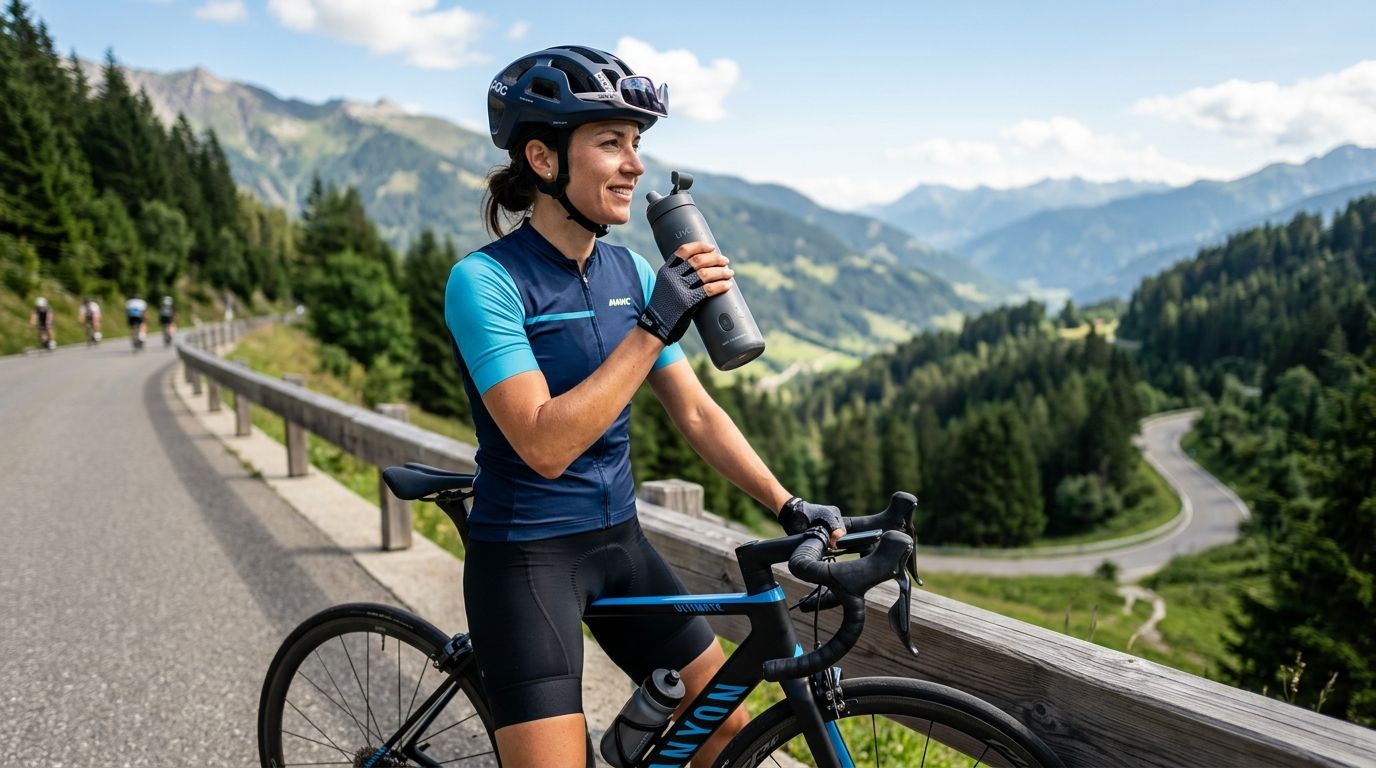
Self-cleaning water bottle for cyclists is a UV-C sanitising bottle built to zap bacteria growth between rides, not just after a wash. Standard bottles get gripped with sweaty gloves, refilled from unfamiliar taps, and left capped in a hot bike cage for hours — a self-cleaning bottle interrupts that cycle without you scrubbing anything.
- A self-cleaning water bottle for cyclists uses UV-C light to reduce bacteria buildup between rides, cutting the smell and slime that regular bottles develop.
- Manual washing still matters in 2026 — a self-cleaning bottle is a backup system, not a replacement for rinsing after every ride.
- Vital by Napio's UV-C self-cleaning bottle line is built for riders who refill mid-ride and can't scrub a bottle at the trailhead.
- Bite valves and straw-style caps trap more residue than wide-mouth lids, regardless of whether the bottle self-cleans.
Why self-cleaning water bottles matter for cyclists
A bike cage sits in direct sun for the length of a ride, and a bottle left there gets warmer than one on a desk or in a bag. Warm, damp, capped — that's the exact environment bacteria need. Add electrolyte mix, which leaves sugar residue behind long after the liquid is gone, and a bottle that only gets a rinse at the end of a ride is doing less than it looks like.
Cyclists also refill more often than the average water bottle owner: at a servo, a mate's tap, a public fountain on a group ride. Every refill introduces new bacteria to a bottle that hasn't had a proper wash since the morning. How UV-C self-cleaning bottles kill bacteria walks through the mechanism — UV-C light disrupts bacterial DNA, and it's the same principle used in water treatment and hospital sanitising equipment, not a gimmick invented for bottles.
A self-cleaning water bottle for cyclists doesn't replace washing — it closes the gap between washes, which for most riders is where the actual bacteria growth happens.
“If you can smell your bottle before you've even unclipped it from the cage, it's already grown something you don't want to drink.”
Rinse and air-dry after every ride
Before any gadget enters the picture, the free habit still does most of the work. This step costs nothing and takes under a minute.
- Rinse with plain water immediately after the ride, before residue dries onto the plastic
- Tip the bottle upside down to air-dry rather than capping it wet
- Avoid leaving a capped, damp bottle in a gym bag or car boot overnight
- Wipe the mouthpiece or bite valve separately — it collects more grime than the bottle body
- Skip flavoured mixes in a bottle you don't plan to wash that same day
Deep-clean weekly with basics you already own
A rinse handles surface residue. A proper deep clean handles the film that builds up on the inside walls over a week of riding.
- Fill with warm water and a spoonful of baking soda, shake, and let it sit for 10-15 minutes
- Use a bottle brush with a narrow head to reach the base and threading
- Soak bite valves separately in a vinegar-water solution to clear residue in the folds
- Check the lid gasket for a slimy film — it's the most commonly missed spot
- Run the bottle through a top-rack dishwasher cycle if the manufacturer lists it as dishwasher-safe
Switch to a UV-C self-cleaning bottle for days you can't scrub
A training block, a multi-day event, or a commute where the bottle refills three times before you're home — that's where manual washing breaks down. This is where how to use a UV self-cleaning water bottle becomes the faster path, running a sanitising cycle at the press of a button instead of a sink and a brush.
- Look for a UV-C cycle time under two minutes so it fits a quick stop, not a full break
- Confirm the bottle is rechargeable, not disposable-battery, if you ride multiple days a week
- Check the lid seals fully during the UV cycle — an open-air UV cycle does less than a sealed one
- Pair the self-clean cycle with a weekly manual wash rather than treating it as the only clean the bottle gets
- Confirm the UV element sits away from the drinking surface so it's not something you're sipping past
Match capacity and mount to your bike setup
A self-cleaning bottle that doesn't fit the cage is a bottle that rides in a jersey pocket instead, which defeats a chunk of the point.
- Measure your bike cage diameter before ordering — self-cleaning bottles run slightly wider than standard bottles to fit the UV element
- Pick 500-750ml for road cycling where weight matters more than capacity
- Go larger for gravel or MTB rides where refill points are further apart
- Check the base shape clears the cage's retention clip, especially on carbon cages
Set a self-clean cycle around your ride schedule
Running the UV cycle at the wrong time wastes the feature. The point is timing it to when bacteria actually has a chance to grow.
- Run a cycle the night before a big ride, not just after
- Run a second cycle mid-multi-day-event if the bottle sits capped overnight between stages
- Avoid running the cycle on a bottle that's still wet inside from a rinse — dry it first for a full-strength result
- Set a phone reminder if the bottle doesn't auto-notify for the next cycle
Check the mouthpiece and valve for cycling-specific fit
The cap matters as much as the bottle body for a cyclist, because it's the part your mouth touches mid-ride with gloved hands.
- A push-pull bite valve is faster to drink from one-handed but harder to hand-scrub in the folds
- A straw valve traps more residue than a flip-top and needs a straw brush, not just a bottle brush
- A magnetic or clip-lock cap keeps the valve from flopping open and picking up road grit
- Confirm the valve is replaceable — cracked valves are the most common reason a bottle gets binned early
Maintain the UV lamp and battery
The gadget only works if the hardware inside it is looked after, and this is the step most riders skip.
- Charge fully before a multi-day ride rather than topping up mid-trip
- Wipe the UV lamp housing dry before storing the bottle for more than a few days
- Don't submerge the base or charging port — check which parts of the bottle are actually washable
- Replace or service the UV element if cycle times start running longer than usual
Comparing the options for cyclists
| Option | Best for | Key limitation | Verdict |
|---|---|---|---|
| Manual wash bottle | Casual, short rides with easy access to a sink | Needs daily scrubbing to stay bacteria-free | Skip for multi-day training blocks |
| UV-C self-cleaning bottle | Daily commuters and multi-day cyclists | Needs charging; can't fully submerge the base | Buy for regular riders |
| Dishwasher-safe wide-mouth bottle | Weekend riders with dishwasher access at home | Still air-dries slowly between rides | Hold if you already own one |
| Insulated straw-valve bottle | Hot-climate rides needing cold fluid longer | Straw valve is the hardest shape to hand-scrub | Skip unless paired with a weekly brush routine |
The best self-cleaning water bottle for daily use for a cyclist is the one that fits your cage, seals during the UV cycle, and charges fast enough to keep up with a training week — not the one with the most features on the box.
Common mistakes cyclists make
- Storing the bottle capped and wet in a gear bag — this is the single fastest way to grow bacteria between rides, self-cleaning or not
- Running the UV cycle over a wet bottle interior — moisture blocks the light from reaching every surface evenly
- Ignoring the valve because the body looks clean — most of the smell in a cycling bottle comes from the cap, not the bottle wall
- Leaving electrolyte mix in the bottle overnight — sugar residue feeds bacteria faster than plain water residue does
- Assuming a self-cleaning bottle never needs a manual wash — the UV cycle handles bacteria, not the visible film that builds up on the inside walls over weeks
FAQ
What is a self-cleaning water bottle for cyclists?
It's a bottle with a built-in UV-C light that runs a sanitising cycle to reduce bacteria growth between washes, which matters most for riders who refill multiple times per ride and can't scrub a bottle mid-route.
Do UV-C self-cleaning bottles actually kill bacteria?
Yes — UV-C light disrupts bacterial DNA, the same principle used in water treatment systems. A self-cleaning bottle still needs a manual wash weekly, since UV-C reduces bacteria but doesn't remove built-up residue on the walls.
Is a self-cleaning water bottle better than manual washing for cycling?
It's a backup system, not a replacement. Rinsing after every ride and a weekly deep clean still handle residue a UV cycle doesn't touch, so the two work together rather than one replacing the other.
Can I put a self-cleaning bottle in the dishwasher?
Check the specific bottle's washable parts first — the UV element and charging base usually can't be submerged, even if the outer bottle body is dishwasher-safe.
How often should a cyclist run the UV self-clean cycle?
Running it before a big ride and again if the bottle sits capped overnight during a multi-day event covers most cycling schedules, on top of a normal after-ride rinse.
What size self-cleaning bottle fits a bike cage?
Most road cycling cages fit 500-750ml comfortably; measure your specific cage diameter first since self-cleaning bottles run slightly wider than standard bottles to house the UV element.
Why does my water bottle smell even after washing?
The smell usually comes from the cap or valve, not the bottle body — bite valves and straw caps trap residue in folds a bottle brush can't reach, which is why they need separate soaking.
Does a self-cleaning bottle work with a bite valve?
It depends on the model — the UV cycle sanitises the bottle interior, but a bite valve still needs manual cleaning since the UV light doesn't always reach into the valve folds.
One last thing
The part of a cycling bottle that fails first usually isn't the bottle body — it's the valve. A cracked bite valve or a straw that's gone cloudy is the most common reason riders bin a bottle years before the UV element or the plastic itself gives out, so check the valve for wear before assuming the whole bottle needs replacing in 2026.