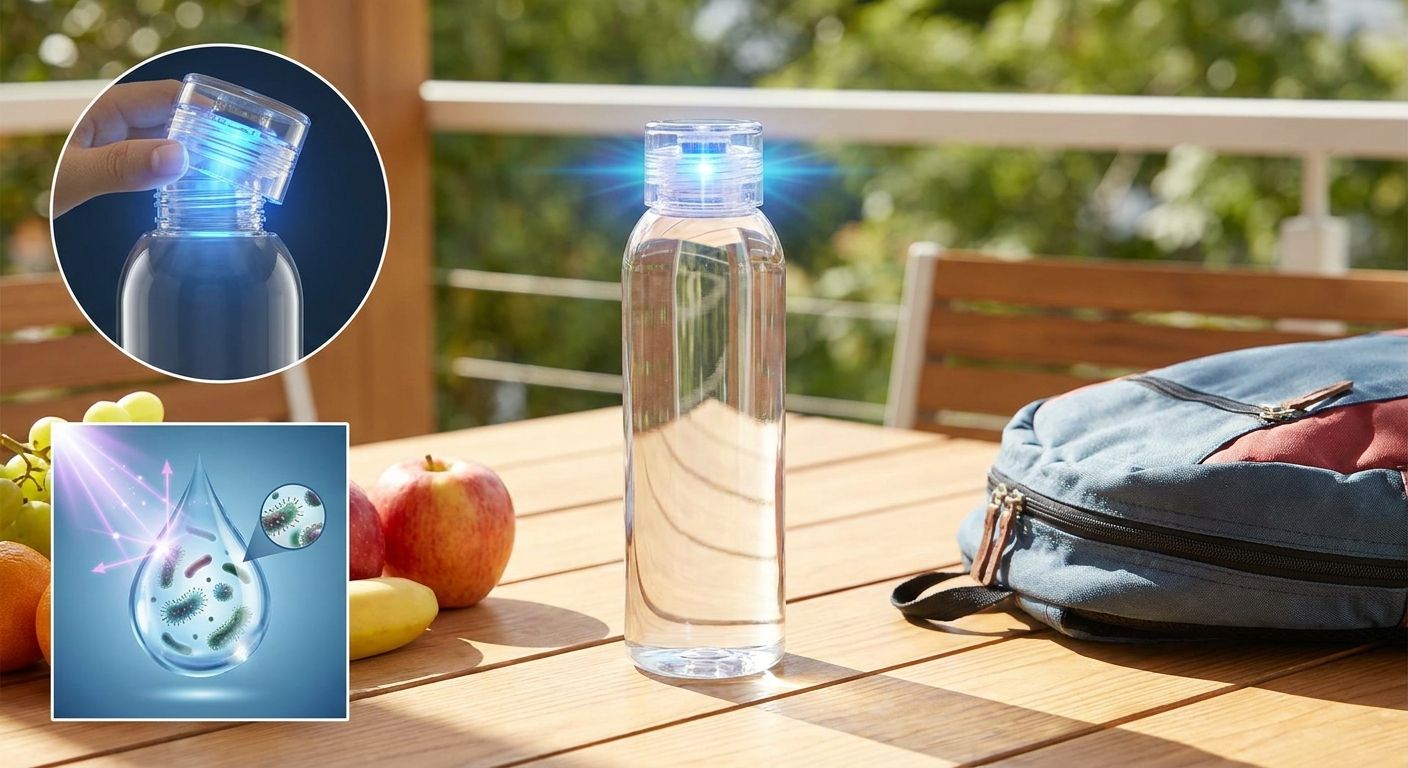
UV-C self-cleaning bottles kill bacteria the same way hospitals disinfect surgical tools: short-wavelength ultraviolet light scrambles the DNA and RNA inside microorganisms so they can't replicate. The cap houses a small UV-C LED that fires into the water for a set cycle, and anything single-celled sitting in the beam's path stops functioning within that window.
- UV-C light at 200-280nm damages bacterial DNA/RNA, the same principle behind hospital sterilization since the early 1900s.
- How UV-C self-cleaning bottles kill bacteria comes down to direct line-of-sight exposure inside the cap, not the whole bottle at once.
- UV-C kills bacteria and viruses on contact but does nothing for mineral scale, old smells, or gunk already stuck to plastic.
- Skip a cycle for a day or two and biofilm can re-form on the cap threads before UV-C gets another shot at it.
- Napio's UV self-cleaning water bottle guide covers cycle timing and charge habits for daily use in 2026.
Why this matters
A reusable bottle that never gets a proper wash is a warm, wet breeding ground. UV-C self-cleaning bottles cut down that bacterial load without soap, without a bottle brush, and without you remembering to do anything except press a button. That's the appeal, and it's also where the confusion starts, because "kills bacteria" gets thrown around as if the light reaches every square millimetre of a 750ml bottle. It doesn't.
Understanding the actual mechanism tells you what a UV-C bottle is genuinely good for in 2026, and what it still leaves to you.
How UV-C self-cleaning bottles kill bacteria
The process is mechanical, not chemical, and it happens in a handful of predictable steps:
- A UV-C LED sits in the cap or lid, positioned to shine down into the neck of the bottle where bacteria concentrate around the drinking spout and threads.
- Pressing the cycle button activates the LED for a fixed duration, exposing the water surface and cap interior directly to the ultraviolet wavelength.
- UV-C photons between roughly 200 and 280 nanometres penetrate bacterial cell walls and strike the DNA and RNA inside, causing molecular damage known as a thymine dimer.
- That damage blocks replication. A bacterium that can't copy its genetic material can't reproduce, and without reproduction the population collapses instead of multiplying every time you sip.
- The cycle ends and the LED shuts off automatically, usually tied to a timer so you're not left guessing whether it ran long enough.
This is the exact germicidal principle water treatment plants and hospitals have used for decades, just shrunk down into a bottle cap. The science isn't new; the packaging is.
What UV-C does not do
| Task | UV-C self-cleaning bottle | Soap and water wash |
|---|---|---|
| Kills bacteria on contact | Yes | Yes, if scrubbed thoroughly |
| Reaches deep scratches/crevices | Only what's in direct light path | Yes, with a brush |
| Removes mineral scale or residue | No | Partially |
| Clears existing odors baked into plastic | No | Sometimes |
| Requires manual effort daily | Minimal, press a button | Full wash each time |
The honest takeaway: UV-C handles the bacterial load between washes, it doesn't replace an occasional proper clean. If you want the walk-through on running cycles correctly, the UV self-cleaning water bottle guide covers when to press the button and how long to let it run.
Why kill rates vary between bottles
Not every UV-C bottle performs identically, and the gap usually comes down to a few physical factors:
- LED wavelength and output strength — cheaper LEDs can drift outside the effective 200-280nm germicidal band or run at lower intensity.
- Distance from the LED to the water surface — UV-C intensity drops sharply the further it travels, so cap geometry matters.
- Cycle duration — a rushed cycle exposes bacteria to less total UV-C dose than a longer one.
- Water clarity — cloudy or particle-heavy water scatters UV-C light before it reaches everything.
- Biofilm already stuck to the cap threads — light can't kill what it can't reach, and biofilm forms fast in warm, humid caps.
- Battery charge level — a low-charge LED often outputs weaker UV-C, even if the cycle indicator still lights up.
This is also why running the cycle daily beats running it once a week. Bacteria that survive a weak or interrupted cycle get a full 24 hours to multiply before the next attempt, and by then a thin biofilm layer can already be sitting on the cap threads, shielding whatever's underneath.
“UV-C kills what the light touches directly; it doesn't reach bacteria hiding under existing biofilm.”
Do UV-C water bottles kill all bacteria?
No, UV-C water bottles don't kill every organism in the bottle, only whatever sits directly in the light's path during the cycle. Bacteria shielded by biofilm, trapped in scratches, or clumped in cloudy water get partial or no exposure, which is why regular hand-washing still matters alongside the UV cycle.
How long does a UV-C self-cleaning cycle take?
Cycle length is set by the manufacturer and built into the bottle's timer, typically triggered by a single button press that runs for a fixed duration before shutting off automatically. Longer cycles generally deliver a higher UV-C dose, which matters more in bottles used for outdoor refills where water clarity is lower.
Are UV-C self-cleaning bottles safe to use every day?
Yes, daily use is how UV-C self-cleaning bottles are designed to work, since bacteria rebuild fast in a warm, wet cap and a missed day gives them a full cycle to multiply again. The LED only activates when the cycle is manually triggered, so there's no continuous UV exposure to the water you're drinking.
For anyone carrying a bottle through a gym bag or an office desk all day, the difference between a bottle run daily and one run twice a week is the gap where biofilm gets its first foothold. That's a bigger factor in performance than any spec sheet number. If your bottle spends most of its life at a desk, the self-cleaning bottle for office desks breakdown covers realistic daily habits for that setup specifically.
FAQ
How does a UV-C self-cleaning water bottle actually kill bacteria in 2026?
A UV-C self-cleaning water bottle kills bacteria by exposing them to ultraviolet light between roughly 200 and 280 nanometres, which damages the DNA and RNA inside the cell and blocks it from reproducing. The LED sits in the cap and only activates when a cycle is triggered, not continuously.
Is UV-C light safe to use around drinking water?
Yes, UV-C light is safe around drinking water because it's a physical disinfection method with no chemical residue, the same principle used in municipal water treatment. The light only affects microorganisms directly in its path and doesn't alter the water's taste or composition.
Can UV-C bottles kill viruses as well as bacteria?
UV-C's germicidal wavelength range damages the genetic material of both bacteria and many viruses, since the mechanism targets DNA/RNA structure rather than a specific organism type. Exposure time and distance from the LED still determine how effective any single cycle is.
Do UV-C self-cleaning bottles remove odors and mold?
No, UV-C self-cleaning bottles don't remove existing odors or visible mold, since the light only kills active microorganisms and doesn't break down residue already stuck to the plastic. A hand wash with soap is still needed to clear built-up smell or staining.
How often should you run the self-cleaning cycle?
Running the cycle once daily is the standard recommendation, since bacteria can rebuild noticeably within 24 hours in a warm, humid cap environment. Bottles used outdoors or refilled from unfiltered sources benefit from running the cycle after every refill.
Do UV-C bottles work on ice or frozen water?
UV-C light passes through clear ice with reduced effectiveness compared to liquid water, since the light needs a clear path to reach any bacteria present. Cycles are designed and timed for liquid water, so results with ice aren't consistent.
Is a UV-C bottle better than washing with soap and water?
Neither replaces the other outright: UV-C handles daily bacterial control without effort, while soap and water clears mineral scale, biofilm, and residue that UV-C light can't touch. The two work best combined, UV-C daily and a hand wash weekly.
Can UV-C light damage the bottle or the battery over time?
UV-C LEDs are built with a rated lifespan and shielded housing, so normal daily cycles shouldn't degrade the bottle material under typical 2026 manufacturing standards. Battery charge level does affect LED output strength, which is why keeping the bottle charged matters for consistent kill rates.
One last thing
The part most people miss: UV-C only sanitizes what the light can physically reach, which means the cap seal, the drinking spout edge, and any scratch in the plastic below the waterline stay untouched cycle after cycle. A bottle that looks spotless can still be growing biofilm in spots the LED never sees, which is exactly why a weekly hand wash alongside the daily UV-C cycle catches what the light structurally can't.