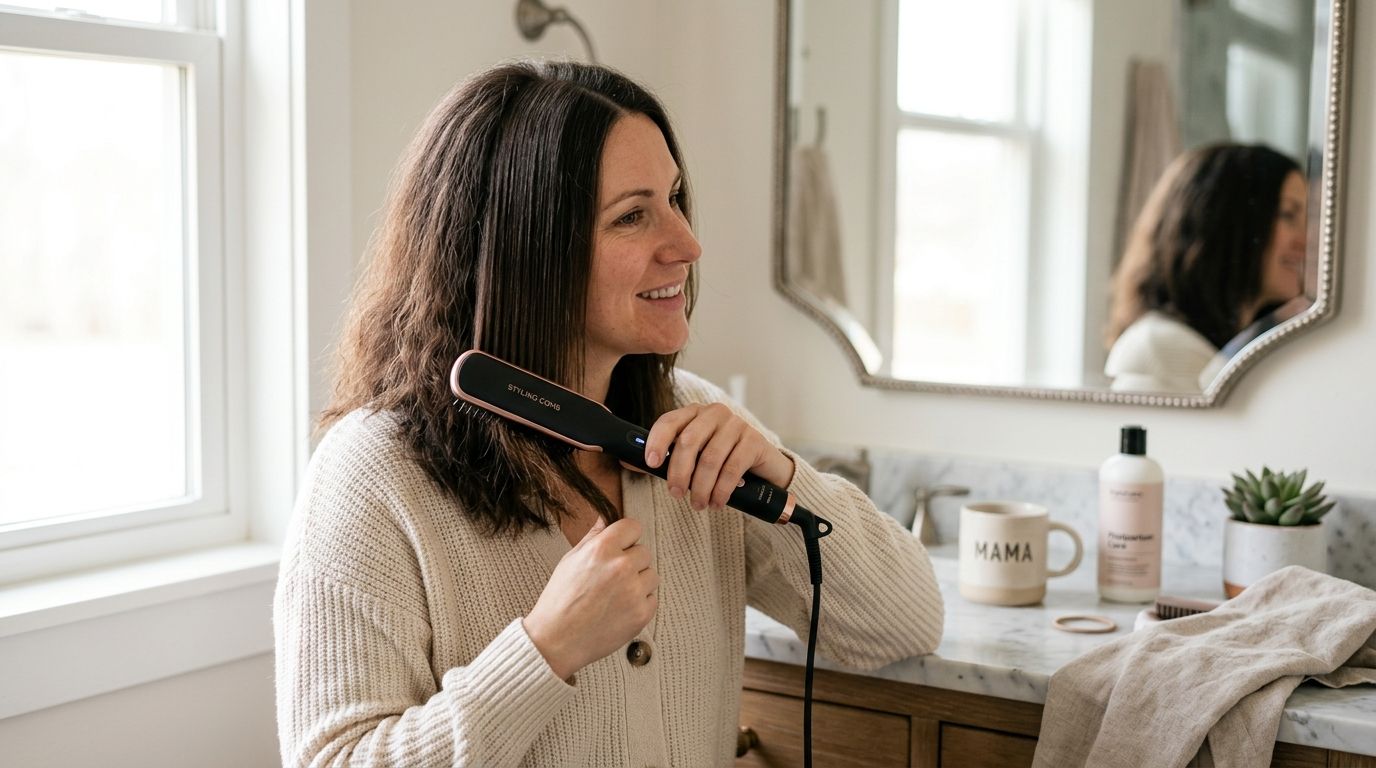
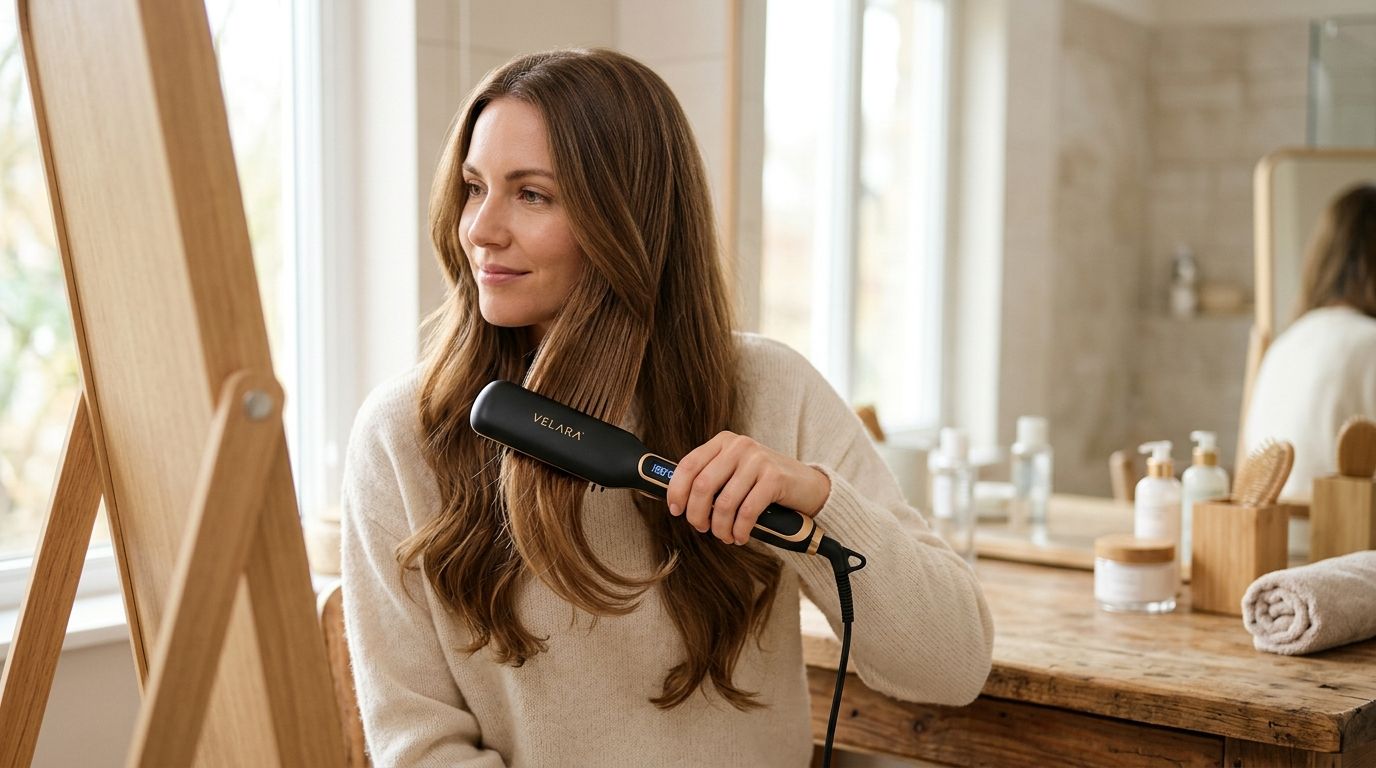
A straightening brush for split ends prevention won't repair hair that's already split — nothing does that except a trim — but the right brush, temperature and technique stop new splits from forming while you style. Split-end-prone hair needs a tool that seals the cuticle in one slow pass instead of dragging heat repeatedly over the same fragile inch of shaft.
- A straightening brush for split ends prevention slows new breakage; it cannot reverse damage already done to the ends.
- Heat above 180°C on fine or color-treated ends accelerates splitting even with a brush instead of a flat iron.
- One slow pass per section beats three fast ones — repeated passes are the main cause of split-end spread in 2026 usage patterns.
- Detangling before heat and trimming every 8-10 weeks matter more than which brush you buy.
Why split ends prevention matters for this segment
If your ends are already fraying, every heat pass is a decision between styling and further damage. Split ends don't heal — they travel up the shaft if left alone, turning a one-inch problem into a three-inch one by the time you notice.
Women searching for a straightening brush for split ends are usually past the point of tolerating a flat iron's direct-plate contact, which concentrates heat on the exact fragile tips they're trying to protect. A rotating or comb-style brush spreads that same heat across bristles instead of two flat plates, which is why this segment gravitates toward brushes over irons in the first place.
The goal isn't a fix. It's damage control while you grow out the trim.
Update your trim schedule before you touch heat
No brush setting compensates for ends that are six months overdue for a cut.
- Book or self-trim every 8-10 weeks if you heat-style more than twice a week
- Check ends under natural light monthly — splits are easiest to spot dry, not wet
- Cut a half-inch minimum; a quarter-inch trim often misses the damaged section entirely
- Treat any visible white dot at the tip as a split already in progress, not a warning sign
Detangle before any heat reaches your hair
Heat locks in whatever tension is already in the strand. Running a straightening brush through knotted hair pulls at the weakest point — usually the end — and that's exactly where splits start.
- Use a wide-tooth comb or detangling brush on dry hair, working from ends up to roots
- Never detangle wet hair with a fine-tooth comb — wet strands stretch and snap more easily
- Apply a light leave-in or detangling spray to fine or coarse textures before combing
- Work in sections no wider than an inch for thick or coily hair
- Stop and re-comb if you feel resistance instead of forcing the brush through
Choose the lowest heat setting that still works
This is where most split-end damage actually happens — not from the brush itself, but from running it at 220°C because that's the default setting.
- Fine or color-treated hair: start around 150-170°C
- Medium, undamaged texture: 170-190°C is usually enough
- Thick or coarse hair: up to 200°C, rarely higher
- Test on an inner section first — if it doesn't smooth in one pass, the setting is too low, not too high
- Drop 10-20°C from your usual iron temperature when switching to a brush; bristle contact styles differently than flat plates
A straightening brush at the right heat setting should smooth hair in one pass. If you're going over the same section three or four times, the temperature is wrong for that section, not the tool.
“If you can't run the brush through in one slow pass, the setting's too hot for those ends.”
Apply a heat protectant every single session
Skipping protectant to save 30 seconds is the single most reversible mistake in this routine.
- Spray or apply protectant to damp or dry hair, focusing on the bottom third where splits form
- Reapply if you're re-styling the same section later in the day
- Choose a lightweight formula for fine hair — heavy products weigh down and slow drying
- Don't substitute a leave-in conditioner for a heat protectant; they solve different problems
Section hair and use one slow pass per section
Speed is not the enemy here — repetition is. One deliberate pass at the correct temperature does more than four rushed ones at a lower setting.
- Clip hair into four to six sections depending on thickness
- Work each section top to bottom in a single continuous motion
- Let the brush glide; don't clamp or pause mid-section
- Move to the next section instead of going back over the same one twice
Cool and seal before you move on
Hair is more pliable and more damage-prone while it's still warm. Letting each section cool for a few seconds before touching it again reduces the chance of re-bending or snapping a fragile tip.
- Run a cool blast from a hairdryer over freshly straightened sections if you have one on hand
- Avoid tying hair up or brushing it again until it's fully cool
- Apply a small amount of hair oil to the ends only, after cooling, to smooth the cuticle
Deep-condition weekly to support the routine
A straightening brush works with whatever condition your hair is already in. Weak, dry ends split faster no matter how careful the styling technique is.
- Use a weekly deep conditioning mask focused on mid-lengths to ends
- Add a protein treatment monthly if hair feels limp or overly stretchy when wet
- Cut back heat-styling frequency to twice a week while ends recover from a trim
Comparing your options for split-end-prone hair
| Option | Best for | Key limitation |
|---|---|---|
| Straightening brush | Fine to medium hair wanting daily smoothing with less direct plate contact | Slower per session than a flat iron on very thick hair |
| Flat iron | Fast, sleek results on thick or coarse hair | Direct plate contact concentrates heat exactly where splits already exist |
| Hot comb | Textured or natural hair needing root-to-tip smoothing in one motion | Not designed for daily use on already-fragile ends |
| No-heat styling (rollers, braids) | Anyone actively growing out damage post-trim | Slower results, less precise on frizz-prone sections |
For split ends specifically, a heated brush built for damaged hair wins over a flat iron on cuticle contact area — buy it if your ends are already compromised and a trim isn't due yet.
Common mistakes this segment makes
- Expecting the brush to fix splits instead of just preventing new ones. No heat tool reverses a split — only scissors do.
- Running the highest setting because hair feels thick at the roots. Roots and ends rarely need the same temperature; splitting happens at the tips, not the scalp.
- Reusing the same section three or four times to chase extra smoothness. Repeated passes, not single high-heat contact, cause most cumulative split-end damage.
- Skipping the trim and blaming the brush when splits keep appearing. A brush slows damage; it can't outpace six months of overdue cutting.
- Styling soaking-wet hair to save a blow-dry step. Wet hair styled with heat is the fastest way to cause breakage at the ends in 2026 as much as any prior year.
FAQ
Does a straightening brush cause split ends?
A straightening brush can cause split ends if used at too high a temperature or run over the same section repeatedly. Used at the lowest effective setting in one slow pass, it causes less cuticle damage than a flat iron's direct plate contact.
Can a straightening brush fix split ends?
No heat tool fixes split ends — only a trim removes them. A straightening brush for split ends prevention only slows the spread of existing splits while you grow out a haircut.
What temperature should I use on damaged or split ends?
Start around 150-170°C for fine or color-treated hair with split ends, rising to 190°C only if one pass doesn't smooth the section. Higher settings on already-fragile ends speed up further splitting.
Is a straightening brush better than a flat iron for split ends?
A straightening brush distributes heat across bristles rather than two flat plates, which reduces direct concentrated contact on fragile tips. A flat iron styles faster but presses heat directly onto the exact section prone to splitting.
How often should I trim hair prone to split ends?
Trim every 8-10 weeks if you heat-style two or more times a week. Waiting longer lets splits travel further up the shaft before the cut removes them.
Should I use heat protectant with a straightening brush?
Yes, every session, with extra focus on the bottom third of the hair where splits form first. Skipping protectant on already-damaged ends accelerates further breakage regardless of the brush's settings.
Can I use a straightening brush on wet hair to prevent split ends?
No. Styling wet hair with heat causes more breakage at the ends than dry styling, because wet strands stretch and snap under heat and tension.
One last thing
The detail most people miss: split ends don't split evenly along the strand — they concentrate wherever the hair was last cut with dull scissors or over-processed with color. If your splits keep reappearing in the same section after a trim, that section needs a deeper cut, not a lower heat setting on the brush.