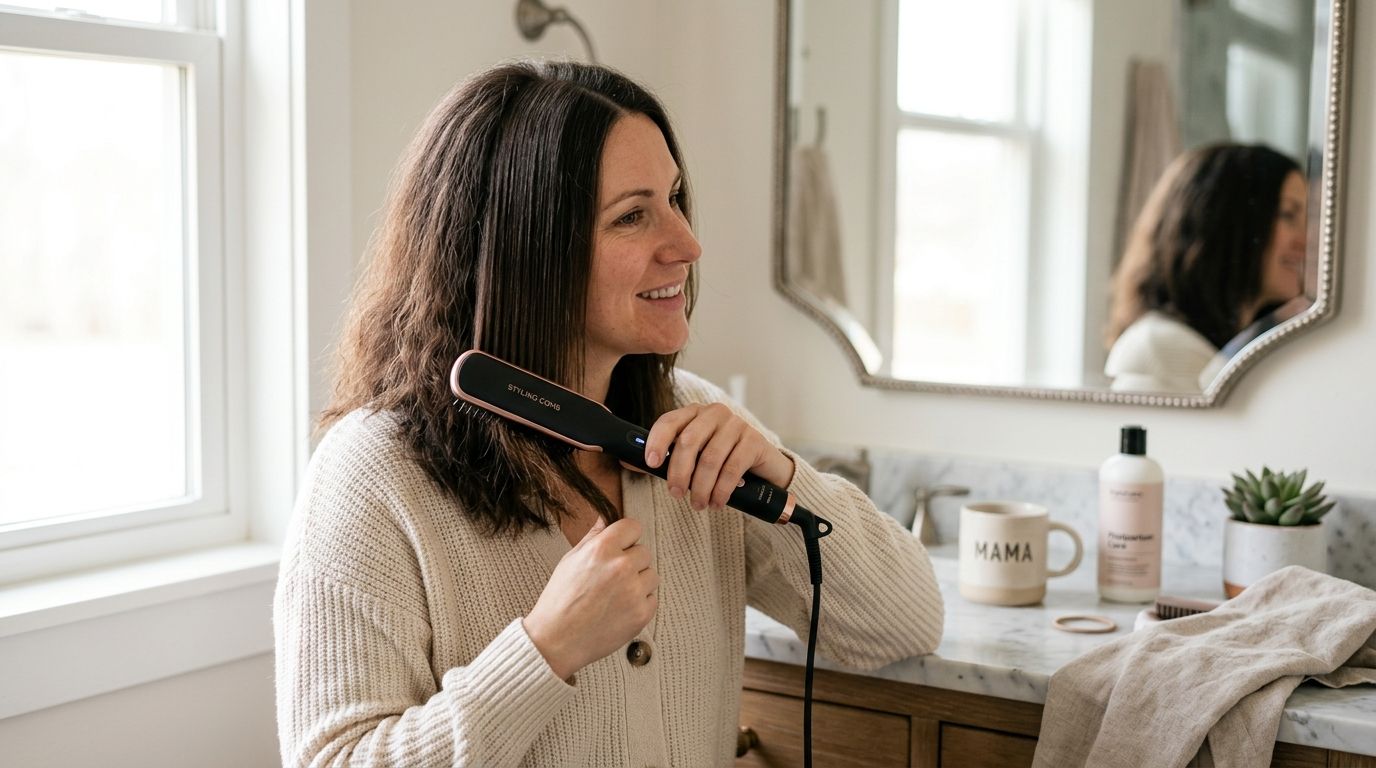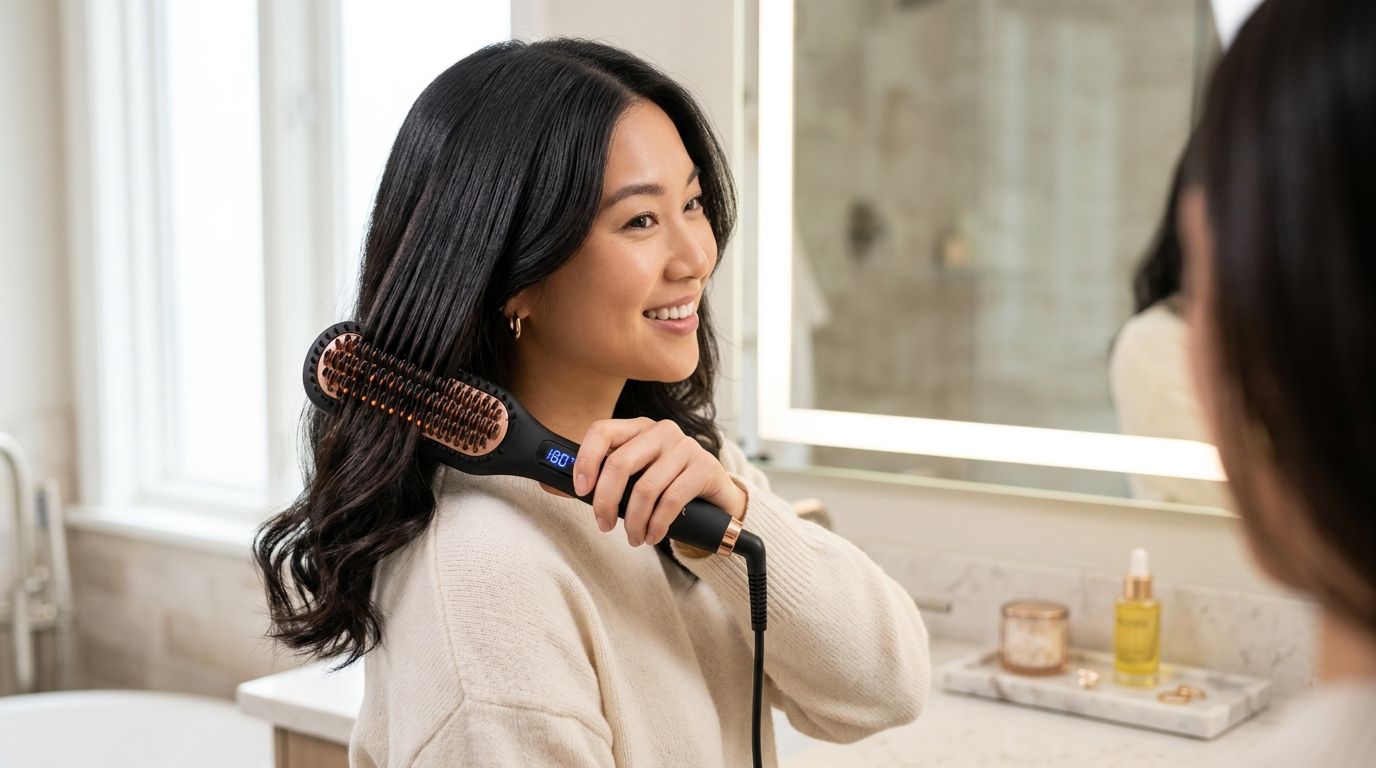
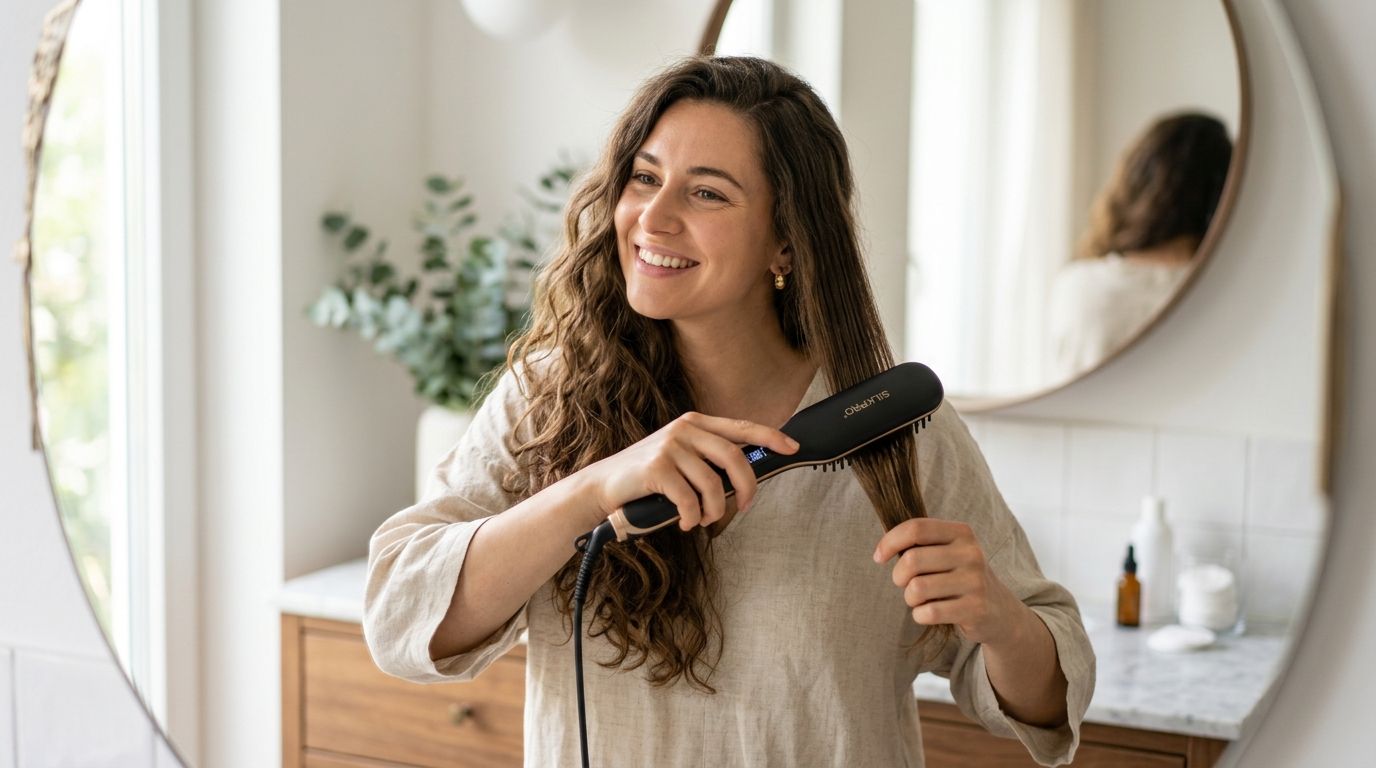
Straightening brush for wavy hair needs a lower heat ceiling and finer-spaced bristles than the tool built for thick, coily strands, because wavy (type 2) hair scorches fast and reverts to frizz within hours if a smoothing pass skips heat protection. Wavy hair is naturally thinner in diameter than curly or coily hair, which means it holds less moisture and takes heat damage faster even though it looks "easier" to style.
- Wavy hair needs a straightening brush with a lower heat ceiling than curly or coily hair to avoid frying finer strands.
- Detangling and heat protectant before the first pass matter more for wavy hair than for thicker textures.
- Vital by Napio's straightening brush for wavy hair works best on hair dried to 80-90% at moderate heat, not maximum.
- A round-brush blowout and a keratin treatment both compete with a straightening brush, but each trades speed for upkeep.
- In 2026, buyers with waves are choosing adjustable-heat tools over fixed-temperature flat irons.
Why a straightening brush matters for wavy hair
Wavy hair sits between straight and curly on the texture chart, and that middle position is exactly why it's harder to style well. It frizzes at the first sign of humidity, it half-reverts by midday, and a flat iron calibrated for coarse or coily hair will run hotter than wavy strands can handle.
A straightening brush solves a specific problem for this segment: it smooths the cuticle and cuts frizz without demanding the pin-straight, plate-clamped pass that thicker hair types need. That distinction matters in 2026, when more people shop by hair type rather than by tool category, and wavy-specific guidance is the gap most straightener guides still skip.
How wavy hair differs from curly or coily hair in styling needs
- Finer strand diameter means faster heat absorption and quicker damage at high settings
- Waves revert faster in humidity than tighter curl patterns, so hold matters as much as smoothness
- Root volume is easy to lose if the brush flattens the crown along with the frizz
- Wavy hair air-dries faster, so timing a damp-hair pass goes wrong quickly
- The underlayer is often coarser than the crown, so one heat setting rarely suits the whole head
Most straightener marketing pushes maximum temperature as a feature. For wavy hair that's backwards — the useful spec is how low the tool goes and how evenly it holds that low setting across a pass.
Update your prep: detangle and dry before you touch heat
Skipping prep is the single biggest reason a straightening brush for wavy hair underperforms. Wavy strands tangle at the mid-shaft, and running a hot brush over a knot either snags hair or forces you to re-pass the same section, doubling heat exposure for zero extra smoothness.
- Comb through with a wide-tooth comb starting at the ends, working up to the roots
- Dry hair to at least 80-90% before the first heat pass, never soaking wet
- Separate the crown from the underlayer so you're not blasting the same section twice
- Apply a lightweight heat protectant spray, focused on mid-lengths and ends
- Skip heavy leave-in conditioners right before styling; they add slip but slow the smoothing pass
Match the heat setting to wavy hair's finer cuticle
Wavy hair burns at settings that barely register on thicker textures. Start low and move up only if the first pass doesn't smooth the section in one go — that's the whole rule.
- Start at the lowest heat setting your brush offers and test one small section first
- Move up only if a single pass isn't smoothing frizz after 2-3 seconds of contact
- Avoid the highest setting entirely on fine or lightened wavy hair
- Slow the pass speed instead of raising heat when a section resists
- Drop back down a setting for the crown, which is usually the finest hair on your head
For a full breakdown of matching settings to hair type, how to choose the right heat setting for a straightening brush covers the temperature bands most brushes offer and which suits wave-prone strands.
Choose a straightening brush built for finer textures
Here the tool decides the outcome, not the technique. A brush with ceramic or tourmaline plates and a genuine adjustable heat dial gives wavy hair control that a fixed-temperature flat iron can't.
- Ceramic or tourmaline plates distribute heat evenly instead of creating hot spots
- An adjustable dial beats a two-position high/low switch for fine, wavy strands
- Rounded bristle spacing that detangles while it smooths cuts the number of passes needed
- A narrower plate width lets you work small wavy sections without flattening root volume
- Fast heat-up matters less than heat stability across a full pass
Vital by Napio builds its electric hair straightening comb around this exact tradeoff: enough heat to smooth frizz on wavy hair without forcing the flat, pin-straight finish that coarse-hair tools are calibrated for. If your waves run on the finer end, the straightening brush for fine and thin hair guide covers where heat tolerance drops further.
Work small sections from root to tip
One wide pass over a large section of wavy hair misses frizz at the ends while over-processing the roots. Sectioning is what keeps heat exposure even.
- Clip hair into 4-6 sections before starting, more for thicker wavy hair
- Take sections no wider than the brush plate itself
- Work each section in one continuous pass from root to tip
- Angle the brush slightly downward at the ends to seal the cuticle
- Never go back over a section more than twice in one styling session
Lock the finish and prevent wave reversion
Wavy hair reverts faster than straight or coily hair once humidity or scalp oil reaches the strand. The finishing step decides how long the result actually holds — often the difference between four hours and a full day.
- Run a cool-air pass over each section immediately after straightening to set the cuticle
- Use a light finishing serum on the ends only, never the roots, to protect volume
- Tie hair loosely or wrap it before bed instead of letting it crease on a pillow
- Avoid touching or re-brushing hair for the first hour after styling
If repeat styling is part of your week, how to prevent heat damage with a straightening brush breaks down protectant layering and cool-down timing in more detail.
“If your straightening brush needs more than one pass per section, the plates aren't hot enough or the hair wasn't dry enough to begin with.”
Build a realistic weekly routine
Wavy hair doesn't need daily heat, and treating a straightening brush as an everyday tool is how damage accumulates without anyone noticing. Two or three heat days a week, with a protectant every single time, holds a smooth finish while giving the cuticle recovery room.
- Style on freshly washed, mostly dry hair rather than day-three hair loaded with product
- Refresh mid-week with a single low-heat pass on the top layer only
- Keep one full heat-free day between styling sessions where possible
- Wipe the plates down once a week so product residue doesn't drag on the next pass
Compare your options for wavy hair in 2026
| Option | Best for | Key limitation |
|---|---|---|
| Traditional flat iron | Pin-straight finish on thicker sections | Runs hot fast; easy to fry fine wavy strands |
| Straightening brush (Vital by Napio) | Frizz control while keeping natural volume | Not built for a full pin-straight, coily-hair finish |
| Round brush blowout | Soft wave smoothing with added volume | Needs dryer skill; slowest routine of the four |
| Keratin or smoothing treatment | Long-term frizz reduction, minimal daily styling | Chemical process, grows out, requires a salon visit |
Verdict: for wavy hair in 2026, a straightening brush with adjustable heat is the better daily-use pick than a standard flat iron or a keratin treatment, because it smooths frizz without erasing the wave pattern or committing you to a chemical service. Best for: type 2 hair that frizzes and reverts but doesn't need to be poker straight.
Common mistakes wavy hair makes with a straightening brush
- Cranking the heat because "wavy isn't that curly" — wavy strands are often finer than curly ones and burn faster, not slower
- Skipping heat protectant on a "quick touch-up" — repeated quick passes without protection add up to the same damage as one long session
- Chasing frizz by re-passing the same section five or six times — that concentrates damage in one spot instead of fixing the cause, which is usually damp hair or too-large sections
- Treating the whole head as one texture — the underlayer is frequently coarser than the crown, so a single setting under-processes one and over-processes the other
- Styling on fully wet hair to save a step — it forces multiple passes per section, which is worse for wavy hair than drying first and doing one clean pass
FAQ
What's the best straightening brush for wavy hair in 2026?
A ceramic or tourmaline-plate straightening brush with adjustable heat, such as the Vital by Napio electric hair straightening comb, suits wavy hair best because it smooths frizz at lower settings without forcing a pin-straight finish. Fixed-temperature flat irons run hotter than most wavy hair needs.
Is a straightening brush better than a flat iron for wavy hair?
For wavy hair, yes. A straightening brush detangles and smooths in one motion at a lower heat setting, while a flat iron gives a straighter result but risks more heat damage on fine, wave-prone strands.
What heat setting should wavy hair use on a straightening brush?
Start at the lowest setting and test one section before increasing. Most wavy hair smooths in a single pass well below the highest heat band a brush offers, and the crown usually needs less heat than the underlayer.
Can a straightening brush damage wavy hair?
Yes, if the heat is too high or the same section gets passed more than twice. Applying heat protectant and drying hair to 80-90% before styling reduces the risk considerably.
How often can I use a straightening brush on wavy hair?
Two to three heat days a week with protectant every time is a sustainable rhythm for wavy hair. Daily high-heat use is where damage compounds without being obvious for months.
Does a straightening brush work on damp wavy hair?
It works best on hair dried to at least 80-90%, not fully wet. Styling soaking hair forces multiple passes per section, which increases total heat exposure rather than saving time.
Will a straightening brush remove all the wave pattern?
Not entirely. A straightening brush smooths frizz and cuticle texture while leaving more root volume and natural movement than a flat iron, which is exactly why it suits wavy hair.
What's the difference between a straightening brush and a hot comb for wavy hair?
A straightening brush combines flat plates with bristles so it detangles and smooths in one pass, while a hot comb relies on comb teeth alone and typically needs more passes on wavy sections.
One last thing
The fastest fix for wave reversion isn't a stronger hold product — it's the cool-air pass right after straightening. Skipping that ten-second step is why so many wavy styles look perfect at 9am and frizzy by noon in 2026's humidity swings. Lock the cuticle while it's still warm, not after it has cooled on its own.