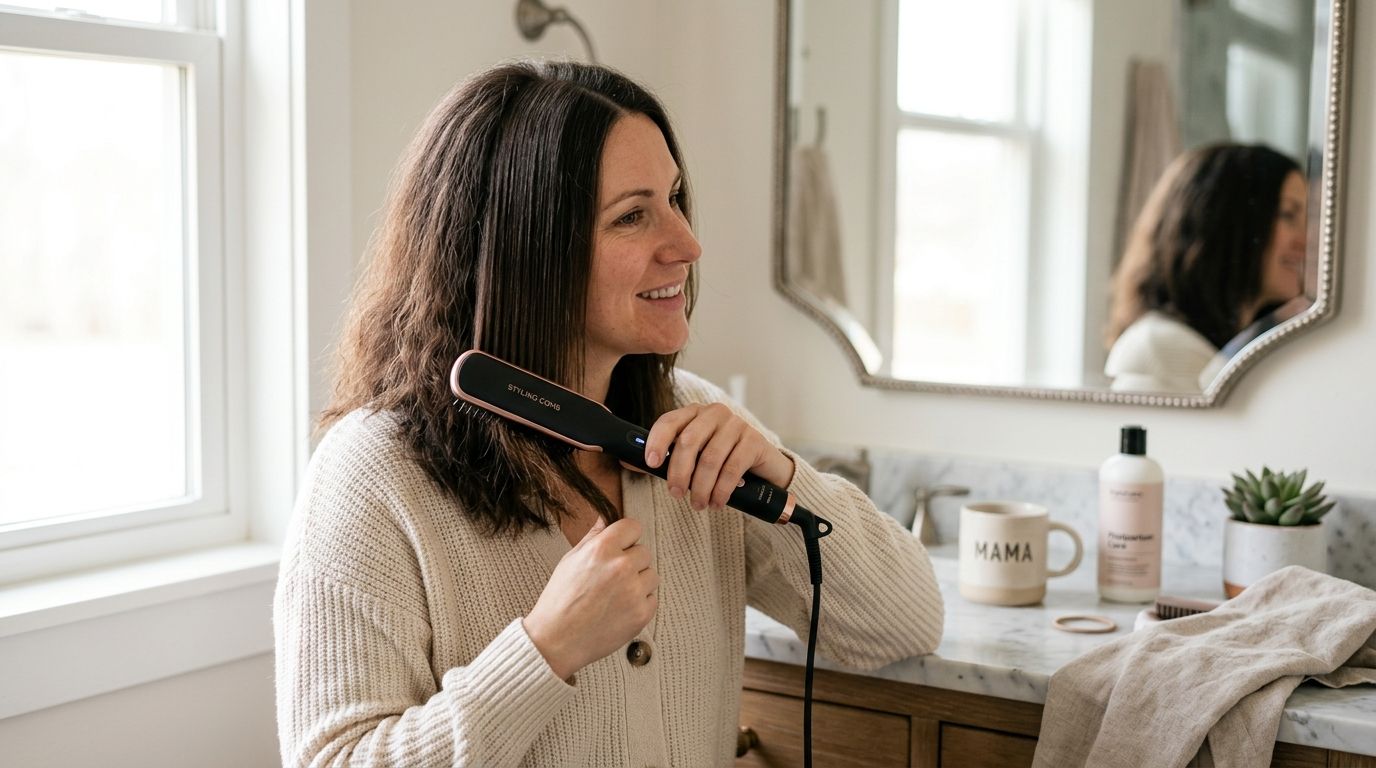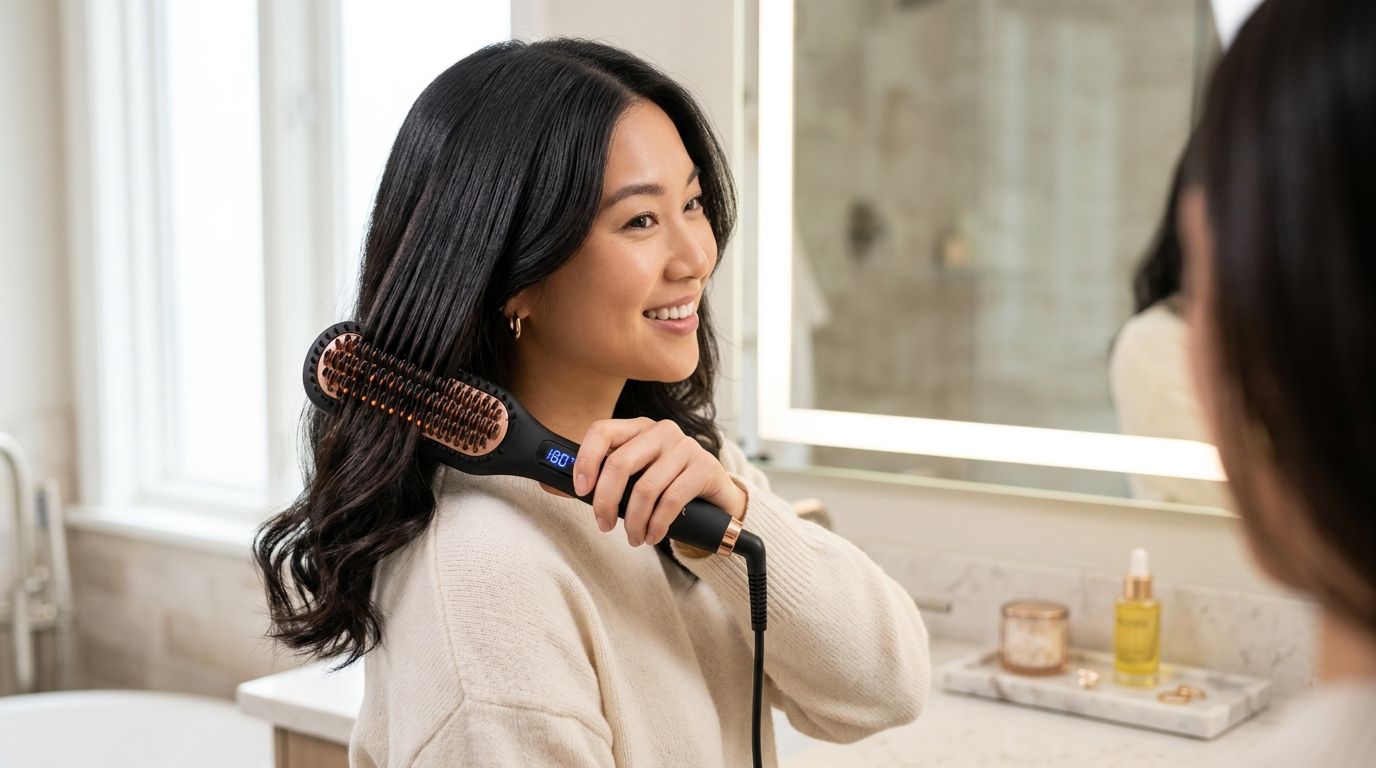
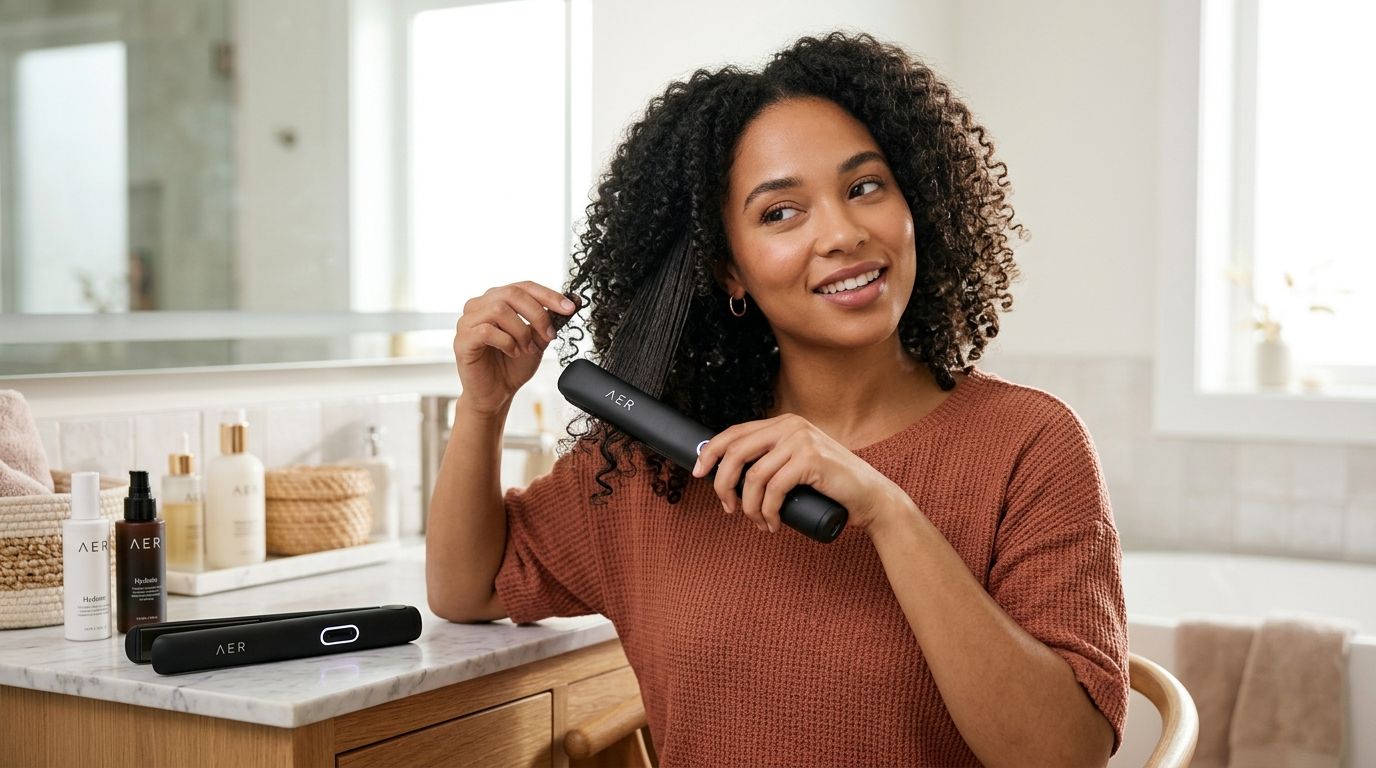
Cordless hair straightener for biracial hair means a battery-powered flat iron, comb, or brush built to handle two curl patterns on the same head without frying the finer sections. Biracial hair usually mixes a looser crown or nape with denser, coarser curls elsewhere, so a single heat setting that works for one zone often scorches the other.
- A cordless hair straightener for biracial hair needs at least two heat zones, not one universal setting.
- Set temperature by your coarsest section (usually 380-450F), never the average texture.
- Section by texture boundary, not by even parts — uneven sections are correct here.
- Detangle and fully dry before heat touches strands; damp heat styling causes the worst breakage.
- Cordless beats corded on mixed-texture hair because you pivot between zones without cord drag.
Why straightening technique matters for biracial hair
Biracial hair rarely behaves as one texture. You might have 2c waves at the temples, 3b coils through the crown, and denser 4a at the nape — three heat tolerances under one part line. A hot comb for natural and afro hair guide assumes fairly uniform density, and that assumption is exactly what burns the finer sections on a biracial head.
Heat damage on mixed-texture hair compounds quietly. Coarse sections show it fast as frizz and reversion. Fine sections show it weeks later as breakage at the crown. By the time both are visible, you have been overheating one zone for months.
The tool is not the fix by itself — the sectioning and heat mapping around it are what protect your ends. Cordless matters here more than on single-texture hair because you switch angles and settings constantly across one head, and a cord fights you every time.
Map your texture zones before you start
Run your fingers through dry hair and note where the curl pattern changes. Do this before you touch a tool, and do it again every few months in 2026 as growth and colour shift the map.
- Clip the crown, nape and temple zones separately and treat them as different heads of hair
- Note shrinkage per zone when damp — more shrinkage usually means more resistance to straightening
- Flag every colour-treated section, since colour lowers heat tolerance regardless of curl pattern
- Flag transitioning or previously relaxed lengths — these take the lowest setting on the head
- Write the map down for the first three or four sessions until it becomes automatic
Section by curl pattern, not by size
Most tutorials tell you to split hair into six or eight even parts. That is wrong for biracial hair because even parts ignore where the texture actually changes.
- Clip along texture boundaries even when the resulting sections are wildly uneven
- Keep the coarsest zone isolated and never blend it with finer hair
- Work top-down so cleared sections do not re-tangle
- Use smaller clips at the crown if that is your densest zone
- Re-clip mid-session if a section is fighting you — that usually means two textures are stuck together
Set heat by your coarsest section, not the average
This is the single biggest mistake on mixed-texture hair. One temperature for the whole head either under-treats the coarse crown or torches the temples.
- Start coarse, curl-resistant sections in the 380-450F range, the usual ceiling for dense hair before damage risk outweighs the result
- Drop to 300-380F for fine, colour-treated or previously damaged sections
- Read the actual plate temperature rather than trusting a numbered dial
- Retest tolerance seasonally — porosity shifts with weather and product buildup
- Comb-style tools spread heat across coarse sections and usually need fewer high-heat passes than plates; the electric hair straightening comb walkthrough covers the angle and speed that make that work
“Dialing heat by zone instead of by habit is the difference between a press that lasts and one that reverts by lunch.”
Detangle and moisturise before any heat
Dry, tangled biracial hair snaps under heat instead of gliding through it. This step gets skipped more than any other because it feels like it slows the session down.
- Detangle with a wide-tooth comb on damp hair, ends to roots
- Apply heat protectant to every zone, heavier on the coarsest section
- Dry fully before straightening — heat on damp hair boils moisture inside the strand
- Avoid high-alcohol leave-ins immediately before heat styling
- Re-moisturise ends specifically, since ends carry the most cumulative heat on any multi-texture head
Work small passes at the crown, wider passes at the temples
Pass count matters as much as temperature once your sections are mapped.
- Take 1-2cm sections through the coarse crown; thick sections need repeat passes and repeat passes are the damage
- Take 3-4cm sections through finer temple and nape hair where one or two passes finish the job
- Move at a steady, unhurried speed — stalling in one spot creates heat spots
- Never re-pass hair that is already straight; check first
- Pivot the tool to match section angle, which is where cordless earns its place
Cool-set each section before releasing it
Hair holds a new shape when it cools in that shape. Skip this and the crown reverts by mid-afternoon.
- Let each section cool 10-15 seconds before unclipping
- Do not brush or touch a section while it is still warm
- Use a cool shot from a dryer on the section straight after the pass
- Pin looser curl zones flat while they cool, since those revert fastest in humidity
Protect the ends and the plates
Ends are the oldest, most heat-exposed part of the strand, and on biracial hair they are often where two textures meet and tangle.
- Oil or serum on ends only, after straightening, never before
- Trim every 8-10 weeks regardless of how the mid-lengths look
- Wipe plates or comb teeth after every session — buildup transfers heat unevenly, which hits mixed texture hardest
- Charge fully before travel so you are not cranking heat to compensate for a slow, low-battery glide
- Store in a heat-resistant pouch so scratched plates do not catch coarse strands
If you fly with your tool, the packing guide for a cordless straightener covers battery rules and cool-down timing before it goes in a bag.
Comparison: options for biracial hair
| Option | Best for | Key limitation |
|---|---|---|
| Cordless straightening comb | Mixed-texture heads needing zone-by-zone heat control | Slower than plates on an all-over coarse head |
| Corded ceramic flat iron | Full-head presses on one dominant texture | Cord tension makes fast zone-switching awkward |
| Heated straightening brush | Looser waves, smoothing, finishing passes | Weaker on tightly coiled crown sections |
| Corded hot comb | Deep coarse-texture straightening in fewer passes | Needs an outlet every session; poor for travel |
Verdict: a cordless straightening comb is the best cordless hair straightener format for biracial hair in 2026, because it lets you change heat and pass count per zone without a cord dragging your part sideways. Napio sells cordless straightening tools in exactly that comb format, and the Napio range is worth checking against the heat ranges above before you buy.
Common mistakes on biracial hair
- One heat setting for the whole head. No single number serves a 2c temple and a 4a nape. Pick per zone or accept damage somewhere.
- Straightening before hair is bone dry. Trapped moisture under heat causes steam damage that looks like frizz and behaves like breakage.
- Over-passing a stubborn crown. Extra passes feel productive and multiply damage faster than they improve smoothness. Lower the section width instead.
- Assuming curlier always means hotter. A coarse low-porosity section can scorch at a temperature that barely touches a finer high-porosity one. Porosity outranks curl pattern.
- Ignoring plate hygiene. Product residue makes heat distribution uneven across a head that is already uneven — the exact problem you bought the tool to solve.
FAQ
What's the best cordless hair straightener for biracial hair in 2026?
A cordless straightening comb with adjustable heat is the best fit for biracial hair in 2026, because it handles two curl patterns without forcing one temperature across the whole head. Napio sells this format.
Is a cordless straightener better than a corded one for mixed-texture hair?
Yes, for mixed texture. You pivot between coarse and fine zones without cord tension pulling your part, which matters when you are re-clipping sections constantly.
What heat setting should biracial hair use?
Coarse, curl-dense sections generally handle 380-450F, while fine or colour-treated sections belong in the 300-380F range. Never set the whole head to one number.
Does a hot comb work better than a flat iron on biracial hair?
A comb spreads heat through coarse sections in fewer passes; a flat iron finishes fine sections faster. Many biracial heads use both across different zones.
How often can you straighten biracial hair without damage?
Spacing sessions 7-10 days apart with a deep moisture treatment in between limits cumulative heat damage on mixed-texture hair. Frequency matters more than temperature over a year.
Can one straightener handle 4a and 2c hair on the same head?
Yes, if the tool has adjustable heat and you section by texture. A fixed-temperature tool cannot serve both patterns safely.
Why do some sections revert faster than others?
Sections that skipped the cool-set step revert first, because hair only holds a shape once it cools in that shape. Higher-porosity zones also revert faster in humidity.
Should colour-treated biracial hair use lower heat?
Yes. Keep colour-treated sections at 300-380F regardless of curl pattern, since colour processing already weakens the cuticle before any heat is applied.
One last thing
The zone that reverts first by evening is almost never the coarsest one. It is the section you rushed because it looked easy. Give the fine temple and nape hair the same slow passes and cool-set seconds you give the crown in 2026, and the whole head holds shape hours longer.