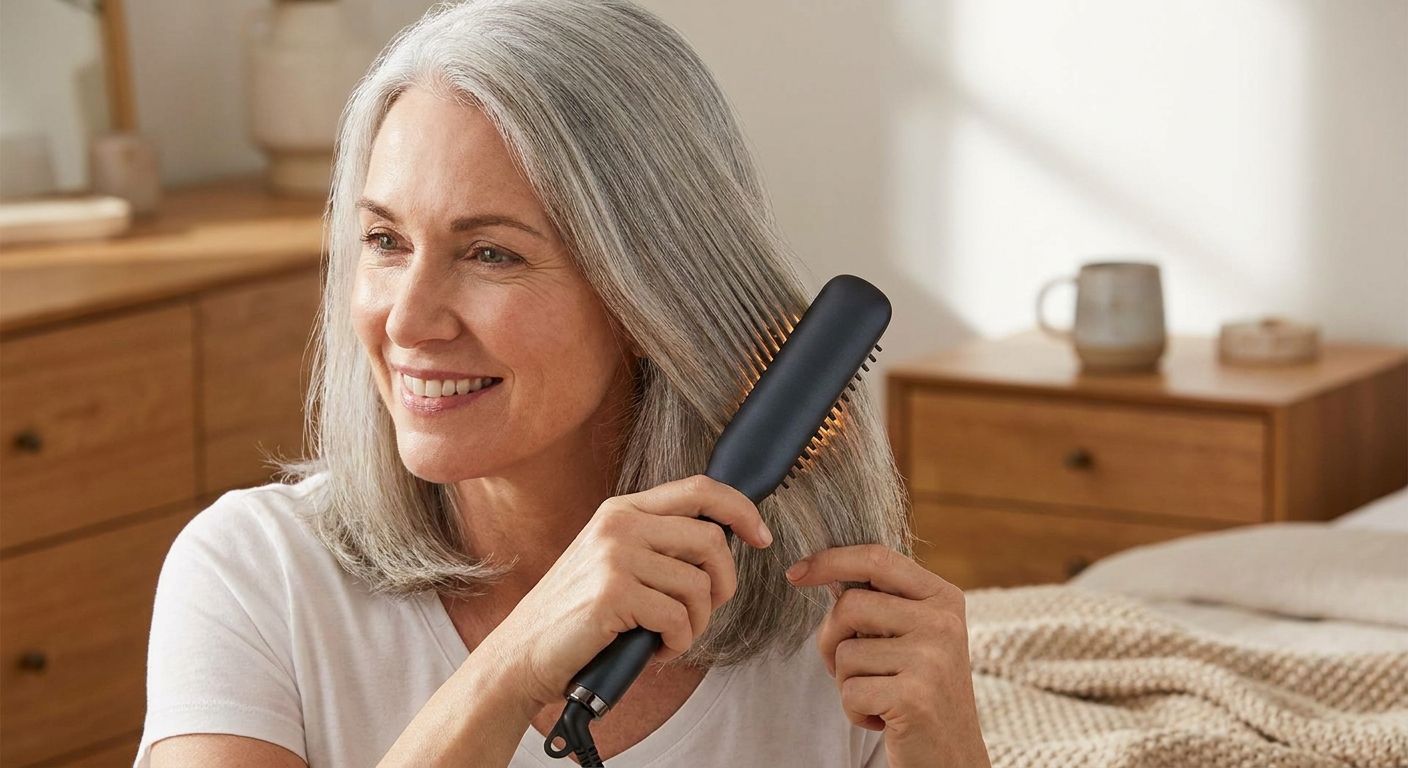
Gray hair behaves differently under heat than pigmented hair, and a heated hair brush for gray hair only earns a spot in your routine if it smooths coarse, wiry strands without stripping the little natural oil gray hair produces. Most gray hair is more porous and drier than it was in your 30s, so the brush, the heat setting, and the brushing technique all need to change with it.
- A heated hair brush for gray hair should run around 180-200°C, not the 230°C settings built for thick pigmented hair.
- Gray strands are more porous, so heat protectant is not optional the way it once felt.
- Weekly plate cleaning stops the residue buildup that dulls gray and white hair fastest.
- Sectioning matters more on gray hair because missed patches show as obvious texture gaps.
- A heated brush beats a flat iron on thinning crowns: one hand, one pass, less pressure.
Why heated styling matters for gray hair
Gray and white hair loses the pigment that used to sit inside the hair shaft, which leaves the cuticle rougher and more prone to frizz and static. That's why a brush set for pigmented hair often over-processes gray hair at the exact same temperature a younger user would pick without thinking.
People searching for a heated hair brush for gray hair in 2026 are usually solving one of three problems: wiry, resistant texture that won't lie flat; dullness or a yellow cast from mineral and product buildup; or thinning at the crown that makes a flat iron feel too aggressive. A heated brush handles the first two in a single pass. For gray hair, a heated brush is the better daily tool than a flat iron, because it smooths in one motion at a lower, more controllable temperature. The best heated hair brush for damaged hair guide covers the overlap when gray hair has already taken heat damage.
Update your heat setting for gray strands
Gray hair is drier at the root than it looks. Cranking the temperature to force wiry texture flat is the fastest way to end up frizzier than when you started.
- Start at the lowest setting your brush offers and only step up if hair resists after two passes
- Keep sessions under 200°C for natural gray or white hair
- Drop to the lowest setting entirely on gray that's been recently toned or lightened
- Give the brush 30-60 seconds to reach temperature so you're not compensating with extra passes
- Re-check the setting each session — hair porosity shifts with season and washing frequency
Section gray hair before you brush
Gray often grows in unevenly alongside pigmented hair, and missed sections show up as visible texture mismatches once you're finished.
- Clip into four quadrants: crown, two sides, nape
- Work in slices no wider than 2-3cm so the plates make full contact
- Brush the crown last, since it's usually the coarsest and most resistant section
- Re-check the hairline and part at the end, where flyaways show most on gray hair
Apply heat protectant made for porous hair
Skipping protectant is the single most common mistake here, because coarse texture reads as "tough" when gray hair is actually more porous.
- Use a lightweight spray rather than a heavy oil that flattens finer gray strands
- Apply to dry or towel-dry hair, never soaking wet
- Concentrate on mid-lengths and ends, where gray hair runs driest
- Reapply if a second pass comes more than 10 minutes after the first
Brush root to tip in single, slow passes
Double-passing the same section is where most heat damage on gray hair happens, because the second pass hits hair already sitting at temperature.
- Move root to tip in one continuous motion, roughly 3-5 seconds per section
- Don't hold the brush stationary at the root, where gray hair is often thinnest
- Let each section cool a few seconds before touching it, so you judge the real result
- For resistant gray patches that need a touch-up mid-week, a cordless hair straightener for thick hair covers the same ground without a power point
Manage yellow cast and buildup
Gray and white hair pick up a yellow tint faster than pigmented hair — mostly mineral content in water plus styling residue baked in by heat.
- Use a purple or blue-toned shampoo once or twice a week to counter the cast
- Rinse cooler where you can; hot water accelerates mineral deposit
- Wipe the heated plates weekly with a damp cloth once fully cooled
- Skip heavy waxes, which build up faster on porous gray hair than on pigmented hair
- Full method: how to clean a heated hair straightening comb
Protect thinning areas at the crown
Gray hair and thinning often arrive together, and a flat iron's clamp pressure is harder to control around a sparse crown than a brush's rounded barrel.
- Use the lowest heat setting specifically at the crown and part line
- Keep sections here under 2cm so you're not pressing hard on fewer strands
- Hold the brush at a slight angle rather than flat against the scalp
- If thinning is the bigger concern, the hair straightening comb for thinning hair guide goes deeper on technique
Build a low-heat weekly rhythm
Two or three heat sessions a week is a workable ceiling for gray hair in 2026. Daily styling is only sustainable at the lowest setting with protectant every single time.
- Pick two "full style" days and use dry shampoo or a low-heat touch-up between them
- Deep condition once a week to offset porosity
- Track which setting actually worked instead of guessing each session
- Give hair one fully heat-free day a week minimum
Heated styling options for gray hair, compared
| Option | Best for | Key limitation |
|---|---|---|
| Heated hair brush | Daily smoothing on wiry or thinning gray hair | Slower than a flat iron on long, dense hair |
| Straightening comb | Root-level control on coarse, resistant gray | Needs more careful technique near the scalp |
| Flat iron | Fully pin-straight, sleek finish | Two-hand technique is harder on thinning crowns |
| Air-dry plus round brush | Lowest total heat exposure | Won't fully tame wiry gray texture alone |
Best for most readers: the heated brush, because gray hair rarely needs pin-straight results — it needs frizz control at a temperature that won't compound the dryness.
Common mistakes gray-haired stylers make
- Maxing the heat setting because wiry texture feels like it needs more power, when gray hair needs less
- Skipping heat protectant, mistaking coarse texture for durable texture
- Brushing damp hair, which produces more frizz rebound on gray strands once fully dry
- Ignoring plate buildup, which transfers yellow-tinged residue straight back onto white hair
- Treating toned and natural gray identically, when toned sections need the lower setting
FAQ
What's the best heated hair brush for gray hair in 2026?
The best pick in 2026 is a brush with an adjustable low-heat range around 180-200°C, since gray hair is more porous and scorches at temperatures pigmented hair tolerates. A rounded barrel that smooths in one pass beats anything requiring repeat passes.
Is a heated brush better than a flat iron for gray hair?
A heated brush is better for gray hair that is thinning or wiry, because it needs one hand and one pass instead of a flat iron's two-hand clamping. A flat iron still wins if you want a fully pin-straight finish.
Does heat styling make gray hair look more yellow?
Heat itself does not yellow gray hair, but repeated heat bakes product and mineral residue onto the shaft, which does. Cleaning the brush plates weekly and using a purple-toned shampoo controls the cast.
How often should you heat style gray hair?
Two to three sessions a week is a sensible ceiling for gray hair in 2026, since it recovers slower from heat than pigmented hair. Daily styling only works at the lowest setting with protectant every time.
Does gray hair need a different heat protectant?
Gray hair does better with a lightweight spray than a heavy oil, which weighs down finer gray strands without adding protection. Apply through mid-lengths and ends before every heat session.
Can a heated brush help thinning gray hair at the crown?
Yes, a rounded barrel applies less direct pressure than a flat iron's clamp, which matters most at a thinning crown. Use the lowest setting and sections under 2cm in that area.
Should toned gray hair use a lower heat setting than natural gray?
Yes, toned or color-treated gray should run at the lowest available setting because toning adds porosity on top of the natural gray texture change. Untreated gray usually tolerates a slightly higher setting.
Why won't my gray hair stay straight after brushing?
Gray hair usually rebounds because it is dry rather than because the heat was too low, so raising the temperature makes it worse. Add a hydrating pre-style step and keep the setting where it is.
One last thing
The detail most people skip: gray hair's refusal to lie flat is usually dryness, not coarseness. A hydrating pre-styling step does more for a smooth finish in 2026 than another 20°C on the dial. And let the brush cool between sessions rather than idling it at temperature — idle heat is what bakes residue onto the plates fastest, and on gray hair that residue is visible within weeks.