A silk press with a straightening brush works when hair is clean, fully dry, and coated in heat protectant before a single pass of heated bristles moves through 1-inch sections at a moderate setting between 300°F and 400°F. The hidden cost isn't the tool, it's repeated passes over the same section, which is what actually fries the cuticle and shows up as breakage weeks later.
- A silk press with a straightening brush needs dry, sectioned hair and one slow pass per section at 300-400°F.
- Fine or color-treated hair needs the lower end of that range; thick natural hair needs the higher end.
- Repeated passes over the same section cause more damage than the heat setting itself.
- A silk press with a straightening brush typically holds for 5 to 7 days if humidity stays low.
- Cooling time, not heat, is what locks the press in place.
Why this matters
Most people blame the tool when a silk press frizzes out by day three, but the tool is rarely the problem. The technique is: too much moisture left in the hair before the first pass, sections too big for the brush width, or three or four passes over the same inch of hair chasing a smooth result that one correct pass would have given.
A straightening brush is more forgiving than a flat iron because the bristles spread tension across the strand instead of clamping it flat. It still needs the same discipline in 2026 that it needed the year before: dry hair, protectant, patience. Napio builds its heated brush range on that same principle — smoothing comes from heat plus tension, not brute force.
How to create a silk press with a straightening brush
- Wash and deep condition, then blow-dry hair 100% dry. Any residual dampness turns to steam under heat and reverses the smoothing.
- Apply a heat protectant through mid-lengths and ends. Skip the roots if your scalp runs oily.
- Section into four to six panels using clips — top, two sides, back. Smaller sections mean fewer passes per section.
- Set the brush to 300°F for fine or damaged hair, up to 400°F for thick or coarse hair. Start low and raise it only if the first pass doesn't smooth the section.
- Take a subsection roughly 1 inch wide and run the brush from root to tip in one continuous, slow motion. Don't stop midway and don't double back.
- Move to the next subsection and work through the panel, then release the next clipped panel and continue.
- Let hair cool completely before touching, brushing, or tying it up. Hair sets its new shape as it cools, not while it's hot.
- Seal with a light serum or oil on the ends only, then wrap with a silk or satin scarf overnight.
| Step | What it fixes | Common mistake |
|---|---|---|
| Full dry-down | Prevents steam under the bristles | Starting on 80% dry hair |
| Heat protectant | Buffers the cuticle from direct heat | Skipping it to save time |
| 1-inch sections | Fewer passes needed per section | Grabbing 3-inch chunks |
| One slow pass | Smoothness without overheating | Passing 3-4 times over one spot |
| Cooling time | Locks the shape in | Tying hair up while it's still hot |
Fine or thin hair: 300°F, one pass
Fine hair holds a silk press with less heat than most people use. A single pass at 300°F on fine or thin strands does more than two passes at 380°F, because thin hair conducts heat faster and reaches its smoothing point sooner. Going hotter doesn't add smoothness here, it just adds damage.
A straightening brush for fine and thin hair with adjustable settings below 350°F is the safer lane for this hair type in 2026. Verdict: stay low, pass once, resist the urge to re-check a section that already looks smooth.
Thick or coarse natural hair: 380-400°F with patience
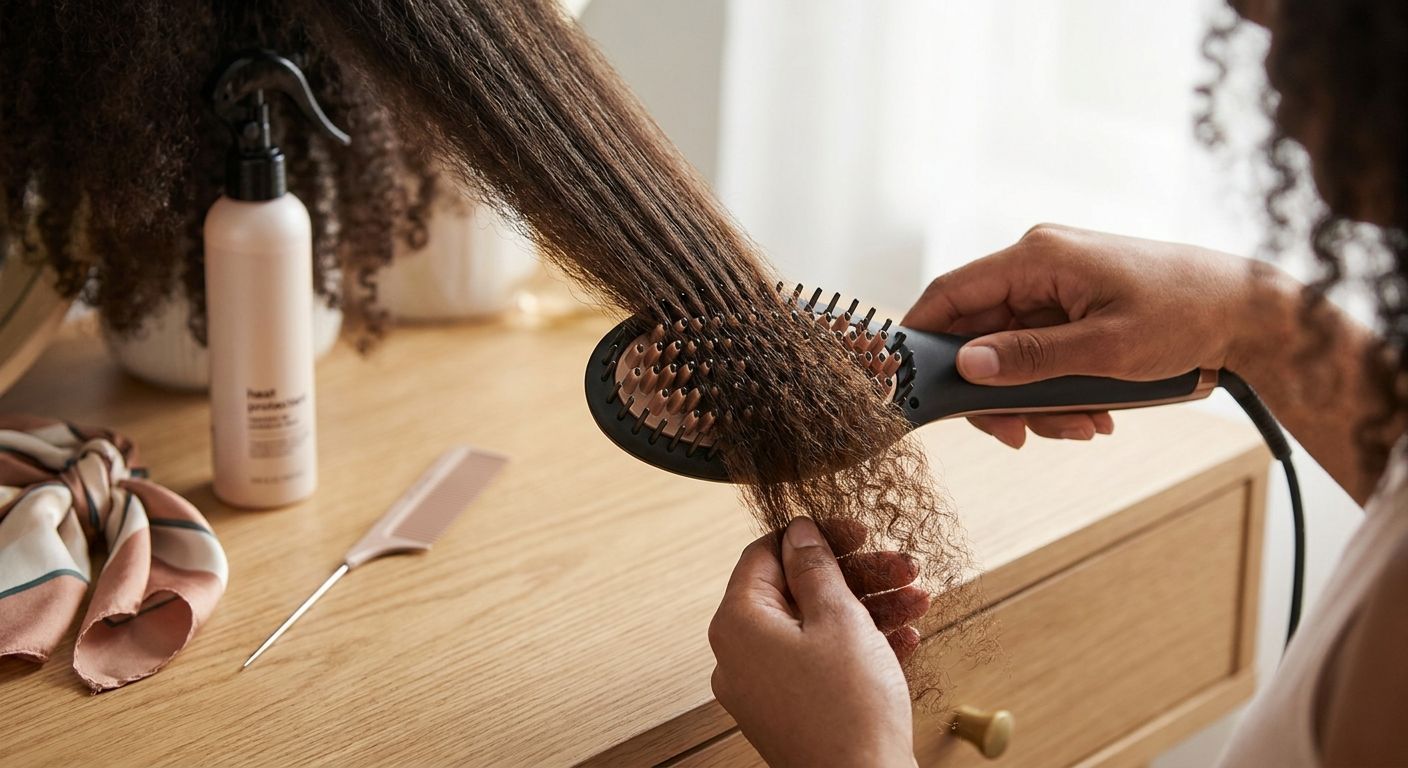
Thick, coarse, or tightly curled hair needs more heat to reach the same smoothing point — typically 380°F to 400°F. The trade-off is time, not temperature abuse. Smaller sections at the higher setting beat large sections at an even higher one.
A hot comb for natural and afro hair built for denser strands handles that range without demanding repeated passes. Verdict: go higher on heat, smaller on section size, and never chase a stubborn root with a third pass.
Color-treated hair: 300-330°F, protectant non-negotiable
Color-treated and previously lightened hair is more porous, so it absorbs heat faster and damages faster. Keep the brush between 300°F and 330°F and never skip the protectant — porous hair without it can singe on contact with heated plates.
Verdict: lowest setting that works, one pass, and stretch the gap between presses.
Why silk press results vary
- Hair porosity — high-porosity hair smooths at lower heat but reverts to frizz faster in humidity.
- Section size — sections wider than 1.5 inches leave middle strands under-smoothed, which tempts a second pass.
- Moisture left in the hair — even slightly damp hair steams under the bristles and undoes the press mid-pass.
- Ambient humidity — a press done on a humid Australian summer day reverts faster no matter the technique.
- Brush speed — too fast under-smooths, too slow concentrates heat on one spot.
- Product buildup — heavy styling cream residue scorches instead of smoothing.
Is a silk press with a straightening brush better than a flat iron?
A straightening brush is gentler on the hair shaft because bristles distribute tension instead of clamping the strand between two plates, which matters most for fine or already-damaged hair. A flat iron still wins on raw sleekness for very coarse, resistant textures where maximum tension is the point.
| Straightening brush | Flat iron | |
|---|---|---|
| Best for | Fine, damaged, color-treated hair | Very coarse, resistant textures |
| Tension | Spread across bristles | Clamped between plates |
| Speed | Faster over large areas | Slower, section by section |
| Damage risk | Lower per pass | Higher per pass |
How long does a silk press with a straightening brush last?
A silk press with a straightening brush typically holds for 5 to 7 days when humidity stays low and hair is wrapped at night. Sweat, rain, or high humidity cuts that window to a day or two regardless of which tool you used.
Can you refresh a silk press without rewashing?
Yes — running the brush lightly over frizzed sections buys another day or two, but it adds heat exposure without a wash cycle to reset the hair's moisture balance. Doing this more than once or twice between washes is where cumulative damage starts.
On refresh days, choosing the right heat setting for a straightening brush matters more than on wash days, because the hair has already taken one round of heat.
What should you do the night after a silk press?
Wrap the hair in silk or satin before bed and avoid tying it tightly at the crown, which creates a permanent dent by morning. A loose wrap keeps the press flat and buys you the back end of that 5-to-7-day window.
FAQ
What heat setting should I use for a silk press with a straightening brush?
Use 300°F for fine, color-treated, or damaged hair and up to 400°F for thick or coarse natural hair. Start at the lower end and raise it only if one pass doesn't smooth the section.
How many passes does a silk press need per section?
One slow, continuous pass per section is enough for most hair types. Passing the same section three or four times is the main cause of heat damage, not the temperature setting itself.
Do I need a heat protectant for a silk press with a straightening brush?
Yes, heat protectant is non-negotiable, especially on color-treated or high-porosity hair. Skipping it raises the risk of singeing and speeds up long-term breakage.
Can I use a straightening brush on wet hair?
No, hair needs to be 100% dry before a silk press. Residual moisture turns to steam under the heated bristles and undoes the smoothing as you go.
Is a silk press with a straightening brush good for 4c natural hair?
Yes, with smaller sections and a setting toward 380-400°F, a straightening brush smooths 4c hair without the harsher clamping of a flat iron. Section size matters more than raw heat here.
How much does a silk press with a straightening brush last?
A silk press with a straightening brush holds for 5 to 7 days in low humidity when wrapped at night. Sweat and rain are the fastest way to cut that short.
What's the difference between a silk press and a blowout?
A silk press adds a heated straightening step after the blowout to fully smooth the cuticle, giving a sleeker, shinier finish. A blowout alone keeps more natural volume and movement.
How often is it safe to do a silk press?
Most hair types handle a silk press every few weeks rather than weekly, since heat damage is cumulative. Stretching the gap between presses matters more than the exact temperature you use.
One last thing
The step people skip isn't temperature, it's cooling time. Hair sets its final shape while it cools, not while it's hot — so running fingers through freshly-pressed sections or tying hair up straight off the brush undoes part of the work before it locks. Let each section sit untouched for a few seconds after the pass, finish the whole head, then style. That single habit is worth more in 2026 than any upgrade in tool.