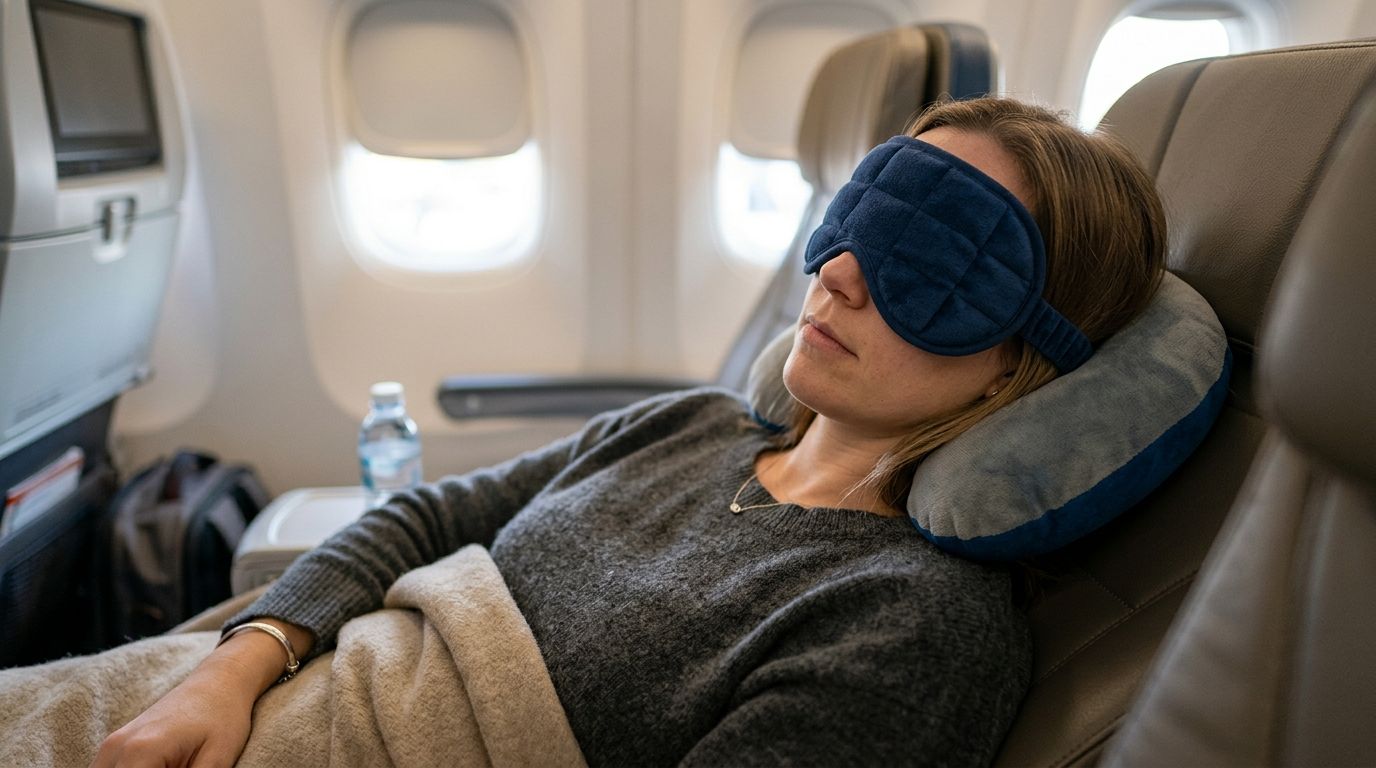
Weighted eye mask for jet lag is a full-face sleep accessory that combines gentle, evenly distributed pressure with total blackout, built for travelers trying to fall asleep on a plane and reset their body clock once they land. Frequent flyers need more from an eye mask than casual home sleepers do: cabin lights that never fully dim, seatback screens flashing three rows over, dry recycled air, and a body clock that thinks it's 3pm when the plane says it's midnight.
- A weighted eye mask for jet lag blocks cabin light and adds calming pressure to help you sleep on long-haul flights in 2026.
- Vital by Napio's weighted eye mask works best paired with a neck pillow for upright dozing on planes.
- Time zone adjustment runs roughly one day per zone crossed, so mask use matters most in the first 48 hours.
- Standard foam eye masks lose to weighted masks on pressure and blackout but win on packability.
Why a weighted eye mask matters for jet lag
Travel medicine guidance has said for years that your circadian rhythm needs roughly a day to adjust for every time zone you cross. Cross eight zones flying Sydney to Los Angeles and you're looking at the better part of a week before your body reliably wants to sleep and wake on local time. A weighted eye mask doesn't shrink that adjustment window, but it controls the one variable you can actually manage mid-flight: light exposure hitting your eyes at the wrong moment.
Aircraft cabins run humidity as low as 10-20%, drier than most deserts, which is part of why in-flight sleep feels shallow even when you do drop off. Add unpredictable cabin lighting cycles and a seat that reclines maybe 15 degrees, and it's clear why frequent flyers search for jet lag fixes differently than someone sleeping in a dark bedroom at home. The mask has to work in bright, noisy, upright conditions — not ideal, dimmed ones.
Update your pre-flight light exposure
Before any product enters the picture, control what your eyes see in the hours before boarding.
- Get outside in natural daylight in the morning if you're flying overnight
- Dim phone and laptop screens at least an hour before your flight departs
- Avoid the airport lounge's harsh overhead lighting if you're trying to sleep on board
- Set your watch to the destination time zone the moment you board
Choose blackout over partial light-blocking
Many travel eye masks marketed as "blackout" still leak light around the nose bridge or temples, which matters more on a plane than at home because cabin lights sweep across your face at odd angles during meal service and landing prep.
- Check for a contoured nose bridge that seals without pinching
- Look for extended coverage past the temple, not just the eye socket
- Test the mask in a lit room before your flight, not for the first time at 30,000 feet
- Confirm the strap doesn't dig in when you tilt your head against a headrest
A weighted eye mask for better sleep uses distributed weight rather than a tight strap to hold blackout in place, which matters more on a flight where you're shifting position every twenty minutes.
Time the weight to when you actually want to sleep
This is where the weighted format earns its keep over a plain blackout mask. The gentle pressure across the eyes and brow is associated with a calming, parasympathetic response, similar to how a weighted blanket works on a larger scale.
- Put the mask on only when you've decided it's "night" for this flight, based on your destination clock
- Avoid wearing it during meal service or turbulence when you might need to remove it fast
- Pair it with earplugs or noise-cancelling headphones rather than relying on the mask alone for isolation
- Store it somewhere accessible in your seat pocket, not buried in an overhead bag
Pair the mask with upper-body support
Sleeping upright in an economy seat strains your neck in a way a bedroom eye mask routine never accounts for. A heated neck pillow for long flights keeps your head from lolling forward once you actually manage to nod off, which matters because waking up every time your head drops defeats the point of the mask entirely.
- Choose a pillow that clips to your seatbelt or tray table so it doesn't slide
- Combine mask and pillow before takeoff so you're not fumbling with both mid-flight
- Recline as far as your seat allows before settling in
- Keep a light layer or blanket over your shoulders — cold shoulders wake people up fast
Set a wear schedule around arrival time, not departure time
Frequent flyers who treat every long flight the same, regardless of direction, tend to make jet lag worse. Eastward and westward travel demand different sleep timing.
- Flying east (losing time): sleep earlier on the plane, wear the mask sooner after boarding
- Flying west (gaining time): stay awake longer, save the mask for the back half of the flight
- Check your arrival local time before boarding and build backward from it
- Avoid caffeine within six hours of your planned in-flight sleep window
Measure how fast you're adjusting on arrival
Once you land, the mask's job shifts from blackout-on-demand to reinforcing a new sleep schedule in an unfamiliar room, often with unfamiliar light leaking through hotel curtains.
- Get morning sunlight exposure on day one if you flew east, evening light if you flew west
- Keep the mask on the nightstand for naps as well as full nights — short naps under 30 minutes help without deepening jet lag
- Track how many nights it takes to sleep through without waking at 3am local time
- Drop the mask once you're sleeping normally again; using it indefinitely out of habit isn't necessary
Comparison: eye mask options for frequent flyers
| Option | Best for | Key limitation |
|---|---|---|
| Weighted eye mask (Vital by Napio) | Long-haul flyers who want blackout plus calming pressure | Bulkier to pack than a flat foam mask |
| Standard flat foam mask | Short flights, budget travelers | Light leaks around nose and temples |
| Blackout curtain-style travel mask | Side sleepers who shift position often | No pressure benefit, can slip off mid-flight |
| Prescription sleep aid | Severe, recurring jet lag | Requires medical guidance, not a light-blocking fix |
The best weighted eye mask for deep sleep picks for full-coverage blackout tend to outperform flat foam masks specifically because the weight keeps the seal intact as you shift in a cramped seat — foam masks slide the moment you turn your head.
Verdict: a weighted eye mask is the better jet lag tool for anyone flying more than one time zone away, but it works alongside a sleep schedule shift, not instead of one.
Common mistakes frequent flyers make
- Wearing the mask the entire flight regardless of destination time — this ignores whether you're flying east or west and can leave you groggier, not less jet-lagged
- Buying a mask for the first time at the airport gift shop — untested masks with poor nose-bridge seals fail exactly when cabin lighting cycles hit
- Skipping morning sunlight on arrival — the mask handles darkness, but daylight exposure on day one is what actually resets the clock
- Relying on the mask alone without noise control — a silent, dark face doesn't fix a crying baby three rows back
- Packing the mask in checked luggage — frequent flyers who need it most often forget it's useless if it's not in the cabin
FAQ
Does a weighted eye mask actually help with jet lag?
A weighted eye mask helps by blocking cabin light and adding calming pressure, which supports falling asleep on the flight itself. It doesn't shorten the days your body needs to adjust to a new time zone, but it improves the sleep quality during that adjustment.
Is a weighted eye mask better than a regular blackout mask for flights?
Yes, for long-haul flights, because the distributed weight keeps the seal against light in place as you shift position in a cramped seat. A flat foam mask tends to slip once you turn your head against a headrest.
How heavy should a weighted eye mask be for travel?
Lighter weighted masks designed for travel sit gently across the eyes and brow without adding bulk to pack. Heavier home versions built for stationary bedroom use can feel excessive in an upright airline seat.
When should I put on a weighted eye mask on a long flight?
Time it to your destination's local night, not your departure time. Flying east, put it on sooner after boarding; flying west, wait until later in the flight.
Can a weighted eye mask help with jet lag insomnia after landing?
Yes, using the mask at your new local bedtime helps block hotel room light leaks and signals to your body that it's time to sleep on the new schedule. It works best combined with morning or evening sunlight exposure depending on travel direction.
Do weighted eye masks work for naps as well as full nights?
Short naps under 30 minutes with a weighted eye mask can help without deepening jet lag, since they don't push you into a full sleep cycle. Longer naps closer to bedtime can backfire by delaying nighttime sleep.
What's the difference between a weighted eye mask and a blackout eye mask?
A blackout eye mask focuses purely on blocking light, while a weighted version adds distributed pressure across the eyes and brow for a calming effect similar to a weighted blanket. Many travel masks now combine both features.
One last thing
Most frequent flyers over-focus on the flight itself and under-focus on the first 48 hours after landing, which is actually when a weighted eye mask does the most work resetting a new sleep schedule in an unfamiliar bed. Pack it in your carry-on, not your suitcase, and keep it on the nightstand for at least two nights after arrival even once the flight is behind you.